

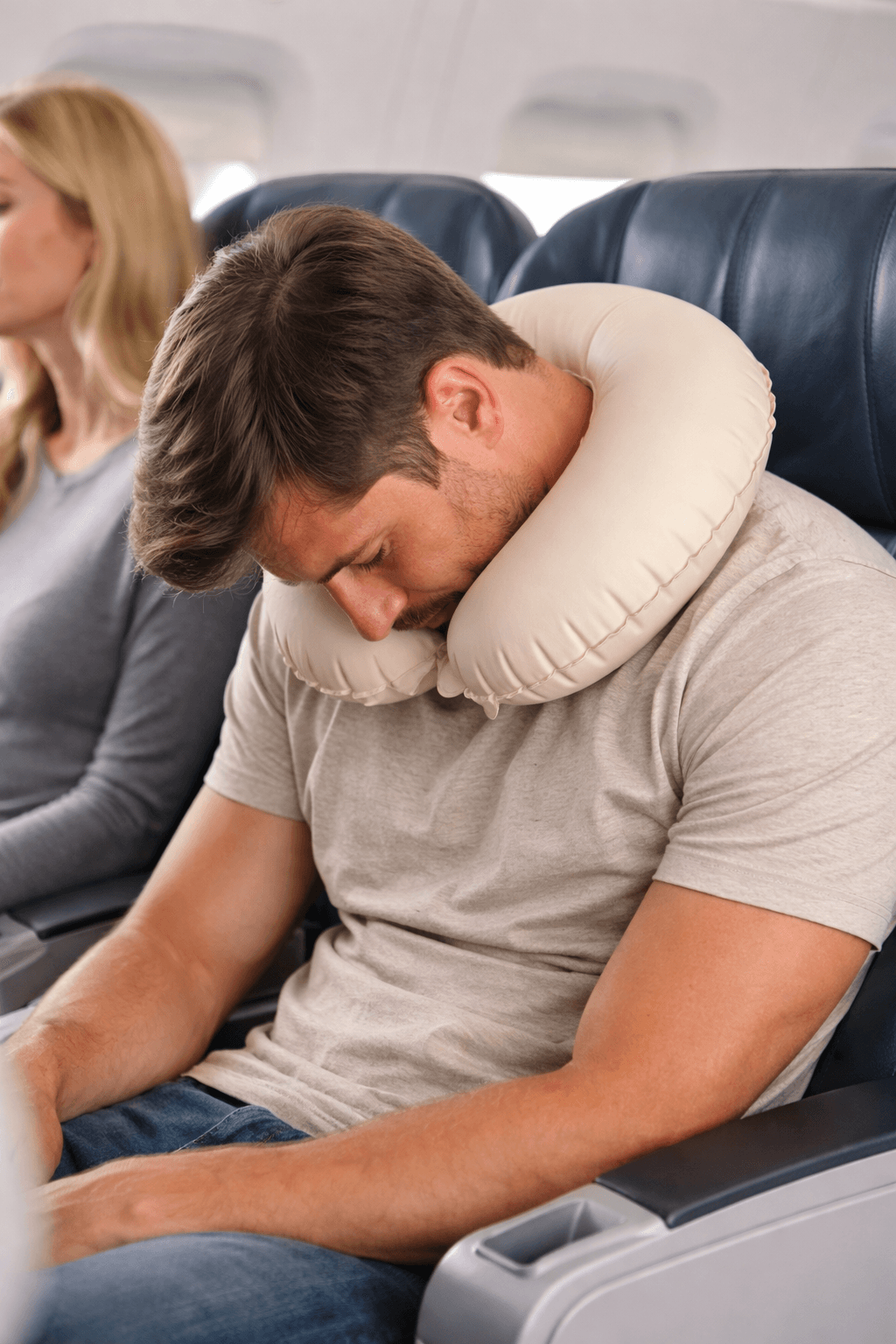
Most travel neck support products fail not because they are poorly made, but because they are designed to support the neck alone. In upright economy seating, the torso relaxes first. When the torso collapses, the head follows, regardless of how much padding surrounds the neck. True travel comfort depends on supporting the full seated posture, not restricting movement or wrapping the neck.
Table of Contents
Key Takeaways
| Point | Details |
| Neck-only support fails upright | Inflatable pillows, foam cushions, and wraps focus on the neck, but upright rest fails when the torso relaxes and the head drops forward due to gravity. |
| Avoid neck wrapping and compression | Designs that wrap the neck can trap heat and feel restrictive during long flights. Open airflow improves comfort. |
| Upright rest requires diagonal support | Real comfort comes from supporting the head, jaw, chest, and upper torso together — not isolating the neck. |
| Space efficiency matters | Effective travel support should be packable, lightweight, and functional without adding bulky gear to your bag. |
What Are Neck Support Alternatives?
Most travel neck support products attempt to solve discomfort by focusing only on the neck. These include inflatable pillows, memory foam cushions, compression wraps, posture bands, and seat-mounted headrest devices. While these products vary in materials and appearance, they all share the same limitation: they attempt to support a 10–12 pound head without supporting the upper body that carries it.
In upright travel environments like economy-class airline seats, neck-only support cannot work on its own. When the torso relaxes and collapses, the neck is forced to compensate; regardless of how soft, adjustable, or lightweight a product may be. This is why many travelers cycle through multiple neck support options without lasting relief.
True upright rest requires support that works with the body’s natural diagonal resting angle — stabilizing the head, jaw, chest, and upper torso together instead of isolating the neck.
Here’s how leading travel neck support types vary in user experience:
| Support Type | Common Claim | Real-World Limitation | ||
| Inflatable Travel Pillows | Adjustable and compact | Collapse under head weight; no torso support | ||
| Memory Foam Cushions | Soft, contouring comfort | Bulky; neck-only support fails upright | ||
| Compression Wraps | Discreet stabilization | Traps heat; restricts airflow | ||
| Headrest Attachments | Keeps head in place | Seat-dependent; inconsistent support | ||
| Posture Bands | Encourages alignment | Does not support resting or sleep |
Types of Travel Neck Support Designs
Most travel neck support designs fall into a few common categories, each attempting to reduce discomfort in different ways. While these products are widely marketed, they share structural limitations when used in upright seating.
Common designs include inflatable pillows, memory foam cushions, compression wraps, headrest attachments, and posture bands. These products rely on neck contact, external tension, or seat dependency to stabilize the head, but they do not counterbalance the downward pull created when the upper body relaxes in seated rest.
As a result, many travelers experience head drop, neck strain, or overheating, not because the products are poorly made, but because they are designed to support the neck instead of the full seated posture.
Key Features of Effective Upright Travel Support
Effective upright travel support does not rely on electronics, sensors, or rigid control systems. Instead, it depends on structural design that works with how the body naturally relaxes in seated rest.
The most effective support solutions share a few practical characteristics:
• Distributed Support — Supporting the head, jaw, chest, and upper torso together instead of isolating the neck
• Open Airflow — Avoiding neck wrapping or compression that can trap heat and restrict breathing
• Passive Stability — Using shape and placement to reduce head drop without forcing posture
• Lightweight Construction — Providing support without adding bulk or rigid components
• Packable Form — Remaining easy to carry without consuming valuable luggage space
When upright support is designed around body geometry rather than neck tension, the body can relax naturally instead of fighting gravity. This structural approach is what separates effective seated rest from short-term cushioning.
How Upright Sleep Support Works
Upright sleep support is designed to counter the natural challenges of resting while seated. Unlike lying flat, seated rest requires structural support that works with gravity instead of fighting it. The goal is to maintain body alignment while allowing the muscles to relax naturally.
Rather than relying on neck tension, straps, or compression, effective upright support redistributes weight across the upper body. This reduces the strain that occurs when the torso relaxes and the head loses its natural support.
Key mechanisms of effective upright sleep support include:
-
Weight Distribution Against Gravity
Redirecting the load of the head across the jaw, chest, and upper torso instead of isolating the neck. -
Structural Stabilization
Using shape and placement to prevent uncontrolled head drop without rigid restraint. -
Muscle Relaxation Support
Allowing the body to rest without constant muscular engagement to stay upright. -
Spinal Alignment
Maintaining a natural seated posture rather than forcing the neck into position. -
Postural Foundation
Creating a stable base that supports rest while seated for extended periods.
Sleeping in an upright position can feel uncomfortable when the body lacks proper structural support. When support is designed around body geometry instead of neck compression, the body can relax more naturally without excessive shifting or strain.
The principles behind effective upright sleep support are simple:
-
Supporting the head without wrapping or squeezing the neck
-
Distributing weight beyond a single pressure point
-
Reducing the effort required to stay upright
-
Allowing partial relaxation while seated
-
Supporting natural movement and comfort over time
When upright sleep support is properly designed, seated rest becomes more stable and sustainable. Instead of fighting gravity or constantly readjusting, the body is supported in a way that makes extended travel more comfortable.
Comparing Comfort, Risks, and Space Efficiency
Choosing the right neck support solution requires balancing three practical factors: comfort during extended use, stability while seated, and efficient use of limited travel space.
Most travel support products prioritize one of these factors at the expense of the others. Some focus on softness but collapse under real weight. Others rely on compression or rigid structure that limits movement. Many are simply too bulky to justify carrying.
The most useful comparisons focus on how a support performs in real travel conditions, not marketing claims.
Key factors to evaluate include:
-
Comfort Consistency
How well the support maintains comfort over long periods without constant readjustment. -
Stability While Seated
Whether the design prevents head drop and upper-body collapse without forcing posture. -
Freedom of Movement
Allowing natural shifts and breathing rather than locking the body into position. -
Portability
How compact and practical the support is when not in use. -
Adaptability
Whether the support works across different body types and seating environments.
Effective neck support solutions balance these factors through structure rather than pressure. Designs that distribute support beyond the neck tend to feel more stable over time while remaining easier to carry and use.
When evaluating different options, prioritize how the support behaves once your body relaxes. Comfort that only works while sitting upright and alert rarely holds up during real rest.
The most successful designs combine stable support, minimal bulk, and natural positioning — making them practical not just in theory, but across long flights and extended travel.
Discover Smarter Neck Support for Comfortable Travel
Finding effective neck support while traveling is harder than it should be. Most options focus only on the neck, leaving the rest of the body unsupported once you relax into a seat. That’s why discomfort, head drop, and constant readjusting are so common on long flights, train rides, and road trips.
True seated comfort comes from supporting the body as a whole — not just the neck. When the head, jaw, chest, and upper torso are supported together, the body can rest naturally without being forced into position or squeezed by wraps and rigid cushions.
Bolstie Travel Pillow was designed around this idea. Instead of wrapping the neck, it creates a gentle diagonal resting angle that stabilizes the upper body while allowing airflow and movement. The result is a more natural upright resting position that helps you relax without fighting gravity.
Because it compresses down when not in use and fills with clothing when needed, Bolstie also solves the space problem that comes with bulky travel pillows — making it practical for carry-on travel and long-haul flights alike.
If you’ve tried traditional neck pillows and still struggle to rest comfortably while seated, a support system that works with your full seated posture — not against it — can make all the difference.

Explore Smarter Neck Support for Travel
If you’re searching for better neck support while traveling, you’re not alone. Many travelers discover that traditional neck pillows and wraps don’t work well once the body relaxes in an upright seat. Comfort during long flights, train rides, and road trips depends on supporting more than just the neck.
Thoughtfully designed travel support solutions focus on overall seated posture — helping stabilize the head and upper body while staying lightweight and easy to pack. When support works with the body’s natural resting angle instead of forcing alignment, upright rest becomes far more comfortable.
Bolstie Travel Pillow is designed around this principle. By supporting the head, jaw, chest, and upper torso together, it creates a stable diagonal resting position without wrapping or compressing the neck. Its packable design also helps travelers save space without sacrificing comfort.
Frequently Asked Questions
What are some alternatives to traditional neck braces for travel?
Many travel support options focus on cushioning or stabilizing the neck area, such as inflatable pillows, foam cushions, wraps, or seat-mounted supports. These designs vary in comfort and portability, but many struggle to provide consistent support once the upper body relaxes in an upright seat.
Do inflatable or memory foam travel pillows work well for upright sleep?
Inflatable and memory foam pillows can feel comfortable at first, but they primarily support the neck alone. In upright seating, comfort often breaks down when the torso collapses forward, causing the head to drop despite cushioning around the neck.
What should I look for in a travel neck support solution?
Effective travel support prioritizes overall seated posture rather than neck compression. Features to look for include lightweight construction, open airflow, space efficiency, and support that stabilizes the upper body instead of isolating the neck.
How does upright sleep support improve comfort during travel?
Upright sleep support helps distribute body weight more evenly, reducing the effort required to hold the head up while seated. By supporting the upper body as a whole, it allows the muscles to relax naturally and makes resting while seated feel more stable and comfortable.
Recommended
-
12-Hour Roadtrip to a Wedding to Discover This Neck-Saving Secret – BOLSTIE TRAVEL PILLOW
-
My Commuter Hack For Drivers: Life-Changing – BOLSTIE TRAVEL PILLOW
-
The Biggest Hidden Cause Of Neck Pain Mid-Flight — Poor Posture – BOLSTIE TRAVEL PILLOW
-
This Travel Pillow Never Wraps Around My Neck — I Refuse Those That Do – BOLSTIE TRAVEL PILLOW

