

TL;DR:
Ergonomic support during travel prevents muscle strain and reduces back pain.
Effective pillows support neck, chin, and upper chest for true upright rest.
Choosing small, supportive, and body-geometry matched pillows improves long-flight comfort.
Most travelers don’t think about ergonomic support until they land with a stiff neck, a tight lower back, and the kind of exhaustion that three cups of coffee won’t fix. Economy seating was never designed with rest in mind, and yet millions of us attempt to sleep upright in those narrow, reclined-just-enough seats every single day ✈️. Whether you’re a frequent flyer clocking red-eye routes every few weeks, a parent managing a long-haul trip with restless kids, or someone who just wants to arrive feeling human, understanding how your body responds to poor support is the first step toward actually fixing it.
Table of Contents
-
Research-backed solutions: What actually works for economy travelers
-
Our take: The uncomfortable truth about economy travel comfort
Key Takeaways
| Point | Details |
|---|---|
| Ergonomic support reduces pain | Proper support can cut neck and back pain risk by over half during economy-class travel. |
| Mechanics matter for upright rest | Effective pillows prevent head droop by supporting the chin and jaw, not just wrapping the neck. |
| Compactness doesn’t mean compromise | Small ergonomic pillows can deliver high comfort when designed well for neck and chin support. |
| Choose evidence-backed solutions | Research shows structured foam and multi-point support outperform traditional designs for both adults and children. |
| Testing pays off | Trying pillows at home before travel helps ensure you choose the right design for your needs. |
What does ergonomic support mean in travel?
Having set the scene of travel discomfort, let’s clarify what ergonomic support actually is and why it matters so much when you’re 35,000 feet in the air.
Ergonomics is the science of designing environments and tools to fit the human body, rather than forcing the body to adapt to the environment. In travel, that means giving your neck, spine, shoulders, and jaw the structural support they need to rest without strain. It’s not a luxury concept. It’s basic body mechanics applied to an environment that actively works against you.
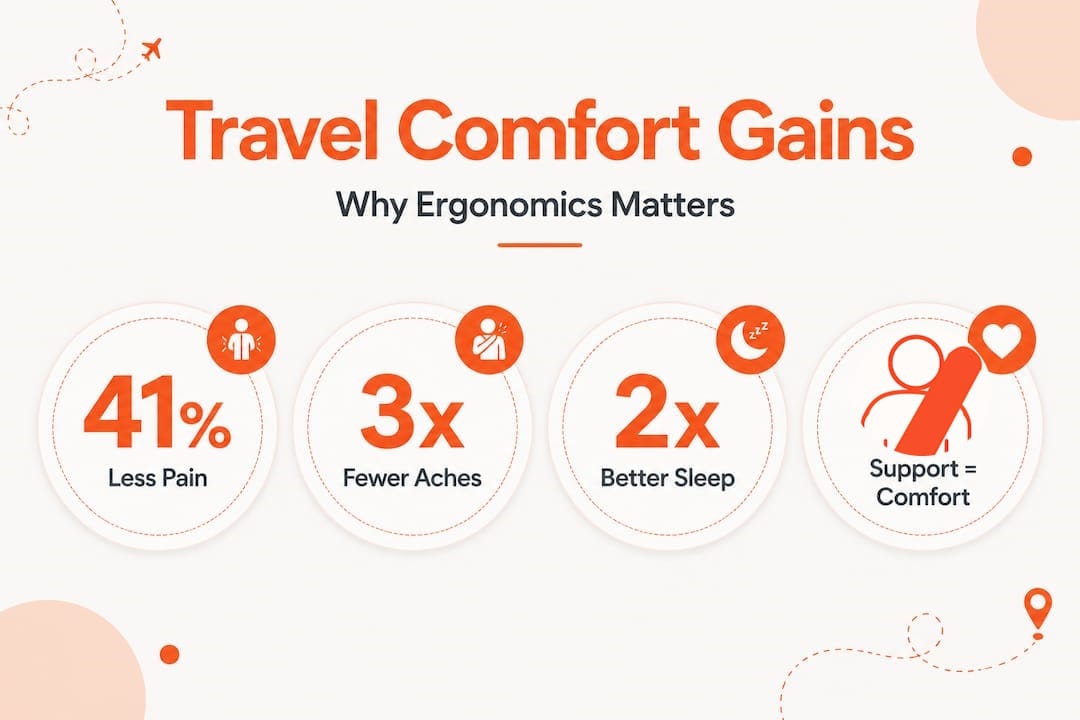
Economy-class seats are notoriously unforgiving. They’re narrow, the headrests are rarely in the right position, and the recline is minimal. Your spine ends up compressed, your head tips forward, and your muscles try to hold everything in place for hours. That’s exhausting work. Over a long flight, it adds up to real pain.
The areas that need the most support during upright travel rest are:
-
Neck: Prevents forward head drop and lateral tipping
-
Chin and jaw: Stabilizes the head when muscles relax during light sleep
-
Spine and upper back: Maintains natural curvature rather than rounding forward
-
Lumbar region: Reduces compression and lower back tension during long sits
Research backs up just how serious this is. Uncomfortable seating triples the odds of lower back pain, as seen in studies of airline pilots whose seated posture and environment closely mirrors what economy passengers experience. That’s not a minor inconvenience. That’s a meaningful health risk for frequent travelers.
“Seat comfort isn’t a perk. It’s the single biggest variable between arriving refreshed and arriving in pain. And most travelers don’t even realize they have control over it.”
Learning more about the benefits of ergonomic travel pillows can shift how you approach every future trip. And once you understand travel pillow ergonomics, you start to see the design flaws in most products on the market.
The mechanics of upright rest: Why most pillows fail
Now that we know where support is critical, let’s explore why so many pillows don’t deliver true comfort during upright rest.
Here’s the thing about sleeping upright: it’s not something your body naturally wants to do. When you relax, your muscles stop contracting, and your head wants to fall forward or sideways. Gravity pulls constantly. Your chin drops toward your chest. Your spine curves. The weight of your head, which is roughly 10 to 12 pounds, suddenly has to be caught by something other than your neck muscles.
Most traditional travel pillows address only one part of this equation: the neck. They wrap around, provide some cushion, and that’s it. But the neck alone can’t hold your head in a neutral position without additional support. Here’s exactly why conventional pillows fall short:
-
They compress under sustained load. Memory foam and soft fills flatten quickly under the weight of your relaxed head, losing their supportive shape within an hour or two.
-
They miss chin and jaw support. When you fall into light sleep, your mouth drops open and your chin falls forward. A neck-only pillow can’t catch that.
-
They push the head forward. U-shaped pillows placed around the neck often actually push the head slightly forward, worsening the very alignment problem they’re meant to fix.
-
They create heat. Wrapped designs trap heat against your neck, making long use uncomfortable and sticky.
-
They don’t support the upper chest or torso. Real rest in an upright position involves your whole upper body settling naturally, not just your neck floating in a foam donut.
Effective support requires preventing forward head drop through chin and jaw control or full-body pressure distribution, not just neck wrapping. And most pillows simply aren’t designed with that in mind.
Pro Tip: When shopping for a travel pillow, don’t just check if it supports your neck. Ask whether it also stabilizes your chin and jaw. If it doesn’t address both, it’s only solving half the problem.
Understanding why neck support fails on planes helps reframe what you’re actually looking for. And if you’re still on the fence about traditional designs, the reasons to avoid neck-based travel pillows might surprise you.
Research-backed solutions: What actually works for economy travelers
Equipped with an understanding of what fails, let’s look at pillows and techniques that actually make a difference, backed by testing and research.
The good news is that better options exist, and they’re backed by real-world testing. Ergonomic pillows with structured neck support that hug the neck circumference and prevent head lean consistently rank highest among tester panels for comfort, and many compress to a small enough size for compact carry-on packing. That combination matters a lot when you’re already managing a full bag.
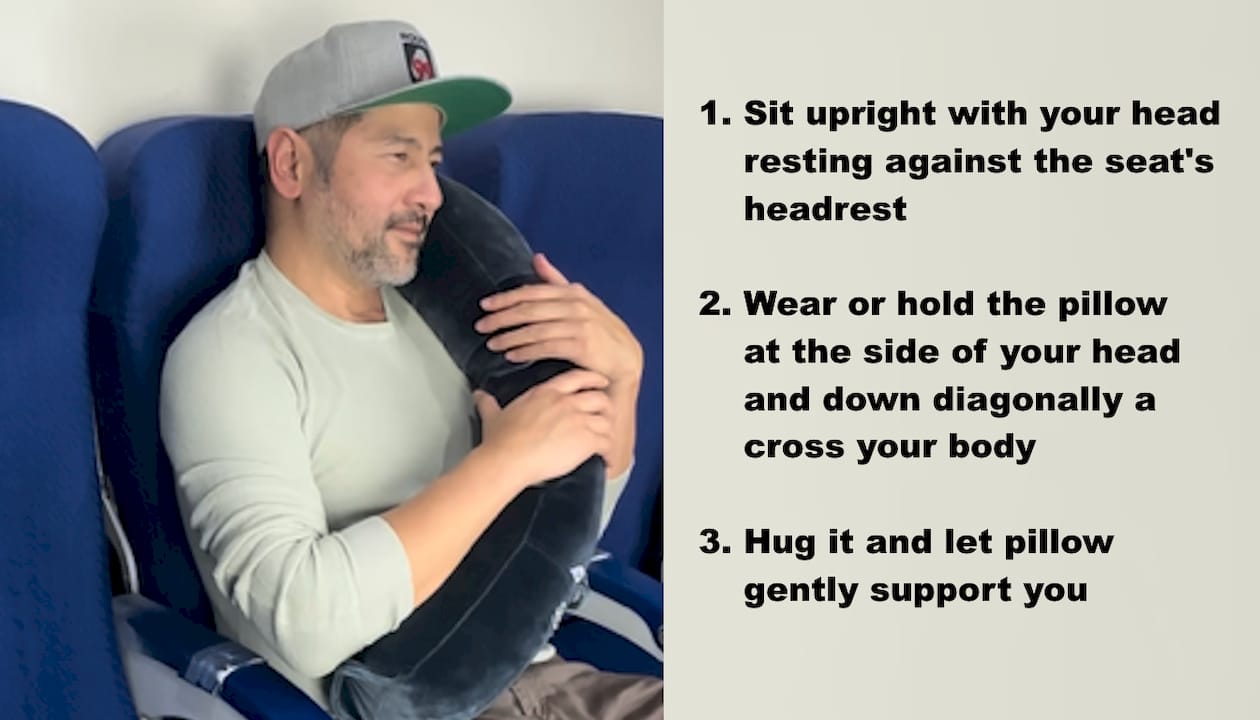
A pilot study on seat comfort showed that travelers using properly supportive setups experienced roughly 41% less muscle strain than those sitting without dedicated support. That’s the difference between landing feeling functional and landing feeling like you fought a wrestling match in your sleep.
Here’s a comparison of the main ergonomic travel pillow design types and how they stack up:
| Design type | Key support zone | Compactness | Best for |
|---|---|---|---|
| U-shaped foam | Neck only | Moderate | Short flights |
| Wraparound structured | Neck and chin | Good | Long-haul economy |
| Full-body diagonal | Head, chest, torso | Excellent | Red-eye flights, families |
| Inflatable | Neck only | Excellent | Light packers (limited support) |
| Hybrid fill cylinder | Head, jaw, upper chest | Excellent | Frequent flyers, kids |
Who benefits most from getting this right?
-
Frequent flyers who accumulate hours in economy seats and feel the compounding effect of poor posture across multiple flights
-
Long-haul travelers on overnight or 10-plus-hour routes where real rest is essential, not optional
-
Parents managing children in economy who need a setup that works for smaller bodies too
-
Red-eye travelers trying to arrive at early-morning destinations alert and functional
-
Anyone with existing neck or back sensitivity who can’t afford to make things worse with poor in-flight posture
For practical strategies that go beyond the pillow itself, long-haul flight tips cover everything from hydration to seat selection and movement breaks. And if you want to go deeper on how design choices affect rest quality, our guide on how travel pillows improve upright rest breaks it down clearly. We’ve also put together a focused guide on how travel pillows cut neck pain that’s worth reading before your next booking.
How to choose and use ergonomic travel solutions
Having explored what works, let’s walk through practical steps for choosing and maximizing ergonomic solutions as you travel.
Choosing the right ergonomic travel pillow is less about brand names and more about matching the product’s support geometry to your body and your travel style. Here’s a straightforward process for making a confident decision:
-
Check for chin and jaw support. Look at how the pillow positions your head when your muscles relax. Does it catch your chin? Does it stop forward head drop? If the design only cushions the back or sides of your neck, it’s likely to fail mid-flight.
-
Test compressibility for packing. Your carry-on is valuable real estate. A pillow that compresses down to the size of a water bottle is infinitely more practical than one that straps to the outside of your bag or takes up half a compartment.
-
Consider your travel companions. If you’re traveling with kids, look for child-sized variants or adjustable designs. Children have smaller neck circumferences and lighter heads, so an adult-sized pillow won’t stabilize them correctly. Multi-use travel pillows that can double as packing tools are especially practical for family travel.
-
Read for sustained support, not just initial feel. A pillow can feel great in-store and collapse after two hours in use. Look for reviews that specifically mention how it performs after extended wear, not just first impressions.
-
Evaluate the heat factor. If the pillow wraps fully around your neck, ask whether airflow is part of the design. Heat buildup on a long flight is a comfort killer, especially on overnight routes.
Pro Tip: Test your new pillow at home before the trip. Sit in a firm chair with your back upright and try to nap in it. If your head slips or your chin drops within 20 minutes, the pillow isn’t doing its job. Better to find out at home than halfway over the Atlantic.
Structured pillows that hug the neck circumference and compress small consistently outperform larger, softer alternatives in real-world tester scenarios. Common pitfalls to avoid include pillows that rely only on a neck wrap without a front support element, and any design that forces your head forward rather than holding it upright in a natural neutral position.
Our take: The uncomfortable truth about economy travel comfort
With practical strategies in hand, it’s time to confront the often-overlooked realities of economy travel and what most guides miss.
Here’s something we’ve noticed after years of thinking about travel comfort: most people treat their in-flight pillow as an afterthought. They grab whatever’s cheap, throw it in their bag, and hope for the best. And then they wonder why they land exhausted every single time.
The honest truth is that a 41% reduction in muscle strain isn’t a minor perk. That’s a massive difference in fatigue that compounds across hours of flight time. Think about it this way: if every muscle in your upper body is working slightly harder than it needs to for 10 hours straight, your body is running a hidden energy deficit the entire flight. You arrive already spent, before your trip has even started.
“A 41% reduction in muscle strain isn’t just a statistic. It’s the difference between stepping off the plane ready to go and spending your first day recovering from the journey.”
We also think there’s a real gap in how travelers think about pillow design. The conversation almost always centers on neck support, as if the neck is the only structure that matters. But your chin is what controls whether your head stays up when you actually relax into sleep. Your upper chest is what keeps your whole upper body from collapsing forward. Supporting the neck without addressing the chin is like fixing the brakes on a car and ignoring the steering. You’ve solved part of the problem and left the bigger one wide open.
This is exactly why we believe in a body-first approach to support geometry. Focusing only on neck-only pillows is a trap that most of the travel industry still hasn’t escaped. When you start thinking about how your whole upper body rests together, rather than just one joint, the design logic shifts entirely and so does the result ❤️.
Explore the best ergonomic solutions for your next journey
After sharing our perspective, it’s only natural to point you toward proven solutions for your next flight.
If this article has shifted how you think about travel comfort, we’d love to show you what a body-first pillow design actually looks and feels like. Bolstie Travel Pillow was built specifically for economy-class travelers who want real rest without carrying a bulky rig through the airport. It stabilizes your head, jaw, and upper chest together, compresses down small when empty, and doubles as a packing cylinder when filled with your clothes. Smart and simple.
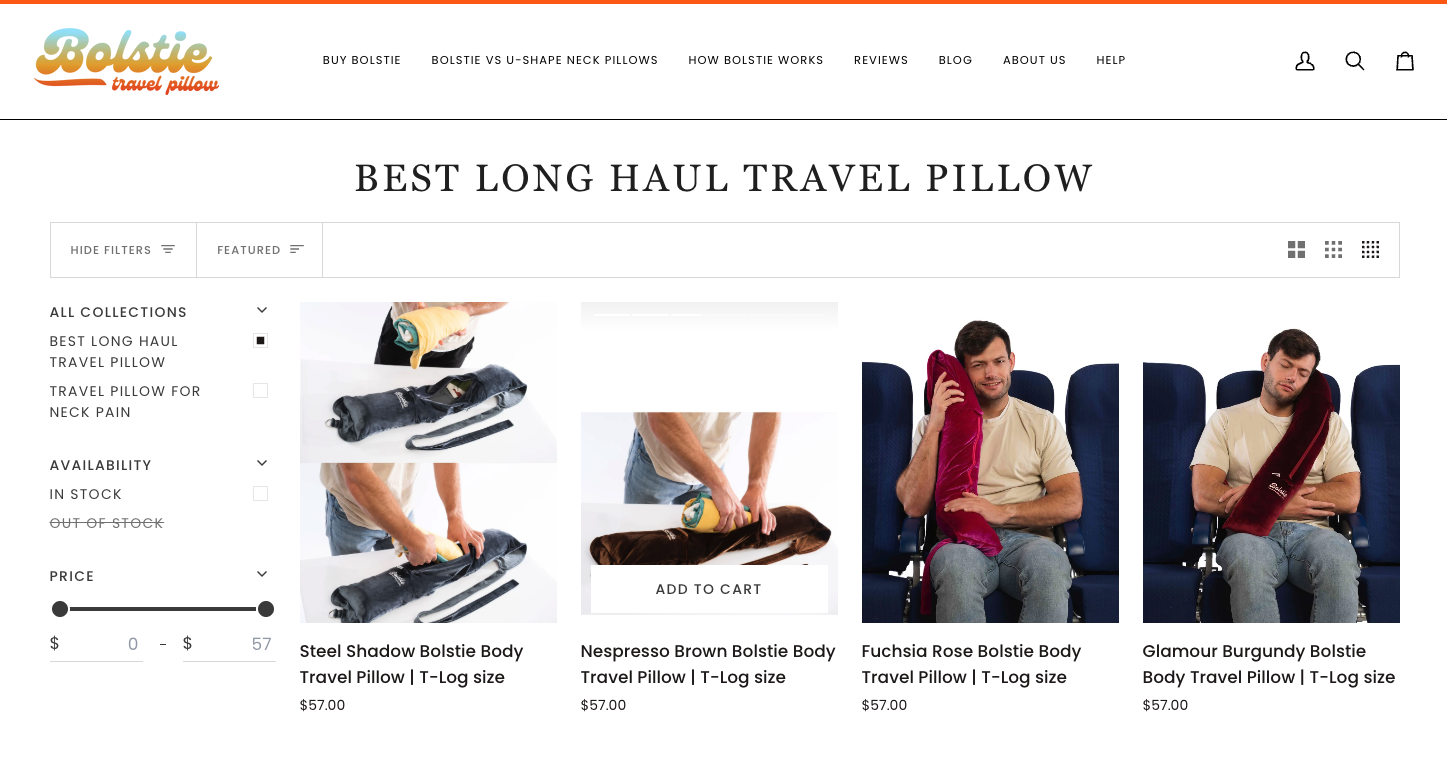
Our best long-haul travel pillow collection is designed for exactly the kind of traveler this article was written for. And if you want to start with a specific favorite, the Nespresso Brown Bolstie pillow is a top pick for frequent flyers who want structured support in a compact, elegant package. Your next flight deserves better than a foam donut and crossed fingers. ✈️
Frequently asked questions
What type of pillow is best for preventing neck pain during travel?
Pillows that support both the neck and chin using structured foam or adjustable designs perform best for minimizing neck pain. Tester panels consistently rank structured ergonomic pillows highest for comfort on long journeys.
Can ergonomic travel pillows help kids sleep upright in economy seats?
Yes. Child-sized ergonomic pillows with chin and neck stabilization help children rest upright more comfortably and safely during long flights. Look for adjustable or compact designs that fit smaller neck circumferences correctly.
How does lack of ergonomic support increase the odds of back pain?
Poor pillow design and uncomfortable seating can more than triple the odds of lower back pain in travelers, as consistently shown in airline pilot musculoskeletal studies that mirror economy passenger conditions.
Are compact travel pillows as effective as larger models?
Yes, if they’re designed correctly. Compact ergonomic pillows that effectively support the head, neck, and chin can match or outperform larger models, especially when compressibility is built into the design rather than sacrificed for size.
How much do ergonomic pillows reduce muscle strain compared to not using one?
Properly designed ergonomic pillows can reduce muscle strain by up to 41 percent compared to unsupported upright seating, making a real and measurable difference in how rested you feel on arrival.
Recommended
-
Why choose multi-use travel pillows for economy comfort – BOLSTIE TRAVEL PILLOW
-
Why Travel Pillow Design Matters for Real Comfort – BOLSTIE TRAVEL PILLOW
-
What Defines Ergonomic Travel Pillows for Flyers? Not This! – BOLSTIE TRAVEL PILLOW
-
7 Benefits of Ergonomic Travel Pillows for Economy Flyers – BOLSTIE TRAVEL PILLOW

