

Every traveler faces the struggle of packing light for international trips while still battling neck discomfort in cramped economy seats. The hunt for a compact travel solution that actually works is more urgent than ever, given how poorly designed neck-only pillows can worsen stiffness and pain on long flights. This article unpacks what these U-shaped travel pillows really offer, why they can disappoint, and what to look for so your next flight feels less stressful and more restful.
Table of Contents
Key Takeaways
| Point | Details |
| Neck-Only Pillows Limit Support | These pillows only support the neck, neglecting the entire upper body’s need for support during upright rest, leading to discomfort and tension. |
| Biomechanical Mismatch | A neck-only pillow cannot accommodate natural body positions, causing strain and misalignment over time. |
| Heat and Airflow Restrictions | The design often traps heat, leading to overheating and discomfort during extended use. |
| Modern Alternatives Provide Whole-Body Support | New pillow designs focus on full-body stabilization, allowing for better alignment and more restful sleep during travel. |
What Neck-Only Pillows Are and How They Work
Neck-only pillows are U-shaped or horseshoe-shaped travel pillows designed to wrap around your neck and support it while you sleep upright. They’ve become the default option on planes, trains, and cars because they’re compact and affordable.
They work by cradling your neck from both sides, theoretically keeping your head in alignment. The design assumes your neck is the only part of your body that needs support during upright rest.
The Basic Design
Most neck-only pillows share these features:
-
Horseshoe shape that wraps around the front and sides of your neck
-
Memory foam or inflatable core for firmness
-
Compact enough to attach to a carry-on or tuck into a personal item
-
Soft fabric exterior
The idea sounds logical. Your neck is where pain happens on planes, so support the neck and you’re done.
How They’re Supposed to Work
According to orthopedic pillow design principles, neck-only pillows aim to maintain proper cervical alignment by filling the gap between your neck and shoulder. They’re built on the assumption that keeping your neck straight equals comfort.
The theory is straightforward: wrap your neck, prevent forward head drop, reduce strain.
But that’s where the problem starts.
The Reality of Wearing One
Here’s what actually happens after 30 minutes on a real flight:
-
Your head drops forward despite the pillow
-
The pillow compresses under the weight of your head
-
Your jaw tightens as the pillow pushes upward
-
You overheat because the wraparound design traps air against your skin
-
You wake up every 20 minutes to adjust it
-
You’re more uncomfortable than if you’d used nothing
Neck-only pillows focus on one area while ignoring the fact that your entire upper body shifts and rotates when you rest upright.
The challenge is biomechanical. When you sleep sitting upright, your neck needs alignment support, but so does your entire head and upper torso. A pillow that only touches your neck can’t stabilize your jaw, chest, or shoulders, so your whole body compensates by tensing up.
Pro tip: If you’re currently using a neck-only pillow and it keeps slipping, the pillow isn’t failing you—the design itself doesn’t work for upright rest because it ignores how your body actually needs support.
Common Design Flaws and Comfort Issues
Neck-only pillows have a fundamental problem: they try to solve an upright sleeping crisis by supporting one body part. The result is a product that creates as many problems as it claims to fix.

The most obvious flaw is insufficient support under pressure. Your head weighs 10 to 12 pounds. When you rest against a neck pillow for hours, that weight compresses the foam or inflatable core until it feels like resting on cardboard. The pillow flattens. Your neck gets no support at all.
Why the Shape Doesn’t Work
The horseshoe design assumes your neck stays centered and upright. It doesn’t. When you doze off on a plane, your head naturally tips forward, tilts sideways, or drops onto your shoulder. A rigid U-shape can’t accommodate any of those positions.
Common design failures include:
-
Pillow collapses under head weight within 30 minutes
-
Head tilts forward despite support, increasing neck strain
-
Wraparound design prevents natural head movement and rotation
-
One-size-fits-all shape doesn’t match different body proportions
-
Material is either too soft (no support) or too firm (painful)
-
This design lack a counterbalance resistance to the weight of the head
The Biomechanical Mismatch
Your body doesn’t rest in isolation. When your neck lacks proper support during upright sleep, your entire upper body compensates by tensing. Your shoulders rise. Your jaw clenches. Your back muscles tighten.
Neck-only pillows force your body into conflict. The pillow says “rest your neck here.” Your natural body positioning says “I need to tilt my head.” You lose.
A pillow that only touches your neck can’t prevent the head tilt, jaw tension, or forward head drop that actually causes travel discomfort.
Heat and Airflow Issues
The wraparound design traps warmth against your skin. On a six-hour flight, your neck and jaw become a sweat zone. You overheat. You adjust constantly. You never actually rest.
Poorly designed travel pillows often lack ventilation, making extended wear uncomfortable in cabin air that’s already dry and recycled.
Pro tip: Before buying any neck pillow, test whether the cover material breathes and whether the core is firmness remains stable after 20 minutes of pressure—most retail neck pillows fail both tests.
Risks of Poor Alignment and Airflow Restriction
When a neck-only pillow fails to support your cervical spine properly, the consequences go beyond just discomfort on the flight. Poor alignment creates real physical risks that can linger long after you land.
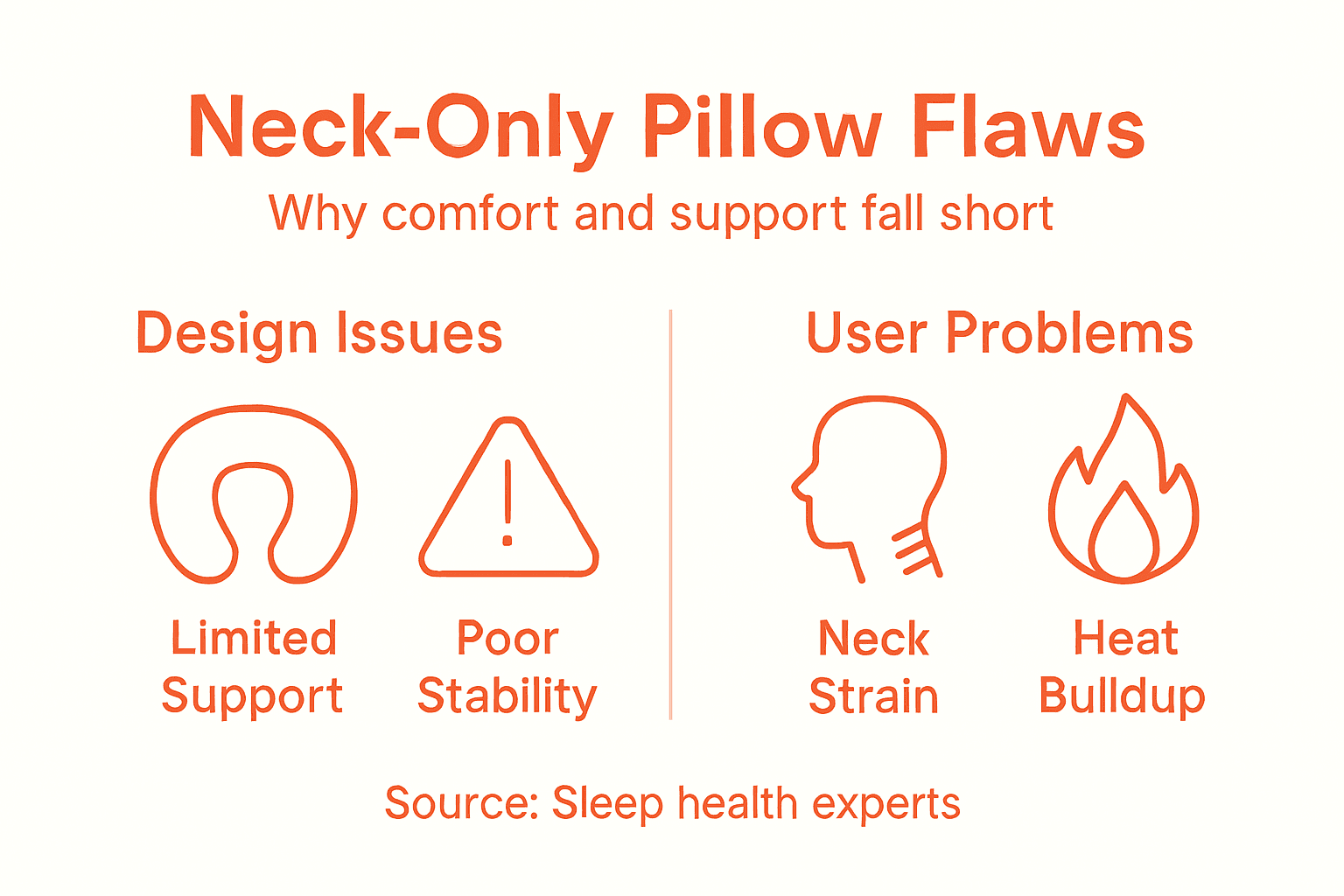
Your neck isn’t designed to flex forward for eight hours straight. Yet that’s exactly what happens when a pillow compresses under your head weight and stops doing its job. Your chin drops toward your chest. Your cervical spine curves unnaturally. The pressure accumulates.
The Alignment Problem
Poor cervical spine alignment can lead to degenerative disc disease and chronic neck pain when sustained over time. Neck-only pillows can’t maintain proper positioning because they ignore the fact that your entire upper body needs support, not just your neck.
What happens during prolonged misalignment:
-
Spinal discs experience uneven pressure distribution
-
Neck muscles remain in constant tension to compensate
-
Joints compress from repeated forward-head positioning
-
Nerve compression may cause tingling or numbness in arms
-
Muscle soreness extends beyond your neck into shoulders and upper back
Airflow Restriction and Breathing Issues
The wraparound design of neck-only pillows can inadvertently restrict airflow, especially if the pillow pushes your head forward or the material compresses against your throat.
Pillows that alter spinal curvature can restrict airflow through the respiratory system, potentially causing light-headedness, headaches, or fragmented sleep. You might wake feeling like you never actually rested, even though you were eyes-closed for six hours.
A pillow that compromises both alignment and breathing essentially guarantees a poor sleep experience and potential physical strain.
On long flights, restricted airflow compounds fatigue. Your body gets less oxygen during rest. You feel groggy for hours after landing. Some travelers experience headaches that persist for a full day post-flight.
Long-Term Consequences
One flight isn’t dangerous. But frequent travelers using inadequate support accumulate alignment damage. Repeated misalignment can contribute to chronic tension headaches, arthritis progression, and muscle imbalances that affect posture even after you return home.
Pro tip: Pay attention to how your neck feels 24 hours after flying, not just during the flight—if you’re sore, stiff, or have a persistent headache, your pillow was compromising alignment the entire time.
Space, Packing, and Real-World Usability Concerns
Neck-only pillows promise convenience. What you actually get is a bulky item that takes up valuable carry-on space and doesn’t compress when you need it to.
The horseshoe shape doesn’t fold small. It doesn’t roll tight. It doesn’t flatten. You end up with an awkward object the size of a volleyball that takes up roughly 20 percent of your carry-on capacity. That space could hold clothes, shoes, or a second battery pack.
The Packing Reality
Neck-only pillows often pose challenges such as bulkiness and lack of compressibility when packing carry-on luggage. Many travelers discover too late that the pillow they bought doesn’t actually fit where they expected it to go.
Common packing frustrations include:
-
Pillow takes up half your carry-on, forcing you to check a bag
-
Rigid horseshoe shape prevents creative packing around other items
-
Can’t compress down smaller than original size, no matter how hard you try
-
Attachment loops break or fail when hooked to bags
-
Pillow becomes detached during baggage handling
-
Extra weight adds up on international trips with strict baggage limits
Usability Across Different Travel Scenarios
Neck-only pillows work fine if you stay in the exact same position on a plane for eight hours. Reality is different.
Real-world usability of neck-only pillows is frequently limited by their size and shape, making them difficult to use across different travel environments. On a train, you might want to lean sideways. In a car, you need something that works against the door. On a connecting flight with a two-hour layover, you need to pack and unpack fast.
The pillow works for exactly one scenario: sitting upright with your head forward and on your back for the entire flight. The body is not designed that way. Switch positions and it becomes useless.
A pillow that only works in one position and takes up a quarter of your carry-on isn’t solving a travel problem—it’s creating one.
The Weight Factor for Frequent Travelers
Parents managing five carry-on items plus a child. Business travelers on red-eyes with tight luggage limits. Anyone who flies economy knows that every pound and inch matters.
A neck-only pillow adds roughly 1 to 2 pounds of dead weight to your bag. Over 12 flights per year, that’s moving an extra 12 to 24 pounds of stuff that doesn’t actually solve your comfort problem.
Pro tip: Weigh your current neck pillow, then calculate how many extra carry-on trips you’ve taken because of it—most frequent travelers discover they’ve paid to check bags because the pillow consumed their carry-on space.
Modern Alternatives That Support Whole-Body Rest
The pillow industry has moved beyond the horseshoe. Modern travel pillow designs recognize what neck-only pillows ignore: your body needs support as a system, not in isolated parts.
These alternatives work because they support your head, jaw, chest, and upper torso together. When your entire upper body is stabilized, your muscles relax. You actually sleep instead of tensing up for eight hours.
What Makes Modern Designs Different
Modern travel pillow designs have evolved beyond neck-only support, incorporating full head and shoulder support with ergonomic shapes and memory foam materials. They’re built on the principle that upright rest requires total upper-body stabilization, not just neck support.
Key improvements include:
-
Support extends from head through chest and shoulders
-
Ergonomic shaping prevents head tilt and forward drop
-
Memory foam adapts to your body instead of forcing you into a rigid shape
-
Attachment straps keep pillow stable without constant adjustment
-
Materials allow airflow instead of trapping heat
-
Designs work across multiple positions and body sizes
How Whole-Body Support Changes Everything
When your neck is supported but your head, jaw, and chest aren’t, your body fights back. The new generation of pillows eliminates that conflict by supporting all the areas that matter during upright rest.
Whole-body supportive orthopedic pillows provide support to the neck, shoulders, back, and lumbar regions, maintaining the natural curve of the spine. Your muscles stay relaxed because nothing is forcing your body into an unnatural position.
This approach prevents the cascade of problems neck-only pillows create:
-
No forward head drop
-
No jaw clenching
-
No shoulder tension
-
No heat buildup
-
No constant repositioning
Design Features That Matter
Look for pillows with adjustable firmness. Different body types need different support levels. A one-size-fits-all approach fails whether it’s a neck-only pillow or a new alternative.
Breathable materials matter on long flights. Memory foam is great if it allows air circulation. Heat trapping defeats the purpose of a better design.
Seat attachment features keep the pillow stable during sleep so you don’t wake up adjusting every 20 minutes.
A pillow that supports your whole body requires less adjustment, provides better sleep, and actually solves the problem instead of creating new ones.
Real Results for Economy Travelers
Frequent flyers who switch from neck-only pillows report sleeping through entire flights instead of waking every 30 minutes. Parents can rest knowing they’ll be alert at landing. Business travelers arrive ready to work instead of groggy and stiff.
The difference isn’t marketing. It’s biomechanics.
Pro tip: Before committing to any new pillow, test whether it actually supports your head, jaw, and chest together in an upright position—not just your neck in isolation.
Upgrade Your Travel Comfort Beyond Neck-Only Pillows
The article clearly highlights the frustrations of traditional neck-only pillows that fail to support your entire upper body during upright rest. If you struggle with neck strain, forward head drop, heat buildup, or a bulky pillow that does not compress, you are not alone. These common pain points arise because conventional travel pillows focus solely on the neck, ignoring the critical support needed for your head, jaw, chest, and shoulders.
That is where the Best long haul travel pillow from Bolstie makes a difference. Designed around body-first principles, Bolstie Travel Pillow stabilizes your entire upper body in a natural diagonal resting position without wrapping or restricting your neck. It improves airflow, reduces heat, and stays firm without collapsing under your head’s weight. Plus, it compresses down small for efficient packing so you can travel lighter.

Experience real comfort and smarter space use today with Bolstie Travel Pillow. Discover solutions for neck pain with our Travel Pillow for Neck Pain | Bolstie Smart Comfort collection. Don’t settle for outdated designs that leave you uncomfortable and restless. Make your next trip the one where you arrive refreshed and pain free. Shop now and travel better at https://bolstietravelpillow.com/collections/bolstie-best-neck-travel-pillow
Frequently Asked Questions
What are neck-only pillows and how do they work?
Neck-only pillows are U-shaped or horseshoe-shaped travel pillows designed to support your neck while you sleep upright. They wrap around the neck to maintain alignment, but often fail to provide adequate support for the entire upper body.
Why are neck-only pillows ineffective for travel comfort?
Neck-only pillows focus solely on the neck, ignoring the need for support for the head, jaw, chest, and shoulders. This can lead to discomfort, tension, and poor alignment, especially when sleeping upright during travel.
What are the common design flaws of neck-only pillows?
Common flaws include insufficient support under pressure, inability to accommodate head tilting, poor airflow causing heat buildup, and a one-size-fits-all approach that doesn’t cater to individual body types.
What alternative pillow designs provide better support for travel?
Modern travel pillows that offer whole-body support incorporate ergonomic shapes, memory foam, and features that stabilize the head and shoulders. These designs help maintain proper alignment, prevent tension and clenching, and improve overall travel comfort.

