

Long flights in economy class can leave even the most seasoned traveler rubbing a stiff neckmid-flight before the time they land. For busy parents balancing restless kids or business professionals sprinting between meetings, finding a travel pillow that actually prevents discomfort is more than a luxury—it is about restoring comfort and rest on the go. This guide explains how travel neck pillows are designed to support your head and neck during trips, and highlights what truly makes a pillow effective for travelers from the United States and Canada who want compact, reliable solutions.
Table of Contents
Key Takeaways
| Point | Details |
| Neck Support is Insufficient | Traditional neck pillows often focus solely on neck support, neglecting the need for comprehensive upper body alignment. |
| Adaptability is Crucial | Many travel pillows fail to accommodate different body types and sleeping positions, resulting in discomfort during travel. |
| Heat Retention is a Concern | Common materials like memory foam can trap heat, leading to discomfort and interrupting sleep. |
| Support Structure Matters | Effective travel solutions prioritize structural support over mere softness to ensure comfort throughout the journey. |
What Are Neck Pillows For Travel?
Travel neck pillows exist to solve one specific problem: your neck hurts when you try to sleep upright on a plane. They’re designed to support your head and neck during flights, car rides, and train journeys when you can’t lay flat.
The basic idea is simple. Your neck needs support to stay in a comfortable position while you’re sitting up. Without it, your head drops forward, your chin tucks into your chest, and your neck muscles strain for hours. That’s the pain you feel when you wake up.
How Traditional Neck Pillows Work
Most travel neck pillows use one basic approach: they wrap around your neck like a collar. The goal is to keep your head from falling forward or to the side.
They typically come in a few styles:
-
U-shaped pillows that wrap around your neck and supposedly support from both sides
-
Memory foam designs that mold to your neck shape but collapse under weight
-
Inflatable options that compress small but expand to full size but leaks mid-flight
-
Adjustable models with straps or closures feel more like restrains than support
Most use soft materials like memory foam or microbeads to provide cushioning. The idea is that a comfortable material pressed against your neck will feel good and keep your head stable.
Traditional neck pillows focus only on the neck itself, often neglecting how your entire upper body rests during sleep.
What They’re Trying to Accomplish
Designers know that maintaining proper spinal alignment during sleep reduces neck pain and discomfort. A good pillow should keep your spine neutral—not bent forward, backward, or twisted to one side.
They also aim to:
-
Prevent your head from dropping when you fall asleep
-
Reduce muscle tension in your neck and shoulders
-
Allow you to rest without waking up stiff or sore
-
Work in different sleeping positions (upright, leaning against the window, tilted sideways)
The problem is execution. What sounds good in theory doesn’t always work when you’re actually on a flight.
Why The Design Matters
Your neck is flexible. It moves. It’s not a rigid column that needs the same support all night. When you sleep in a car seat or plane seat, your body shifts position repeatedly. You lean left, then right. You tilt your head back, then forward.
A pillow that works well when your neck is upright might feel terrible when you tilt sideways. One that supports your neck might squeeze your jaw or cut off circulation.
Research shows that the correct pillow positioning prevents stress and discomfort during travel. But finding one that actually stays positioned correctly? That’s where most travelers struggle.
The Reality vs. The Promise
Travel neck pillows promise comfort. They promise you’ll sleep through your flight. They promise you’ll wake up feeling fine.
In reality, many travelers find them uncomfortable after 20 minutes. They’re too tight. They’re not supportive enough. They shift around. They make you hot. They look ridiculous.
That’s not a failure of the concept—it’s a failure of how traditional neck-based pillows approach the problem.
Pro tip: _Before buying any neck pillow, sit in a chair and imagine sleeping in different positions—upright, tilted sideways, head against the wall. If you can’t test those positions comfortably, the pillow probably won’t work on your flight.
Typical Designs and Their Shortcomings
Most travel neck pillows follow the same basic formula, and that’s the problem. They all try to solve the same way, which means they all fail in the same ways.
Manufacturers focus on what feels soft and what’s cheap to produce. They don’t focus on what actually keeps your neck from bearing the weight of the head for three to eight hours on a plane.
The U-Shaped Wrap
This is the most common design you’ll see. It wraps around your neck in a U-shape, with padding on both sides and under your chin.
The idea: your head rests back into the padding, and the sides support your neck from collapsing sideways.
The problem: it only works if your head stays perfectly upright. The moment you tilt your head—which you will—the pillow’s support shifts. The padding that looked supportive when vertical becomes a stranglehold when you lean sideways. Your jaw gets squeezed. Circulation cuts off. They only try to cushion the head after it has fallen, That’s like putting on a helmet after you fell off the bike - it’s too late. You wake up feeling worse than if you had nothing.

The Memory Foam Problem
Designers assume that soft, molding material equals comfort. Memory foam feels nice when you first touch it. But during a long flight, that same material becomes a problem.
Memory foam is best as a cushion, especially for horizontal sleep or butt cushion. Vertical and upright sleep requires both resistance support that also cushions. Another issue is that it holds heat. Your neck sweats. The foam gets warm and damp. After two hours, you’re hot and uncomfortable. Plus, pillow shape and height impact cervical spine alignment more than material does. Using premium foam doesn’t fix a pillow with the wrong shape.
Height and Shape Mismatches
Every person’s neck is different. Some people have long necks. Some have shorter ones. Some shoulders are wider. Some are narrower.
Traditional pillows come in one sizes. They can’t adapt to different body types. A pillow that fits a 5’6" woman’s neck might be too short for a 6’2" man. The same pillow that supports a narrow-shouldered person might be too low for someone with broader shoulders.
This is where the design really breaks down. Inappropriate pillow designs that don’t support the cervical spine properly increase muscle activity and cause discomfort. Your neck muscles work harder to compensate for poor support. That’s why you wake up sore.
The Position Problem
You don’t sleep in one position on a plane. You shift. You lean against the window. You tilt sideways. You adjust constantly.
A pillow designed for upright sleeping fails when you lean left. A pillow designed for leaning sideways doesn’t support you when you sit straight. Most travelers end up spending their flight adjusting, repositioning, and waking up frustrated.
Most neck pillows optimize for one sleeping position while ignoring how bodies actually rest during travel.
What Gets Overlooked
Traditional designs focus entirely on the neck. They ignore your shoulders, upper back, chest, and the gravitational pull and affects on the body as a whole in a seated position. Your whole upper body needs support when you’re sleeping upright. Focusing only on the neck creates muscle imbalance. Your shoulders tense up. Your chest hunches. Your whole spine gets thrown out of alignment.
The pillow supports your neck, but your body still doesn’t rest properly. You’re uncomfortable in ways the pillow wasn’t designed to address. The mind can’t rest when the body is struggling the entire flight.
Pro tip: When testing a pillow, check if it supports you when you’re tilted sideways, not just upright. If it fails in even one common sleeping position, it will fail on your flight.
How Common Problems Undermine Comfort
When you use a neck pillow, the problems start immediately. You might not notice them right away, but by hour three of your flight, you’ll feel every mistake the pillow’s design made.
These aren’t minor inconveniences. They directly attack your ability to rest and recover during travel.
The Pressure Point Problem
Most neck pillows press directly against your neck and jaw. That pressure feels supportive for the first few minutes. After an hour, it becomes painful.
Poor pillow fit and insufficient firmness can cause nerve impingement and increased neck pain. When a pillow squeezes your neck, it doesn’t just make you uncomfortable—it can actually irritate the nerves running through your cervical spine. You wake up with tingling. Your arm feels numb. Your fingers tingle.
This isn’t just discomfort. It’s your body telling you something is wrong.
The Slippage Issue
You’re sitting upright on a plane. Your body shifts. The pillow shifts with it, but not the way you need.
It slides down. It tilts sideways. You readjust it. Ten minutes later, it’s slipped again. You spend your entire flight constantly repositioning the pillow instead of actually resting. Your neck never gets the consistent support it needs, so your muscles stay tense the whole time.
That tightness doesn’t disappear when you land. You’re sore for hours or even days after your flight.
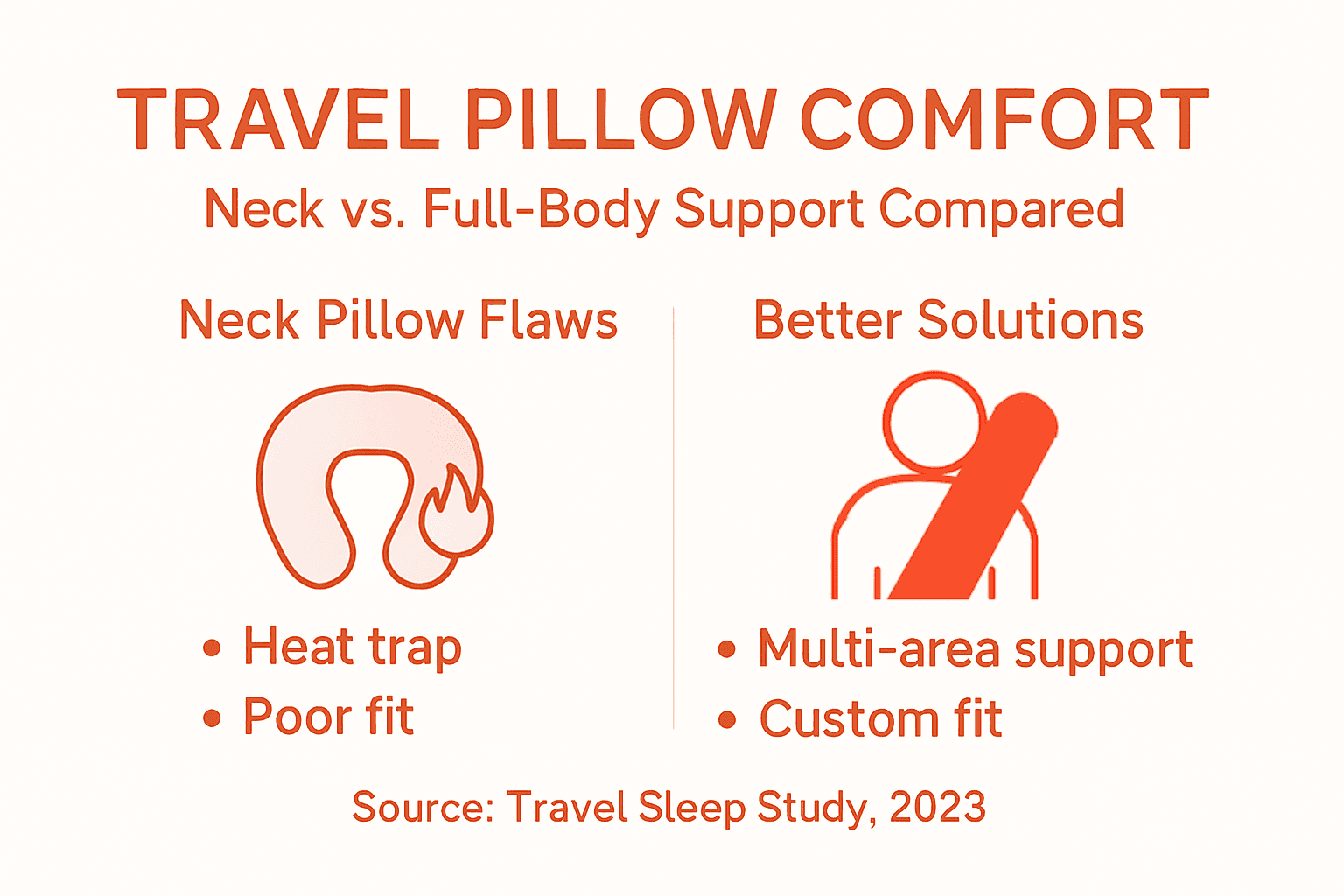
The Heat Trap
Your neck is warm. Soft foam holds that heat. The pillow gets warm. Your skin gets damp. You’re sweating against your own pillow.
Heat makes you uncomfortable. It interrupts sleep. It makes you want to take the pillow off. When you take it off, your neck has no support, so you can’t sleep anyway. You’re stuck choosing between being hot or being sore.
Wrong Size, Wrong Support
Traditional pillows come in standard sizes. Your neck isn’t standard.
If the pillow is too tall, your head tilts back at an angle. Your throat constricts. Breathing feels slightly off. If it’s too short, your head drops forward. Your neck muscles work overtime. If it’s too wide, it crowds your shoulders. If it’s too narrow, your neck hangs off the sides.
Every size mismatch creates a different kind of discomfort.
Below is a summary table comparing common travel pillow issues and their effects:
| Design Issue | Traveler Impact | Symptoms During Travel |
| Wrong pillow height | Poor spinal alignment | Neck stiffness, difficulty breathing |
| Excess compression | Nerve or circulation issues | Tingling, jaw discomfort |
| Lack of adaptability | Inconsistent head support | Frequent adjustments, restless sleep |
| Heat retention | Overheating, sweating | Disrupted sleep, discomfort |
| Neck-only focus | Muscle imbalance, fatigue | Shoulder/upper back pain |
The Neck-Only Blindness
Your neck doesn’t work alone. It connects to your shoulders, your upper back, your chest. When a pillow supports only your neck while ignoring the rest of your upper body, you get muscle imbalance.
Your neck is designed for fine motor movement, not to hold up the head for more than 20-30 minutes. Your shoulders slump forward. Your chest caves in. Your whole posture collapses. Your body isn’t actually resting—it’s just held in an uncomfortable position and your neck hurts the loudest because it’s one of the weakest muscle groups.
A pillow that supports only the neck while ignoring the rest of your body creates strain that spreads throughout your entire upper body.
Common Discomfort Pattern
Most travelers report the same progression:
-
Minutes 0-30: Pillow feels fine
-
Minutes 30-60: Pressure starts to build
-
Minutes 60-90: Neck feels tight
-
Minutes 90-120: Pain or numbness starts
-
After 2 hours: You give up and remove it
This cycle repeats all flight. You never actually rest.
Pro tip: If a pillow causes any numbness, tingling, or pressure on your neck after 30 minutes, it’s not going to work for an eight-hour flight—stop using it and try a different approach.
Beyond Neck Support: Smarter Sleep Solutions
The problem with traditional neck pillows isn’t that neck support is bad. It’s that focusing only on the neck ignores how your whole body actually needs to rest during travel.
Better sleep solutions think differently. They support your entire upper body, not just your neck.
Here’s a comparison of traditional neck pillows and advanced full-body travel sleep solutions:
| Aspect | Traditional Neck Pillow | Advanced Full-Body Solution |
| Support Area | Neck only | Head, shoulders, upper body |
| Adaptability | One or two fixed sizes | Adjusts to many body types |
| Sleeping Positions | Best when upright | Accommodates upright and tilted |
| Heat Management | Retains heat, can be sweaty | Designed for breathability |
| Stability | Prone to slipping/shifting | Remains steady in most positions |
| Comfort Duration | Often short-lived | Lasts through long flights |
| Packing Efficiency | Bulky or only compresses some | Lightweight, highly compact |
What Actually Works During Travel Sleep
Your body doesn’t rest in isolated parts. When you’re sitting upright on a plane, your head, neck, shoulders, chest, and upper back all work together. If one area lacks support, the others compensate by tensing up.
A smarter approach supports the diagonal resting position your body naturally wants to adopt. Your head tilts slightly forward and to one side. Your upper back leans against the seat. Your chest opens slightly rather than caving in. Your shoulders stay relaxed instead of hunching.
This is how your body actually rests on a flight. Not upright and rigid. Not tilted awkwardly. Diagonal and natural.
Beyond Memory Foam Materials
Ergonomic pillow design with advanced materials improves cervical health and sleep quality more effectively than traditional foam alone. The right material matters, but only if the shape and support structure work first.
Better solutions use materials that:
-
Stay firm enough to support your body weight
-
Don’t trap heat against your skin
-
Adapt to different body shapes and sizes
-
Maintain support even after hours of use
-
Allow airflow to keep you cool
Memory foam alone doesn’t do all of this. It feels nice initially but fails on firmness, heat retention, and durability.
Structural Support Over Compression
Traditional pillows compress around your neck. Better solutions use structural support that holds your head and upper body in place without squeezing.
Think of the difference between a tight choke and a firm handshake. The choke (compression) and you can tolerate it for 30 seconds but becomes uncomfortable. The handshake (structural support) stays comfortable because it’s not constantly pressing.
Structural support means your pillow stabilizes your body without wrapping around or constricting anything.
Adaptability to Your Body
One-size-fits-all doesn’t work. Your body is unique. A pillow that works for a 5’4" parent won’t work the same way for a 6’3" business traveler.
Smarter solutions :
-
Doesn’t depend on height and neck length
-
Doesn’t depend on shoulder width
-
Adapts to your preferred sleeping position
-
Adapts to how you naturally need to rest in a seated position on airplanes
-
Adapts whether you lean left or right
A pillow with flexible support systems can work for multiple body types without requiring you to guess which size to buy.
The Full-Body Rest Advantage
Advanced sleep solutions now include smart designs that optimize sleep on the go by supporting the entire upper body. When your whole upper body is supported, not just your neck, something shifts.
Your muscles finally relax. Your breathing stays open. Your spine stays neutral without effort. You don’t wake up every 10 minutes adjusting the pillow. You actually sleep.
Real travel comfort comes from supporting your entire upper body, not from designing a pillow that grips your neck.
What to Look For
When evaluating any travel sleep solution, ask yourself:
-
Does it support my neck alone, or my whole upper body up to my head?
-
Does it squeeze, or does it stabilize?
-
Can it work in different sleeping positions?
-
Will it stay supportive for eight hours?
-
Does it breathe, or will I get hot?
If it only addresses your neck, it’s missing the bigger picture.
Pro tip: Test any pillow or sleep solution by trying it in multiple positions: upright, tilted sideways, and leaning against something. If it fails in even one position, it won’t work for a full flight.
Choosing Effective Alternatives for Economy Trips
Not all travel pillows are created equal. When you’re stuck in economy class for hours, the right choice makes the difference between restless misery and actually sleeping.
The key is knowing what actually works instead of what sounds good in marketing.
What Makes an Alternative Actually Work
Effective travel pillows share specific qualities. They’re not just soft. They’re not just compact. They solve real problems that traditional neck pillows create.
A pillow that works for economy travel:
-
Stays supportive throughout a long flight
-
Doesn’t squeeze your neck or restrict circulation
-
Works in multiple sleeping positions
-
Doesn’t trap heat against your body
-
Takes up minimal carry-on space
-
Adapts to different body types and sizes
If a pillow doesn’t check most of these boxes, it won’t work for you.
The Right Support Structure Matters More Than Material
Ergonomic alternatives with optimal height and support reduce disability and improve neck comfort during travel. What matters isn’t whether it’s memory foam, latex, or spring-filled. What matters is whether it actually supports your body properly.
A pillow with good structure but basic materials works better than a pillow with premium materials but poor design. You want firmness that adapts to your body, not softness that collapses under your head.
Compact Design Without Sacrifice
Economy travelers don’t have space for bulky pillows. But compact doesn’t mean weak.
The best alternatives are lightweight and packable yet provide real support. They compress small enough to fit in a backpack or carry-on, then expand to full functionality when you need them. Some even double as packing tools, letting you stuff clothing inside to make them firmer while saving luggage space.
This matters because space is currency in economy class.
Lightweight Options for Frequent Flyers
Lightweight, compact travel pillows with scientifically supported internal systems offer targeted support without bulk. These are designed specifically for people who fly frequently and can’t tolerate heavy gear.
Look for alternatives that:
-
Weigh less than one pound
-
Compress to backpack size
-
Don’t require inflation or special setup
-
Support your head and upper body together
-
Allow airflow to prevent heat buildup
Frequent flyers know that every ounce matters. A pillow that weighs nothing but works everything is worth the investment.
Adjustability for Different Body Types
Your coworker is 6’2". You’re 5’5". Your partner has broader shoulders. One pillow can’t work the same for everyone.
Effective alternatives include adjustable features like:
-
Fillable chambers you can adjust
-
Height customization
-
Support that works for narrow and wide shoulders
-
Designs that function across sleeping positions
Adjustability means the same pillow works for your whole family, not just one person.
The best travel pillow alternative supports your entire upper body, compresses to nothing, and works for multiple people and positions.
Why Most Travelers Upgrade
People don’t abandon their old neck pillow because they’re stubborn. They abandon it because it stops working after two hours. Then they discover an alternative that actually works, and they never look back.
The transition usually happens on a flight where they’re desperate, borrow something better, and realize what they’ve been missing.
Pro tip: Before your next long flight, test your pillow on a two-hour car ride. If it causes any discomfort by the end, it won’t survive an eight-hour flight—find an alternative now, not mid-journey.
Discover Real Travel Comfort Beyond Neck Pillows
If you have ever struggled with traditional travel pillows that squeeze your neck, trap heat, or fail to support you in different sleeping positions then you understand the frustration described in “Why Neck Pillows Fail – Impact on Travel Comfort.” These pillows focus only on the neck and ignore the natural resting posture of your upper body leading to discomfort and restless flights. Key pain points include improper spinal alignment, muscle tension, heat buildup, and frequent pillow slipping.
Bolstie Travel Pillow offers a smarter solution by supporting your entire upper body — head, neck, jaw, chest, and torso — while allowing airflow and eliminating the tight squeeze around your neck. Designed to stabilize your natural diagonal resting position, the Bolstie pillow lets you stay upright and relaxed without waking up sore or stiff. Compact and space-efficient, it also doubles as a packing cylinder so you can travel lighter without sacrificing comfort. What about the material? Premium Velvet. You will know it the first time you feel it.
Take control of your travel rest now by exploring our Best Long Haul Travel Pillow collection and experience the difference of body-first support.

Upgrade your flight comfort with the Travel Pillow for Neck Pain | Bolstie Smart Comfort and see why so many economy travelers and frequent flyers trust Bolstie. Visit https://bolstietravelpillow.com/collections/bolstie-best-neck-travel-pillow to find your perfect match and stop settling for outdated neck-only pillows on your next trip.
Frequently Asked Questions
Why do traditional neck pillows often cause discomfort during travel?
Traditional neck pillows often fail to provide adequate support for the entire upper body, leading to muscle tension and discomfort. They typically focus solely on supporting the neck, which can create imbalances and result in pain over extended travel periods.
What common design flaws contribute to the ineffectiveness of neck pillows?
Common design flaws include lack of adaptability to different body types, insufficient support for various sleeping positions, and materials that trap heat, leading to discomfort and irritation during long flights.
How can a neck pillow impact my travel experience?
A poorly designed neck pillow can lead to issues such as neck stiffness, increased muscle tension, and interrupted sleep, which ultimately results in feeling sore and tired upon arrival at your destination.
What should I look for in a travel pillow to ensure comfort?
When selecting a travel pillow, look for support that accommodates your whole upper body, adaptability to different body types and sleeping positions, materials that prevent heat retention, and a design that minimizes pressure points and allows for easy adjustments.

