

TL;DR:
- Bulky travel pillows often hinder space, storage, and comfort in economy class.
- Compact, packable pillows provide better support, portability, and ease of use during flights.
- For short trips or minimal sleep, alternative support methods may eliminate the need for a pillow.
You spend good money on a big, plush travel pillow, expecting to finally sleep like a human being at 35,000 feet. Then you squeeze into your economy seat, try to stuff that oversized pillow somewhere useful, and realize it’s taking up half your lap, won’t fit in the overhead bin alongside your carry-on, and is already making you sweat before the plane even pushes back. Sound familiar? The truth is, bigger doesn’t always mean better when it comes to travel pillows, especially in economy class, where every inch of space is precious and comfort is already a challenge. ✈️
Table of Contents
- Why bulky travel pillows fall short in economy class
- The logistics: Space, packing, and real travel scenarios
- Compact pillows: Do you sacrifice support for size?
- Alternatives and when you might skip a travel pillow altogether
- Why smart travelers rethink traditional pillows
- Upgrade your comfort with compact choices
- Frequently asked questions
Key Takeaways
| Point | Details |
|---|---|
| Bulky pillows add hassle | Oversized designs make packing and seat setup harder for economy travelers. |
| Compact options are smarter | Small, lightweight pillows fit better with tight airline seating and carry-on limits. |
| Support vs. size trade-off | Bulky pillows may aid neck support but often aren’t worth their inconvenience in economy. |
| Sometimes less is more | On short flights, consider skipping the pillow altogether to save space. |
| Adaptability is key | Choose travel accessories that work flexibly with your journeys, not just in theory. |
Why bulky travel pillows fall short in economy class
Now that the challenge is clear, let’s detail why traditional oversized pillows often add hassle instead of relief.
Economy-class cabins are not designed with generous storage or personal space in mind. Seat pitch (the distance between your seat and the one in front) has shrunk significantly on many airlines over the past decade. A big, foam-filled U-shaped pillow often doesn’t fit comfortably in that reduced space, and it certainly doesn’t fit neatly in most overhead bins once your carry-on bag is already up there.
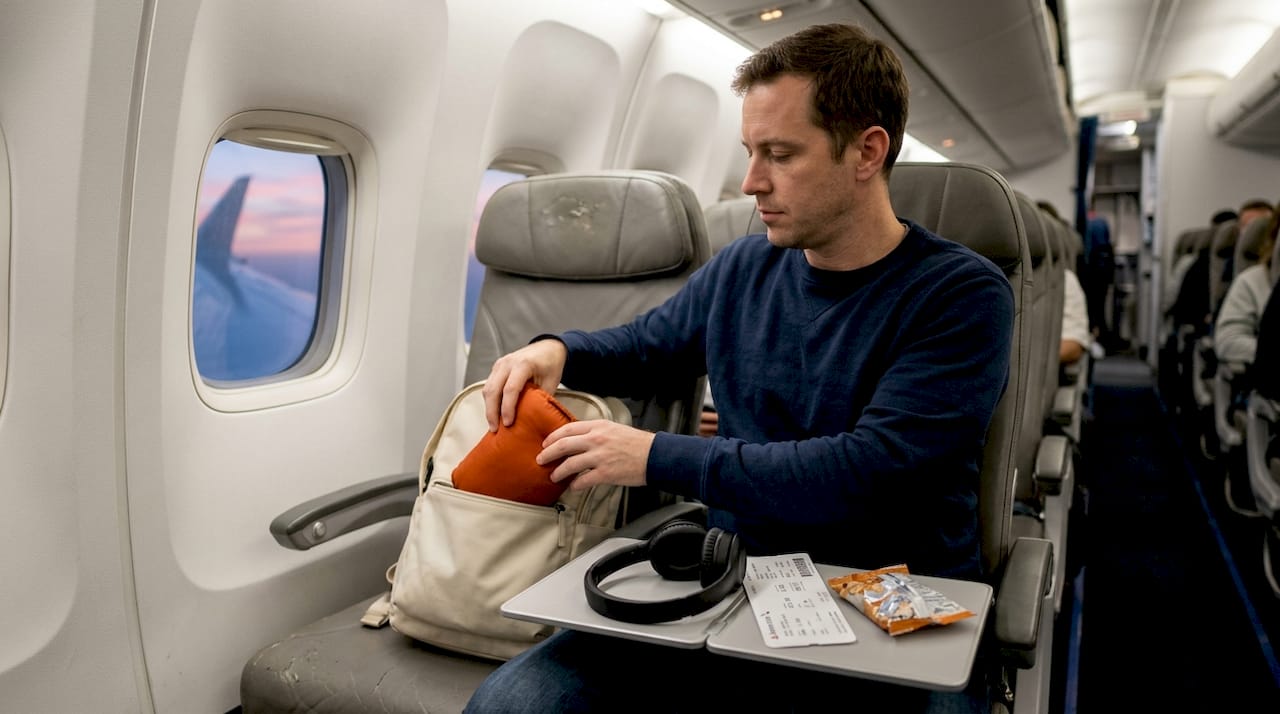
Here’s what actually happens when you bring a bulky travel pillow on a typical economy flight:
- Carry-on conflict: That oversized pillow compresses your packing space, forcing you to check a bag or leave something behind.
- Boarding stress: You’re juggling a pillow, a carry-on, a personal item, and boarding documents, all while shuffling through a narrow aisle.
- Mid-flight awkwardness: If you get up to use the restroom, the pillow falls, gets stepped on, or ends up on your neighbor’s seat.
- Headrest mismatch: Many economy seats have winged or contoured headrests that don’t pair well with a thick U-shaped pillow, leaving your head at an odd angle anyway.
As Wirecutter’s review notes, bulky travel pillows are often less compatible with economy-class constraints (small space, limited carry-on room) and can end up being harder to store and manage mid-journey.
“The best travel pillow isn’t the biggest one. It’s the one that fits your trip, your seat, and your packing style without becoming a burden.”
Pro Tip: Before your next flight, measure the available space around your economy seat. Most economy rows offer roughly 17 to 18 inches of seat width and very limited under-seat storage. A pillow that respects those dimensions will serve you far better than one designed for a first-class suite.
Smart travelers who understand packable pillows for economy travel know that the pillow should work for you, not the other way around.
The logistics: Space, packing, and real travel scenarios
With the drawbacks outlined, travelers need to see the tangible impact of pillow choice on actual travel routines.
Let’s get concrete. Imagine a typical economy traveler heading from New York to London. You have a carry-on bag, a personal item (laptop bag or tote), and a traditional large memory foam travel pillow clipped to the outside of your bag. That pillow alone can measure 12 to 14 inches in diameter and weigh up to 1.5 pounds.
| Feature | Bulky travel pillow | Compact/compressible pillow |
|---|---|---|
| Packed size | 12 to 14 inches diameter | 4 to 6 inches compressed |
| Weight | 1 to 1.5 lbs | Under 1 lb (some under 9 oz) |
| Carry-on impact | Significant | Minimal |
| Mid-flight storage | Difficult | Easy (lap, seat pocket) |
| Headrest compatibility | Low to moderate | Moderate to high |
| Packability score | Low | High |
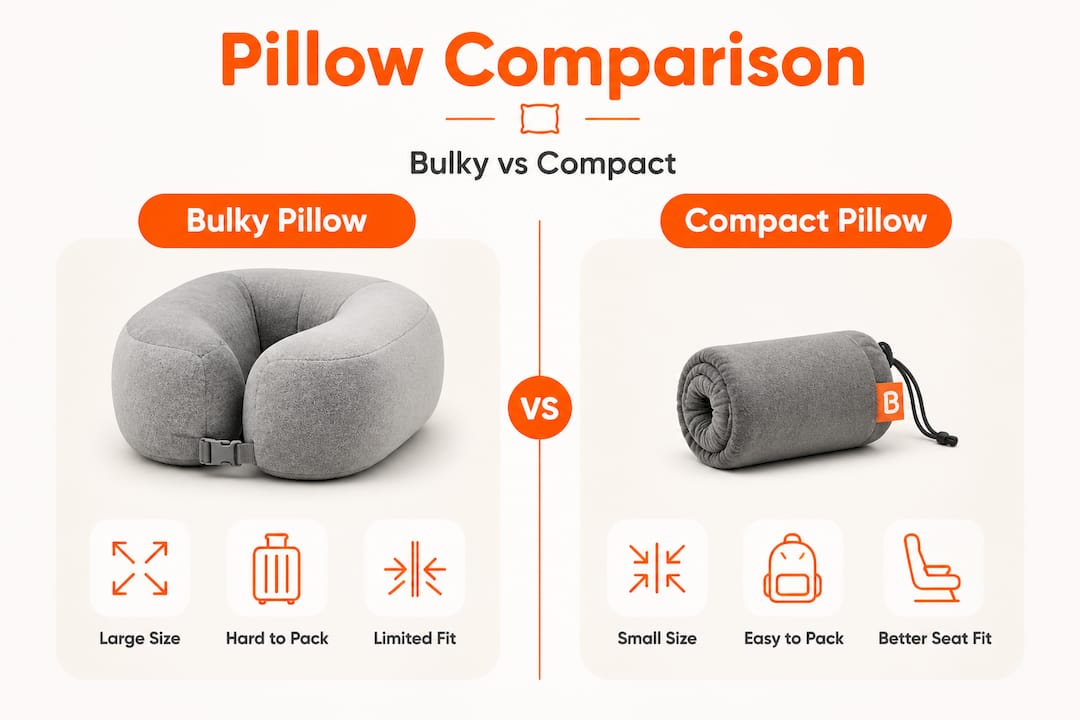
Condé Nast Traveler highlights that the Trtl Plus weighs just 9 ounces and packs easily into a jacket pocket, while Wirecutter’s recommended Travelrest compresses to a quarter of its size and weighs less than a pound. That’s a world of difference from a traditional pillow.
Here’s how the same New York to London journey unfolds differently depending on your pillow choice:
- At home: A compact pillow fits inside your carry-on. A bulky pillow forces you to rearrange or remove items.
- Security: A compressible pillow stays in your bag. A bulky pillow often needs to be removed, creating another tray to manage.
- Boarding: No extra item dangling from your bag. You move through the aisle easily.
- Cruising altitude: The compact pillow is already positioned and ready. The big pillow is wedged somewhere uncomfortable.
- Deplaning: You gather one bag and go. No searching for a pillow that rolled under the seat.
📊 Stat to consider: The average economy carry-on allowance is around 45 linear inches total. A bulky U-shaped pillow can consume 10 to 15 of those inches on its own. That’s space that could hold an extra outfit, your toiletry bag, or a pair of shoes.
Choosing minimal packing pillow options isn’t about sacrificing comfort. It’s about being honest with yourself about what actually makes your journey easier from door to destination.
Compact pillows: Do you sacrifice support for size?
Travelers frequently wonder if smaller pillows can really protect their neck. Let’s break down the real trade-offs.
This is the big question, and it deserves an honest answer. Yes, some bulky pillows, particularly those made from memory foam, genuinely do offer excellent neck support. That’s not a myth. The problem is that excellent neck support doesn’t exist in a vacuum. It has to coexist with the reality of your seat, your posture, your neighbor’s space, and your ability to actually store the thing.
Here’s how five popular pillow categories compare on support and packability:
| Pillow type | Neck support | Packability | Seat compatibility | Best for |
|---|---|---|---|---|
| Traditional U-shaped foam | High | Very low | Low to moderate | Lounge or wide seats |
| Memory foam U-shaped | Very high | Low | Low | Short trips, wide seats |
| Scarf-style (e.g., Trtl) | Moderate to high | Very high | High | Economy, any seat |
| Inflatable pillow | Moderate | Very high | Moderate | Budget travelers |
| Structural support pillow | High | High | High | Long-haul economy |
As Wirecutter’s review points out, bulky memory-foam designs score well for neck support but trade off against packability and compatibility with how the seat headrest shape and back angle meet the pillow. That last part matters more than most people realize.
Here’s why: economy headrests vary wildly. Some are flat, some winged, some adjustable. A thick foam pillow designed to wrap around your neck can actually push your head forward when paired with a winged headrest. That creates more strain, not less. Compact structured designs that work with your body’s natural diagonal resting position can outperform bulky pillows in terms of real comfort during actual economy travel.
Pro Tip: When choosing the right pillow for sleep, think about the type of headrest on the aircraft you most commonly fly. A quick search of your airline and seat type can help you find the right match before you buy. Not all pillows work with all seats, and knowing your seat geometry is half the battle.
The key insight here is that compressible pillow benefits go beyond just saving space. A pillow that fits your actual travel environment will support your body more effectively than one that fights against your seat’s design from the moment you sit down. ❤️
Alternatives and when you might skip a travel pillow altogether
Not every flight or flyer needs a pillow at all. Here’s how to know what’s genuinely practical for you.
This might be the most honest section in this entire guide. Sometimes the most efficient thing you can do is leave the travel pillow at home entirely.
Wirecutter’s review makes a straightforward point: if you only need short naps or don’t intend to sleep, the most efficient solution may be to skip a travel pillow altogether because it’s “another thing you have to carry around.” That’s a refreshingly practical take.
“The ideal travel setup is the lightest one that still meets your needs. Sometimes that means no pillow at all.”
So how do you decide? Run through this checklist before your next trip:
- Flight duration: Under three hours? You probably don’t need a dedicated pillow. Over five hours? It’s worth considering.
- Sleep intention: Are you planning to actually sleep, or are you just hoping to doze? For deep sleep goals, support matters. For light dozing, it probably doesn’t.
- Seat position: Window seat gives you a wall to lean on. Middle or aisle seat? You’ll feel the lack of support more acutely.
- Available space: Checked bag or minimal carry-on? If you’re traveling ultra-light, a rolled jacket or soft packing cube can substitute effectively.
- Physical comfort: Do you already have neck tension or discomfort during flights? If yes, even a compact pillow is a worthwhile investment.
If you decide to improvise, here are practical alternatives that many seasoned travelers swear by:
- A rolled-up hoodie or fleece jacket stuffed between your neck and the headrest works surprisingly well on shorter flights.
- A soft packing cube filled loosely with clothes can provide gentle lateral head support.
- Many modern economy seats have adjustable headrests that, when positioned correctly, reduce neck strain without any pillow at all.
For longer journeys, exploring economy comfort sleep tips and long-haul flight strategies can help you build a complete rest toolkit beyond just your pillow choice. Because good sleep on a plane is a system, not a single product.
Why smart travelers rethink traditional pillows
Here’s my honest take, shaped by watching how real travelers actually behave on real flights: the travel pillow industry has sold us on the idea that more padding equals more comfort. It doesn’t. What actually matters is fit, portability, and adaptability.
The travelers I see resting comfortably in economy are rarely the ones with the biggest pillows. They’re the ones who’ve figured out exactly what their body needs to stay upright and relaxed without fighting their environment. Their gear works with the seat, not against it. They’re not adjusting and readjusting for the first hour of the flight. They settle in, and their whole body finally exhales.
Bulky pillows often fail where it counts most: adaptability. They’re designed in a lab or showroom, not tested in a middle seat between two strangers with a crying baby two rows ahead. A pillow that looked great in a product photo can be genuinely miserable when the passenger in front of you reclines and your available space shrinks by another four inches.
We think the smarter path is to stop optimizing for maximum padding and start optimizing for real-world use. That means prioritizing space-saving pillow innovation that actually works in tight cabins, and testing your gear under honest travel conditions before committing to it. Real-world pillow testing consistently shows that compact, structured designs outperform bulky ones in economy-class scenarios across multiple variables.
The best travel pillow for you is the one you barely notice you’re carrying, and that you can’t imagine flying without once you’re seated. That’s the standard worth chasing.
Upgrade your comfort with compact choices
You’ve seen the data, the comparisons, and the real-world scenarios. The verdict is clear: when it comes to economy-class flying, compact and structured beats big and bulky almost every time.
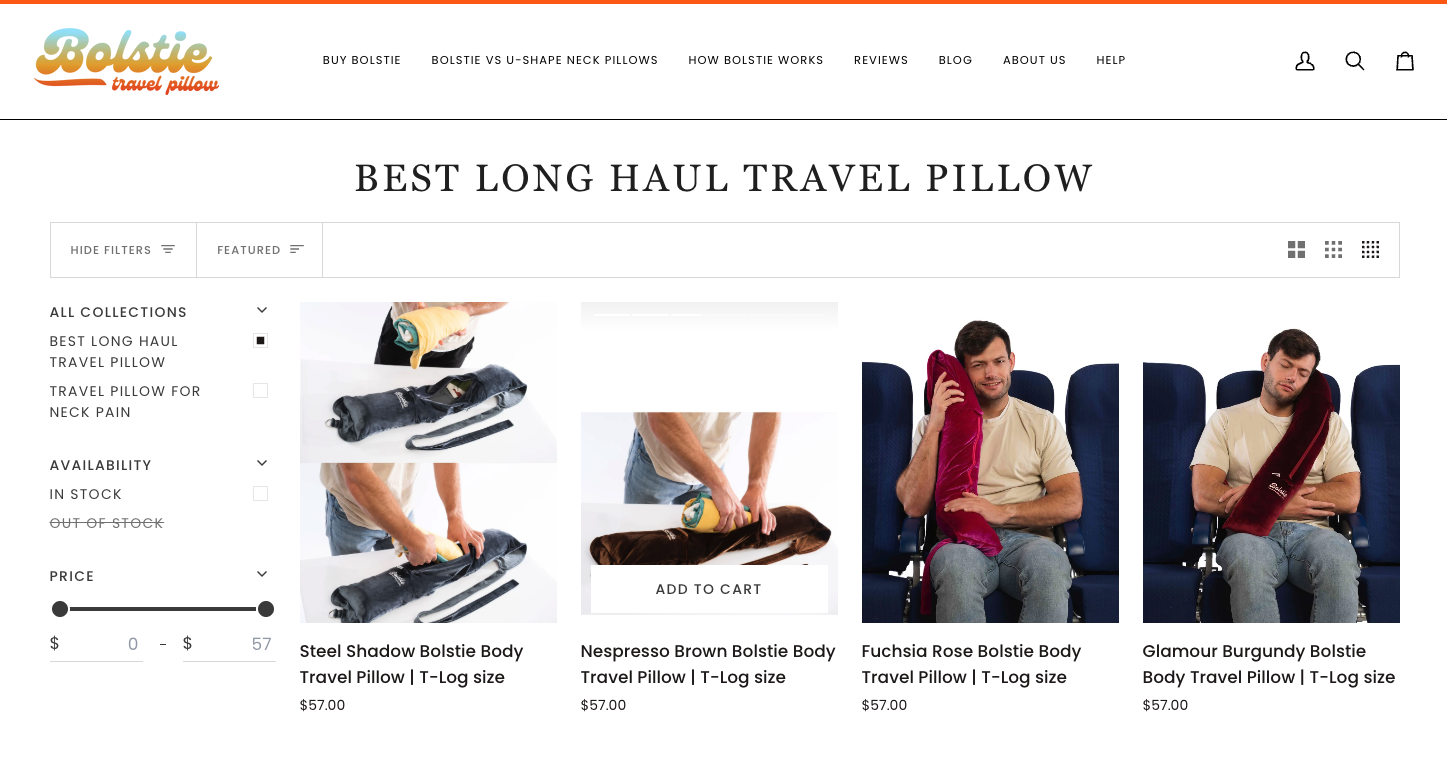
At Bolstie Travel Pillow, we built our pillow specifically for economy travelers who want genuine support without the baggage (literally). Our design fills with your own clothing to create a firm, structured pillow that supports your head, jaw, and upper torso in a natural resting position. When empty, it compresses small enough to tuck inside your carry-on without displacing a single thing. It’s smarter packing and smarter sleep, all in one product. If you’re ready to actually rest on your next flight, explore our travel pillow options and find the one that fits your journey.
Frequently asked questions
Are bulky travel pillows better for neck support?
Some bulky memory-foam pillows do offer strong neck support, but they often trade off against packability and may not fit well with economy cabin headrests or tight seating geometry. A compact, structured pillow designed for your seat type can often match or outperform bulky designs where it actually matters.
What is the most important feature for an economy-class travel pillow?
Packability and compactness are key priorities, since economy-class cabins offer very limited space and carry-on storage. A pillow that fits your bag and your seat without hassle will always outperform a larger one that’s awkward to manage mid-flight.
Should I bring a travel pillow for a short flight?
For flights under three hours or trips where you don’t plan to sleep, you may not need one at all; save the space for something more useful. A rolled jacket or adjustable headrest is often sufficient for brief or light dozing.
How do compressible travel pillows compare to standard bulky designs?
Compressible pillows pack significantly smaller and lighter than bulky U-shaped designs, with scarf-style or strap-supported options packing flatter and weighing far less, making them a far better fit for frequent economy-class travelers who value both comfort and carry-on efficiency.
Recommended
- Why packable pillows are essential for economy travel – BOLSTIE TRAVEL PILLOW
- Why choose multi-use travel pillows for economy comfort – BOLSTIE TRAVEL PILLOW
- 7 Benefits of Ergonomic Travel Pillows for Economy Flyers – BOLSTIE TRAVEL PILLOW
- How travel pillows improve upright rest for economy flyers – BOLSTIE TRAVEL PILLOW
- Luxury airport travel: real benefits, options, and expert insights

