

Long flights in cramped economy seats leave many American and Canadian travelers searching for relief from sore necks and restless sleep. The difference between a painful journey and arriving refreshed often comes down to choosing the right ergonomic travel pillow. Science confirms that keeping your head and neck supported can prevent muscle strain and maintain proper spinal alignment, even in uncomfortable airline seating. This guide details how compact travel pillows offer true comfort without crowding your luggage, so every trip feels easier from takeoff to landing.
Table of Contents
Key Takeaways
| Point | Details |
| Travel Pillows are Essential | They provide necessary support to prevent discomfort and ensure a restful journey in economy seating. |
| Pillow Design Matters | Effective travel pillows support the entire upper body and maintain proper alignment to enhance sleep quality. |
| Packing Efficiency | The best travel pillows compress easily and do not take up valuable luggage space while providing structure. |
| Avoid Common Mistakes | Choosing the wrong size or material can lead to discomfort and wasted luggage space; prioritize quality and fit for optimum results. |
What Makes a Travel Pillow Essential
Your body wasn’t designed to sleep upright in a seat 2 feet wide. Yet millions of people do it every year, and most suffer through it without proper support.
A travel pillow isn’t a luxury. It’s the difference between arriving at your destination rested and arriving with a stiff neck, sore shoulders, and the feeling that you’ve been hit by a truck.
The Physics of Economy Seating
Airline seats don’t support how your body naturally wants to rest. Your head weighs about 10 pounds, and when you’re upright with no support, your neck muscles work constantly to hold it in place. After a few hours, those muscles fatigue.
Research on pillow design shows that proper neck alignment during sleep prevents muscular strain and maintains spinal health. When your head tilts forward unsupported, your cervical spine compresses and your neck flexors tighten.
Without support, this is what happens:
-
Your head drops forward every time you start to doze
-
Your neck muscles wake you up repeatedly
-
You shift position every 20 minutes
-
You arrive exhausted instead of rested
Why Standard Pillows Don’t Work
A regular bedroom pillow is designed for horizontal sleeping. On a plane, it lacks the vertical structural support to push back against gravity constantly pulling the body forward and down. It also becomes a dead weight in your lap or falls between the seat and wall.
Most travel pillows are neck-only designed to wrap around just your neck, creating problems of their own:
-
They squeeze your airway, making breathing harder
-
They collapse under the weight of your head
-
They trap heat around your neck
-
They only address one small part of the problem
Travel neck support solutions vary widely in design, but the best ones stabilize more than just your neck.
What Actually Makes a Travel Pillow Essential
A truly effective travel pillow does these four things:
-
Supports your diagonal resting position — Your body wants to rest at an angle, not perfectly upright. The pillow should work with this, not fight it.
-
Stabilizes your whole upper body — Your head, jaw, chest, and shoulders form one unit. Support needs to involve all of them, not just wrap around your neck.
-
Stays firm when you lean on it — A pillow that compresses under weight becomes useless. It needs internal structure to maintain support through the flight.
-
Doesn’t add bulk to your luggage — You’re in economy. Space matters. The pillow should compress small when you’re not using it.
The best travel pillow supports your body’s natural resting angle while staying compact enough to fit in a carry-on without stealing space from clothes or other essentials.
The Comfort-to-Weight Ratio
This is where most travel pillows fail. They’re either so bulky that you can’t fit them in your bag, or so thin that they offer no real support.

Selecting the right travel pillow for long flights means understanding the trade-off between firmness and packability. Research confirms that seating without ergonomic adjustments causes muscle strain, especially during extended travel periods.
A travel pillow is essential because it solves a specific problem that nothing else can: keeping your body stable and comfortable when your environment offers no support at all.
Here’s how travel pillow features impact your overall journey comfort:
| Feature | Comfort Impact | Packing Impact |
| Diagonal upper body support | Reduces neck and shoulder fatigue | Allows compact storage |
| Firm internal structure | Maintains head stability during sleep | Can pack flat when empty |
| Breathable material | Prevents overheating during flights | Lightweight for carry-on bags |
| Versatile use (packing cylinder) | Enhances rest in economy seating | Saves space by storing clothes inside |
These key aspects lead to better rest and maximize luggage efficiency.
Pro tip: Fill your travel pillow with rolled clothes or a sweater to add weight and firmness without carrying extra luggage — this gives you a firmer, more structured support system that packs flat when empty.
Types of Travel Pillows and Key Differences
Not all travel pillows are created equal. The type you choose determines how well you sleep, how much space it takes up, and whether you’ll actually use it.
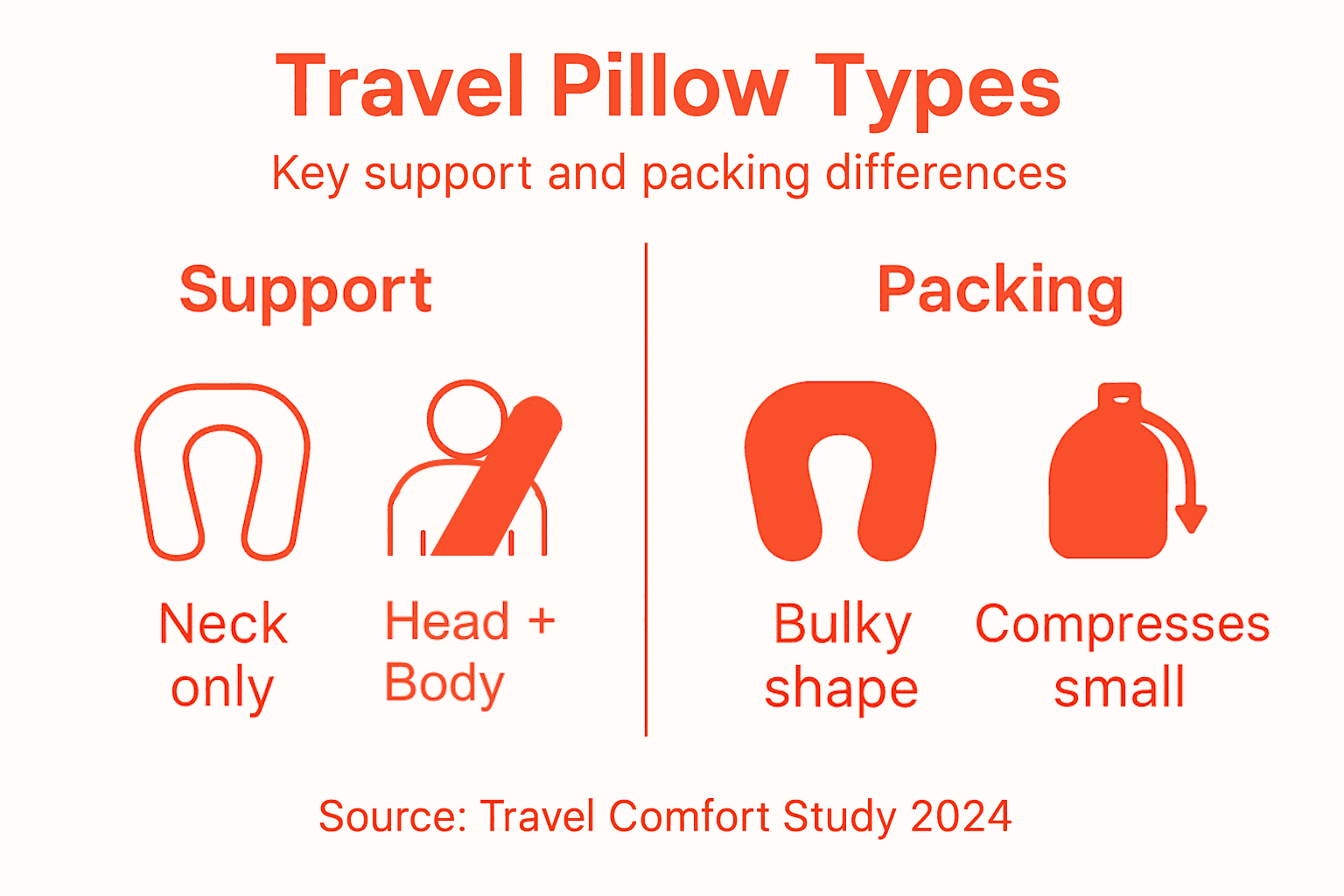
Understanding the main categories helps you match the pillow to your travel style and comfort needs.
Memory Foam Pillows
Memory foam doesn’t contour to the neck, providing a one size fit’s all support. It collapses the moment your head fall on it, This is why you have to squeeze it so tight around your neck just to feel some sort of support.
The tradeoff is weight and heat. Memory foam retains body heat, which can be uncomfortable on longer flights where cabin temperature fluctuates.
Best for: Travelers who prioritize neck support and don’t mind carrying extra weight and heat.
Inflatable Pillows
Inflatable pillows collapse small and adjust to your preferred firmness by adding or removing air. You control the exact level of support you want.
The downside is they can feel cheap and tend to lose air over time. Some travelers find them uncomfortable because they lack plush softness and offer limited padding.
Best for: Budget-conscious travelers or those with limited luggage space and short flights.
Fiber-Filled Pillows
These pillows use soft synthetic fibers for cushioning. They’re lighter than memory foam and cost less, but they compress easily under weight.
Pillow materials affect comfort through their thermal properties and support characteristics. Fiber-filled options sacrifice firmness for softness, which works poorly if you need actual structural support during upright sleeping.
Best for: Travelers who prefer soft cushioning over firm support.
Gel Pillows
Gel-infused pillows stay cooler than memory foam while providing similar support and contouring. They’re ideal for people who overheat easily.
Gel pillows cost more and add weight, but they solve the heat retention problem that makes memory foam uncomfortable on long flights.
Best for: Hot sleepers flying overnight or on long routes.
Hybrid and Structured Pillows
Some pillows combine materials or use internal structures to support your body differently. Travel pillows designed with diagonal support logic stabilize your head, jaw, chest, and shoulders together instead of just wrapping around your neck.
These pillows work with your body’s natural resting angle rather than forcing you into an unnatural position.
Best for: Frequent flyers who want support beyond just the neck.
Quick Comparison
| Type | Weight | Packability | Support | Heat | Cost |
| Memory Foam | Heavy | Poor | Moderate | High | $$$ |
| Inflatable | Light | Excellent | Moderate | Low | $ |
| Fiber-Filled | Light | Good | Low | Low | $ |
| Gel | Moderate | Fair | Moderate | Low | $$$$ |
| Structured | Variable | Variable | Excellent | Low | $$$ |
The right travel pillow matches your comfort needs with your luggage reality. A pillow that weighs 2 pounds but requires a dedicated bag space isn’t practical for economy travel.
Pro tip: If you fly multiple times per year, invest in a structured or gel pillow that provides both comfort and dual functionality—like one that works as a packing cylinder—to eliminate the need to choose between rest and luggage space.
How Travel Pillows Support Better Rest
A good travel pillow does more than just cushion your head. It actively supports your body’s ability to rest deeply, even in an uncomfortable environment.
When your body gets proper support, everything changes. You sleep longer, wake less often, and arrive at your destination actually rested.
Alignment and Spinal Health
Your spine has a natural curve. When you slump forward in a seat without support, your cervical spine compresses and your muscles work overtime to hold your head up.
Proper neck and spine alignment during sleep reduces pain and minimizes sleep disturbances. A pillow that maintains this alignment lets your neck muscles relax instead of staying tense all night.
Without alignment support:
-
Your neck stiffens after 2-3 hours
-
You wake with a dull ache between your shoulders
-
You shift positions constantly, disturbing your sleep
-
You arrive sore and exhausted
Better Breathing and Oxygen Flow
When your head tilts forward, your airway narrows slightly. This restricts breathing and can increase snoring, which fragments your sleep.
A pillow that keeps your head upright and supported maintains open airways. Better airflow means deeper, more restorative sleep.
Your body gets more oxygen throughout the flight. You wake feeling less groggy.
Reduced Sleep Interruptions
Every time you shift position, you partially wake up. Most people don’t remember these micro-awakenings, but they prevent deep sleep.
With proper support, you don’t need to adjust your position every 15 minutes. Your body feels secure and stable, so it stays put.
Fewer adjustments mean longer uninterrupted sleep cycles, which is where real recovery happens.
Weight Distribution
Cheap pillows concentrate pressure on specific points like your neck or the back of your head. This creates discomfort and forces you to shift.
Ergonomic pillows distribute weight evenly across your head, neck, and upper body. Pressure spreads out, so no single area bears too much load.
This sounds simple, but it’s the difference between painful sleep and comfortable sleep.
What This Means for Economy Travel
You can’t upgrade your seat. But you can change how your body rests in the seat you have.
How to sleep on your side in economy is challenging without the right support structure. A pillow designed to stabilize your whole upper body gives you options you don’t have without it.
Better rest on planes comes from support that works with your body’s natural resting position, not against it.
When support is right, your body can actually sleep instead of just sitting with your eyes closed.
Pro tip: Test your pillow before your flight by sitting upright for 20 minutes and checking if your neck feels relaxed or tense—this reveals whether the pillow truly supports your body or just cushions it.
Common Mistakes and Packing Impacts
Most travelers make the same mistakes with travel pillows, and these errors cost them comfort, luggage space, and money.
Knowing what to avoid saves you from wasting space on a pillow that won’t help.
Choosing the Wrong Shape or Size
Travelers often grab whatever pillow is cheapest or most popular, without considering whether it matches their body or travel style.
A pillow that’s too small offers minimal support. One that’s too large takes up an entire carry-on compartment.
Common travel pillow mistakes include selecting improper sizing that reduces effectiveness and causes discomfort. The right size depends on your shoulder width, neck length, and how you prefer to rest.
Before buying, consider:
-
Your typical resting position on flights
-
How much luggage space you actually have
-
Whether you travel with carry-on only or checked bags
-
Your body frame (small, medium, large)
Ignoring Material Quality
Cheap materials compress quickly and lose support halfway through a flight. You paid for a pillow but end up with a flat cushion.
Low-quality memory foam tears after a few uses. Inflatable pillows lose air or develop slow leaks. Fiber fill bunches up unevenly.
Material quality directly impacts how long your pillow lasts and how well it performs.
Buying Bulky Over Functional
This is the biggest economy-travel mistake. You sacrifice luggage space to carry a pillow that doesn’t pack down.
A 2-pound pillow that won’t compress means you’re giving up space for clothes, shoes, or toiletries. That’s a terrible trade-off.
Bulky pillows waste the very resource economy travelers are trying to save: space.
Poor Wearing Position
Many travelers wear neck pillows incorrectly, placing them too high or too low. This defeats the entire purpose of having one.
The pillow should support your natural resting angle, not force your neck into an unnatural position. Wrong placement causes the opposite of relief: neck strain.
Not Testing Before Travel
Buying a pillow and using it for the first time on a 7-hour flight is risky. You might discover it doesn’t work for you 2 hours in, with no alternatives.
Use your pillow at home for a few nights. Sit upright for extended periods and wear it like you would on a flight.
This reveals whether it actually supports you or just looks good.
Quick reference: Common travel pillow mistakes and their consequences.
| Mistake | Comfort Result | Packing Consequence |
| Incorrect pillow size | Minimal support, neck pain | Wastes luggage space |
| Low-quality material | Flattening and discomfort | Frequent replacement needed |
| Too bulky for luggage | Difficult to stow | Reduces clothing capacity |
| Wrong wearing position | Increased muscle strain | No packing benefit |
Avoiding these errors helps ensure restful travel and efficient packing.
The Packing Reality
Every item in your carry-on competes for space. A travel pillow that doesn’t compress or that requires its own bag is stealing real estate from things you genuinely need.
The best travel pillow compresses small when empty, serves multiple functions, and doesn’t force you to choose between comfort and packing efficiency.
Pro tip: Fill your travel pillow with rolled socks, underwear, or a lightweight layer before boarding—this adds firmness, saves luggage space, and eliminates the need to pack those items separately in your bag.
Why Bolstie Travel Pillow Stands Apart
Most travel pillows solve one problem: they cushion your neck. Bolstie solves the actual problem: your body needs support in an environment designed to offer none.
The difference is in how it works, not just what it looks like.
The Physics Behind the Design
Traditional neck pillows wrap around your neck and expect your neck muscles to do all the work. This is backwards. Your neck wasn’t designed to hold up your head while you’re trying to sleep.
Bolstie takes a completely different approach. Instead of wrapping around just your neck, it supports your whole upper body’s natural resting position. Your head, jaw, chest, and shoulders work together as one unit.
No Heat Trapping, Real Breathing
Neck pillows that wrap around your throat create a heat pocket that builds up over hours. You wake up sweaty and uncomfortable.
Bolstie’s design keeps your airways open and eliminates that suffocating feeling. Air flows freely around your neck and jaw, which means:
-
Better oxygen flow throughout the flight
-
Reduced heat buildup
-
Relaxed jaw instead of clenched tension
-
Less chance of snoring or breathing issues
Your body can actually rest instead of fighting the pillow.
Dual-Use Packing Efficiency
This is where Bolstie solves economy travel’s biggest constraint: luggage space.
When empty, it compresses small. When filled with your clothes, it becomes a firm, structured support pillow and a packing cylinder at the same time.
You’re not choosing between comfort and packing space anymore. The pillow becomes part of your packing system.
Designed for Real Travel, Not Photos
Most travel pillows are designed to look good in product photos. Bolstie is designed to function during actual flights, where you’re tired, cramped, and sitting upright for hours.
It works with your body’s natural diagonal resting position instead of forcing an unnatural posture. It stays firm under the weight of your head instead of collapsing. It doesn’t require wrapping, repositioning, or constant adjustment.
The Simplicity Advantage
Simplicity is harder to copy than complexity. Once you understand how diagonal body support works, it’s obvious. Before that, it’s invisible.
Bolstie doesn’t force your body into an uncomfortable position. It supports the position your body naturally wants to be in—and that changes everything.
Most competitors focus on adding features. Bolstie focused on removing problems.
Pro tip: Pack Bolstie with rolled layers or sweaters to test its dual functionality before your flight—this lets you experience how the pillow supports your body while solving your packing puzzle simultaneously.
Discover True Comfort and Smart Packing with Bolstie Travel Pillow
If you struggle with resting upright in economy-class seating or find your neck sore and your luggage space tight, Bolstie Travel Pillow offers the smart solution you need. Unlike traditional neck pillows that collapse or squeeze your airway, Bolstie supports your whole upper body in its natural diagonal resting position. This prevents neck strain and forward head drop while letting you breathe freely and stay comfortable for hours.
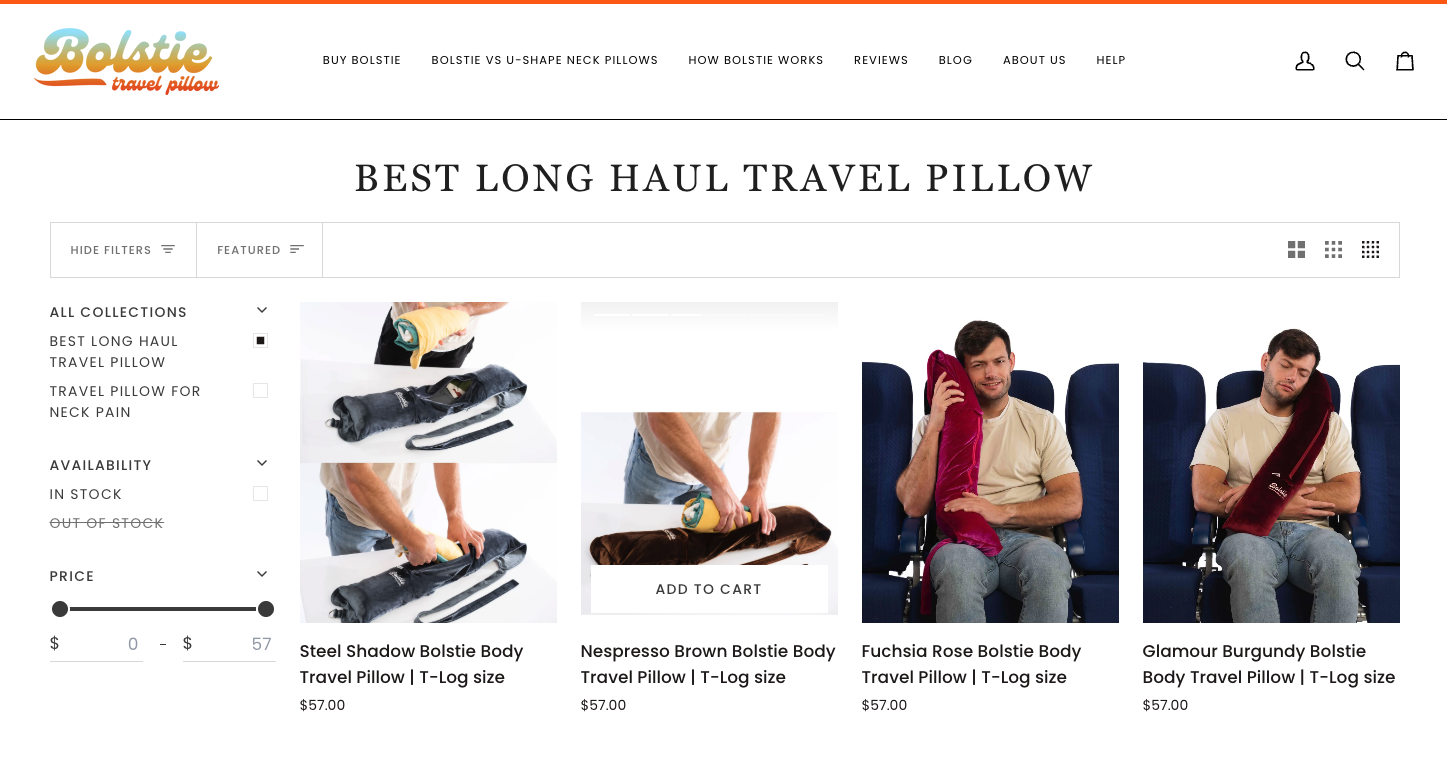
Experience the perfect balance of firm support and compact packing by using a pillow that doubles as a packing cylinder. Bolstie compresses small when empty and becomes a stable, clothing-filled pillow when in use, helping you save carry-on space without sacrificing rest. Ready to upgrade your economy travel comfort? Explore the Best long haul travel pillow – BOLSTIE TRAVEL PILLOW and see why travelers with neck pain choose Travel Pillow for Neck Pain | Bolstie Smart Comfort – BOLSTIE TRAVEL PILLOW.
Take control of your next flight. Visit https://bolstietravelpillow.com/collections/bolstie-best-neck-travel-pillow to find the practical upgrade that makes fatigue and bulky gear a thing of the past.
Frequently Asked Questions
What features should I look for in a travel pillow?
When choosing a travel pillow, look for features that support your body’s natural resting position, such as diagonal upper body support, a firm internal structure, breathable materials, and compact packability for efficient storage.
How do travel pillows improve sleep during flights?
Travel pillows improve sleep by providing proper neck alignment and support for the entire upper body, reducing muscle strain, enhancing breathing, and minimizing sleep interruptions, allowing for deeper and more restorative sleep.
What are the different types of travel pillows, and how do they compare?
The main types of travel pillows include memory foam (excellent support but can be heavy), inflatable (light and compressible but may lack comfort), fiber-filled (soft but compress easily), gel (cooler alternative to memory foam), and structured pillows (designed for diagonal support and multi-functionality). Each type has trade-offs in terms of weight, packability, and support.
Can a travel pillow really help with neck pain during long flights?
Yes, a well-designed travel pillow can help alleviate neck pain by maintaining proper spinal alignment, distributing weight evenly, and preventing your neck muscles from straining while you sleep upright, leading to a more comfortable travel experience.
Recommended
-
Step by Step Travel Pillow Selection for Long Flights – BOLSTIE TRAVEL PILLOW
-
6 Types of Travel Neck Support for Better Economy Rest – BOLSTIE TRAVEL PILLOW
-
Top 5 Ostrichpillow.com Alternatives in 2026 for Comfortable Travel So – BOLSTIE TRAVEL PILLOW
-
The Travel Pillow That’s So Easy To Use Even Kids Instinctively Unders – BOLSTIE TRAVEL PILLOW

