

Every long flight in economy seating tests even the most experienced traveler’s patience, especially when neck pain creeps in after just an hour or two. With airlines tightly packing seats and traditional travel pillows missing the mark on true neck support, it is no wonder that sustained comfort feels out of reach. By unpacking misconceptions about travel pillow design and understanding the impact of upright posture, you can make smarter choices to ease discomfort and keep your journeys more restful.
Table of Contents
Key Takeaways
| Point | Details |
| Understanding Design Flaws | Most traditional travel pillows fail to support the entire upper body and exacerbate discomfort rather than alleviating it. |
| Economy Seating Challenges | Economy-class seating lacks essential support for varied body types, contributing to significant discomfort during long travel periods. |
| Neck Health Risks | Prolonged upright seating leads to neck and shoulder strain, affecting long-term health and comfort. |
| Holistic Solutions | Invest in travel gear that prioritizes comprehensive support and adaptability to enhance comfort during travel. |
Travel Pillow Designs and Common Misconceptions
Most travel pillows fundamentally misunderstand human anatomy and seated rest. Despite manufacturers flooding the market with supposedly innovative neck support options, these designs consistently fail travelers by addressing yet failing to even solve the symptoms and simply ignoring the root causes of discomfort.
Traditional travel pillow designs typically share several problematic characteristics:
-
U-shaped pillows that wrap around the neck, trap heat, push the head forward
-
Memory foam designs that trap heat , collapse under real weight, push head forward
-
Compression wraps that restrict natural movement, trap heat, and suffocating
-
One-size-fits-all solutions ignoring individual body variations and all ofthe above
Researchers have extensively studied these design limitations. A systematic review revealed that pillow design does not significantly improve sleep quality, challenging the core assumptions behind most travel comfort products. The research suggests that simply changing pillow shape or material fails to address the fundamental biomechanical challenges of seated rest.
The real issue lies in how these designs interact with human physiology. When seated upright, our bodies naturally struggle to maintain proper spinal alignment. Traditional neck pillows attempt to solve this by providing localized support, but this approach inadvertently creates additional strain. Design challenges in neck support highlight how uncontrolled head movement during travel continuously stresses neck muscles, a problem most current pillows fail to mitigate.
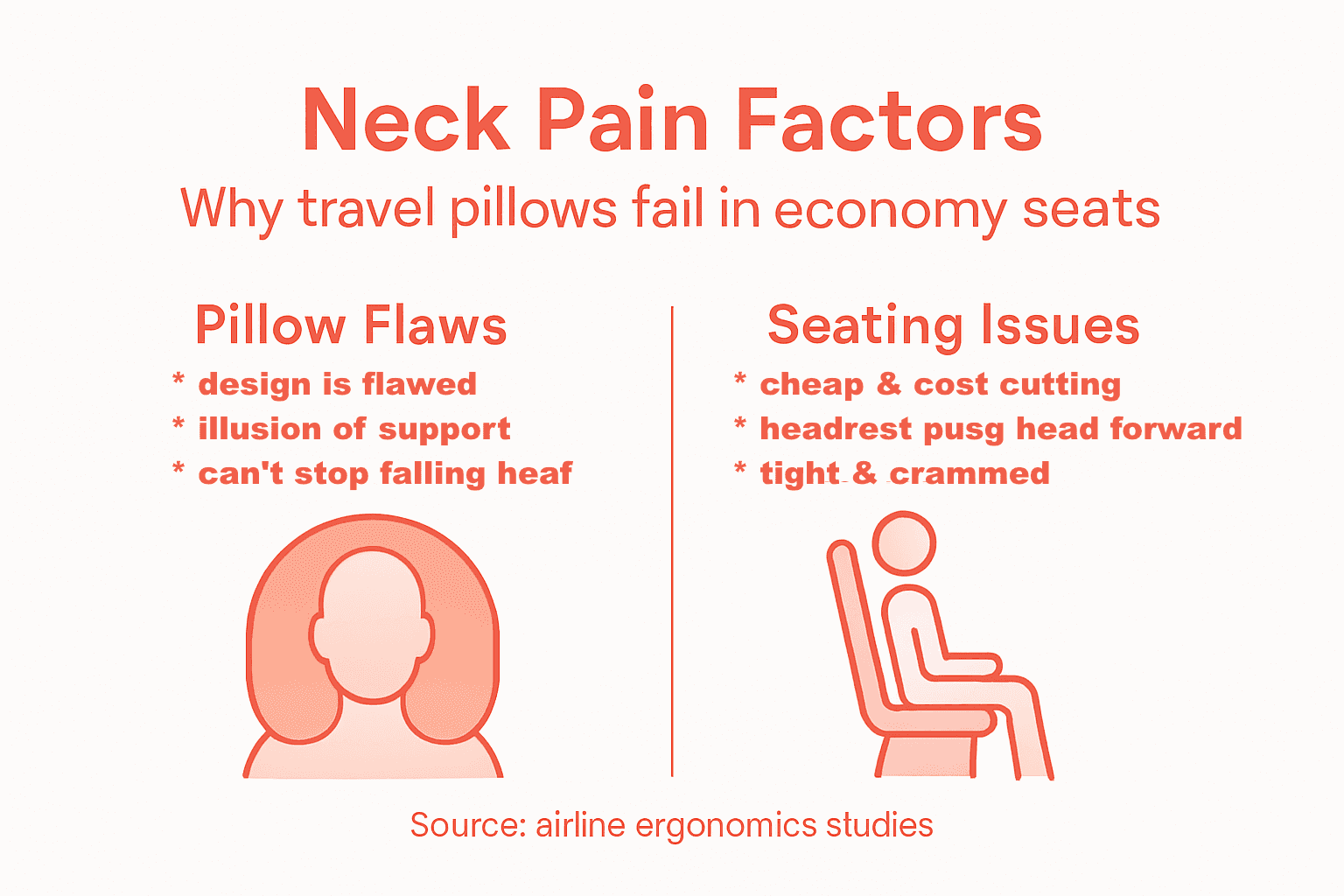
Most travelers do not realize that effective rest requires supporting the entire upper body’s kinetic chain, not just isolating the neck. Proper support means creating a stable diagonal resting angle that allows muscles to relax without excessive compression or heat buildup.
Pro tip: When selecting a travel pillow, prioritize designs that support your entire upper body geometry rather than just wrapping around your neck.
Here’s a comparison of traditional travel pillow approaches vs. holistic support solutions:
| Aspect | Traditional Pillow Approach | Holistic Support Solution |
| Main Support Area | Neck only | Whole upper body |
| Adaptability to Body Shape | One-size-fits-all | Adjustable to personal needs |
| Support Mechanism | Static, compressive | Dynamic, weight-redistributing |
| Heat Management | Often traps heat | Emphasizes breathability |
| Comfort Over Long Duration | Declines with time | Sustained by reduced strain |
The Real Problem: Economy Seating and Human Rest
Economy-class travel represents a perfect storm of human discomfort. Airlines have systematically reduced passenger space to maximize profit, creating an environment fundamentally incompatible with human physiology and rest.
The core issues with economy seating include:
-
Minimal seat pitch (distance between seat rows)
-
Rigid, non-adjustable seat backs
-
Limited lateral and vertical movement options
-
Insufficient lumbar and neck support
-
Uniform seat designs ignoring body diversity
Ergonomic studies of airplane seating reveal stark design failures. Most economy seats fail to accommodate basic human body variations, creating systemic discomfort that extends far beyond mere inconvenience. The lack of regulatory standards means airlines prioritize space efficiency over passenger well-being.
Researchers examining transit seating have discovered that current seat designs fundamentally compromise passenger comfort, with seat geometries that force unnatural postures. The human body simply cannot rest effectively in these compressed, static positions. Our spines are designed for dynamic movement, yet economy seating demands prolonged immobility in positions that strain muscles, compress vertebrae, and restrict blood circulation.
The biomechanical challenges are profound. When seated upright for extended periods, gravity becomes an adversary. Our neck muscles work overtime to support the head’s weight, creating tension that radiates through shoulders, back, and spine. Traditional travel gear like neck pillows offer minimal relief, attempting to treat the symptoms rather than addressing the fundamental ergonomic failure of economy seating design.
Pro tip: Move and stretch periodically during long flights to counteract the harmful effects of prolonged immobility.
How Upright Posture Impacts Neck Health
The human neck is remarkably complex and surprisingly vulnerable. They are designed for fine motor movements, not to hold up a 10-12 lbs head for hours on end. They can hold the head up for 10-15 minutes max then begin to fatigue afterwards. When seated upright for extended periods, particularly during travel, our neck becomes a critical point of biomechanical stress, absorbing forces it was never designed to handle continuously.
Key physiological challenges of prolonged upright posture include:
-
Increased gravitational load on cervical vertebrae
-
Continuous muscle tension to maintain head position
-
Reduced blood circulation in neck muscles
-
Compression of spinal discs
-
Limited range of motion
Prolonged awkward upright postures are significantly associated with neck and shoulder pain. The human body is not meant to remain static, especially in positions that force muscles into constant, unnatural engagement. Our necks essentially become shock absorbers, working overtime to support the 10-12 pound weight of our heads.
The biomechanical consequences are profound. Forward head posture creates specific muscle vulnerabilities, leading to reduced muscle endurance and increased potential for chronic pain. When we sit upright without proper support, specific neck muscles weaken, creating a cascade of potential long-term health issues. The neck’s intricate network of muscles, ligaments, and vertebrae becomes progressively stressed, unable to maintain its natural alignment.
Understanding these challenges is crucial. Every moment spent in an unsupported upright position incrementally damages our neck’s structural integrity. The cumulative effect transforms what seems like momentary discomfort into potential chronic pain syndrome, with muscles gradually losing their ability to support proper head positioning.
Pro tip: Perform gentle neck stretches every 30 minutes during long seated periods to maintain muscle flexibility and reduce tension.
This table summarizes key biomechanical challenges faced during upright travel:
| Challenge | Description | Long-Term Consequence |
| Gravitational Load | Head weight stresses cervical vertebrae | Spinal misalignment |
| Reduced Movement | Prolonged static posture | Muscle fatigue and soreness |
| Blood Flow Restriction | Compression reduces circulation | Increased risk of chronic pain |
| Disc Compression | Spine discs compressed while seated | Potential disc degeneration |
Why Traditional Pillows Fail at Proper Support
Most travel pillows are design disasters masquerading as comfort solutions. They represent a fundamental misunderstanding of human biomechanics, creating more problems than they solve while promising restful travel.
Common design failures in traditional travel pillows include:
-
U-shaped neck-wrapping configurations
-
One-size-fits-all approach
-
Heat-trapping fabrics
-
Insufficient structural support
-
Inability to accommodate different body types
-
Don’t stop the head from falling at all
-
Only attempt to cushion the head once it’s already fallen
Systematic pillow design research reveals critical shortcomings in traditional neck support products. Most pillows fail because they attempt a universal solution, ignoring individual variations in body shape, size, and resting posture. Rubber and spring pillows showed marginal improvements, but still couldn’t address the fundamental ergonomic challenges of upright seated rest.

The biomechanical reality is stark. Pillow shape directly impacts muscular stress and comfort levels. Rectangular designs work differently in supine versus lateral positions, while cylindrical shapes provide varying support depending on body positioning. This complexity exposes the inadequacy of generic travel pillow designs that claim universal effectiveness.
Traditional travel pillows essentially treat symptoms, not root causes. They attempt to immobilize the neck instead of supporting the body’s natural movement patterns. By focusing solely on neck compression, these products create additional tension, restrict blood flow, and generate heat—precisely the opposite of what travelers need for genuine rest.
Pro tip: Prioritize travel support solutions that understand body geometry rather than those promising quick fixes.
Alternatives for Comfortable Upright Travel
Travelers seeking genuine comfort must look beyond traditional neck pillows and explore holistic solutions that support the entire body during long seated journeys. The key is understanding that comfort isn’t about isolated support, but creating a comprehensive rest environment.
Effective alternatives for upright travel comfort include:
-
Adaptive clothing with built-in support panels
-
Modular travel vests with strategic padding
-
Compression garments designed for seated posture
-
Portable lumbar and thoracic support systems
-
Lightweight, multi-positioning body supports
-
Breathable materials with heat-management technology
Transit seating research demonstrates that comfort depends on more than just cushioning. The most promising alternatives focus on dynamic support that allows subtle body movements while maintaining overall postural alignment. This means designing solutions that work with the body’s natural geometry, not against it.
Comfort studies in vehicle configurations reveal that adaptable support is crucial. Reclining positions and seat angle variations significantly improve traveler comfort, suggesting that effective alternatives must offer more than static support. The human body craves micro-movements and the ability to redistribute weight, which traditional travel accessories consistently fail to provide.
The most innovative comfort solutions recognize that upright rest is a complex biomechanical challenge. They focus on creating a supportive ecosystem that adapts to individual body mechanics, redistributes weight effectively, and allows natural muscle relaxation. This means moving beyond rigid, one-dimensional support toward intelligent, responsive design.
Pro tip: Invest in travel gear that supports your entire upper body’s natural positioning, not just your neck.
Find Real Relief From Neck Pain With Bolstie Travel Pillow
If you are struggling with the neck strain caused by traditional travel pillows that focus only on supporting your neck, it is time to rethink your approach. The article explains how most pillows fail by ignoring the whole upper body’s biomechanics and how economy-class seating makes it even harder to rest comfortably. Bolstie Travel Pillow solves this problem by stabilizing the head, jaw, chest, and upper torso together. This smart design supports the body’s natural diagonal resting position, preventing forward head drop and reducing muscle tension.
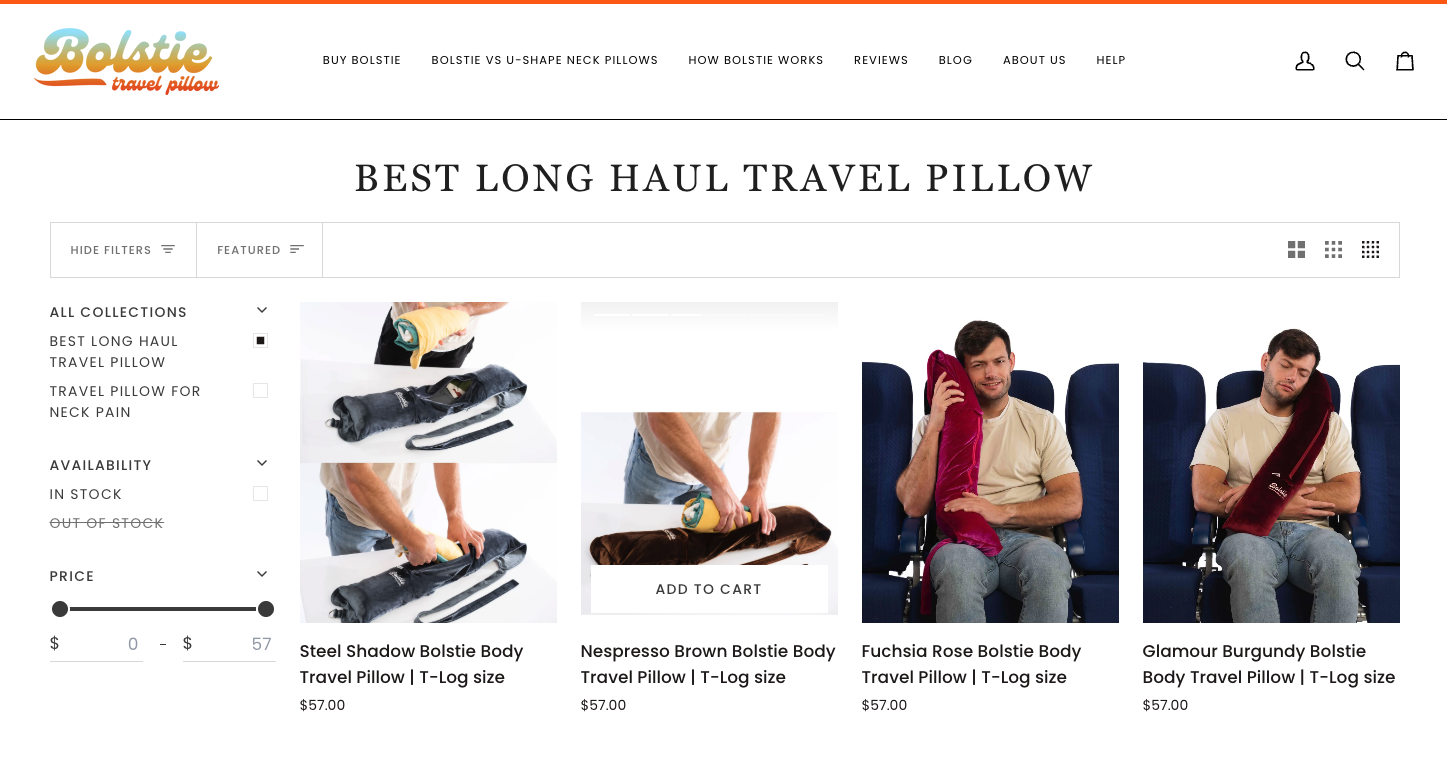
Discover the difference with Travel Pillow for Neck Pain | Bolstie Smart Comfort and see why so many frequent flyers and economy travelers choose Bolstie. Its space-saving, adaptable design also serves as a packing cylinder to save luggage space. Don’t settle for quick fixes that trap heat or restrict movement. Act now to upgrade your travel rest with a pillow designed to support your entire upper body and relieve neck discomfort on long flights. Visit Bolstie Travel Pillow to shop the best long haul travel pillow and experience true comfort on the go.
Frequently Asked Questions
Why do traditional travel pillows cause neck pain?
Traditional travel pillows often fail to account for human biomechanics, providing inadequate support to the neck and leading to additional strain. Their designs typically emphasize neck compression rather than supporting the entire upper body, causing discomfort and pain during travel.
What are the main design flaws of standard travel pillows?
Common design flaws in traditional travel pillows include U-shaped configurations that only support the neck, one-size-fits-all approaches, heat-trapping materials, and rigid structures that prevent natural movement, all of which can lead to neck pain during long journeys.
How can I choose a better travel pillow for neck support?
To select a better travel pillow, look for designs that offer holistic support for the entire upper body rather than just the neck. Pillows that allow for adjustability, promote breathability, and emphasize proper spinal alignment are more likely to reduce discomfort and pain.
What strategies can I use to alleviate neck pain while traveling?
To alleviate neck pain during travel, consider performing gentle neck stretches every 30 minutes, using supportive travel gear that accommodates body geometry, and ensuring you take regular breaks to move and stretch during long periods of seated travel.
Recommended
-
The Biggest Hidden Cause Of Neck Pain Mid-Flight — Poor Posture – BOLSTIE TRAVEL PILLOW
-
How I Sleep on My Side in a Plane Seat, Even in Basic Economy – BOLSTIE TRAVEL PILLOW
-
Short Necks? Long Necks? Why You Can’t Win with Neck Wrapping Travel P – BOLSTIE TRAVEL PILLOW
-
Why Are We Still Suffering on Planes? – BOLSTIE TRAVEL PILLOW

