

TL;DR:
Choosing a window seat mid-cabin over the wings improves sleep by reducing turbulence and noise.
Packing a supportive travel pillow, eye mask, earplugs, and layers enhances economy class rest.
Maintaining proper posture, staying hydrated, and timing melatonin intake can improve sleep quality on long flights.
Long-haul economy flights and good sleep rarely feel like they belong in the same sentence. You settle in, pull out your neck pillow, and somehow still arrive at your destination feeling like you wrestled the armrest all night. Sound familiar? Poor inflight sleep isn’t just uncomfortable. It deepens jet lag, spikes irritability, and can derail the first few days of your trip entirely. The good news: sleeping well in economy is genuinely possible when you stack the right strategies together. This guide walks you through every layer, from picking your seat to timing your melatonin, so your next long-haul flight feels a little less like survival mode.
Table of Contents
-
Perfect your inflight routine: Reclining, positioning, and movement
-
Nutrition and sleep aids: When to eat, drink, and use melatonin
Key Takeaways
| Point | Details |
|---|---|
| Pick the right seat | Window and mid-cabin seats provide the best chance for restful sleep on long flights. |
| Optimize your sleep kit | Pack a neck pillow, eye mask, noise-canceling earplugs, and layers for true comfort. |
| Recline with purpose | Adjust your seat between 100–140°, align your spine, and stretch hourly for better rest. |
| Time your fuel and supplements | Stay hydrated, avoid heavy meals, and take melatonin only at your destination’s bedtime for maximum effect. |
| Set realistic sleep goals | Aim for several decent stretches of sleep rather than perfection, and tweak your routine for future trips. |
Choose the best seat for sleep in economy
Your seat choice is the single highest-leverage decision you make before you even board. Most travelers treat it as an afterthought, but it shapes everything from noise exposure to how naturally your head can rest against a surface.
According to flight attendants, window seats mid-cabin or over the wings are optimal for sleep because they offer less turbulence, a quieter environment, and a wall to lean against for head and neck support. That wall is more valuable than it sounds. Without it, your head has nowhere to drift except forward, which means constant waking and neck pain by hour six.
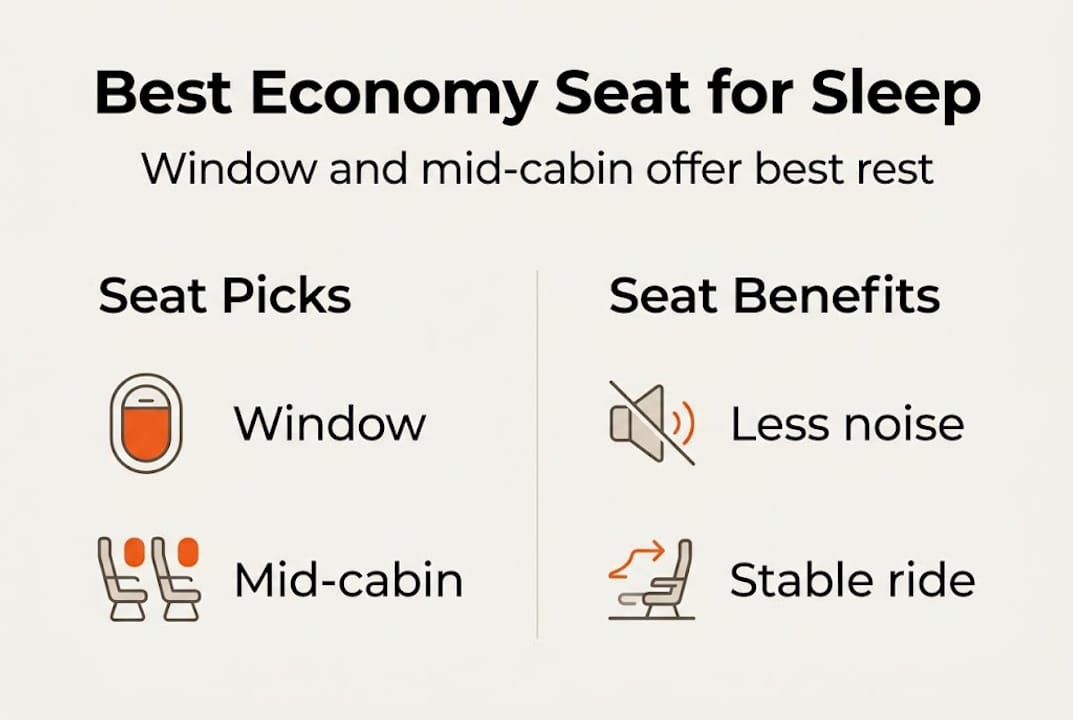
The wings are the aircraft’s center of gravity, so turbulence hits hardest at the front and tail. Sitting mid-cabin keeps the ride noticeably smoother. Pair that with a window seat, and you’re already ahead of most of your fellow passengers. For more space-smart seating tips, it’s worth planning this before your check-in window opens.
Seats to avoid for sleep:
-
Galley and lavatory rows: High foot traffic, constant noise, and bright lights every time a flight attendant moves through
-
Last few rows of the cabin: More engine noise, bumpier ride, seats that often don’t recline fully
-
Bulkhead or exit row seats: Extra legroom is tempting, but these spots can be colder and noisier and armrests are often fixed, limiting how much you can shift position
-
Middle seats: No wall, no escape ✈️
Seat comparison at a glance:
| Seat type | Pros | Cons |
|---|---|---|
| Window, mid-cabin | Wall support, less turbulence, quiet | Must climb over others |
| Aisle | Easy movement, legroom stretch | Light, cart noise, no wall |
| Bulkhead/exit row | Extra legroom | Fixed armrests, cold, noisier |
| Rear economy | Easy boarding | Bumpiest, loudest, may not recline |
Pro Tip: Use SeatGuru or your airline’s seat map to cross-check your row against galley and lavatory positions before booking. Spending two minutes on this can save you eight hours of misery. You’ll also find practical long-haul comfort tips that pair well with smart seat selection.
Economy sleep essentials: What to pack and wear
With your seat picked, be sure you pack tools that turn an economy spot into a sleep space. The right gear doesn’t have to be heavy or expensive. It just has to be the right stuff.
The Sleep Foundation recommends using an eye mask and earplugs with a noise reduction rating of 32 or higher, along with a neck pillow and layers to block light and noise while maintaining body alignment. Cabin environments fight against sleep at every angle: bright overhead lights, unpredictable noise spikes, and dry, recycled air that dehydrates you faster than you’d expect.
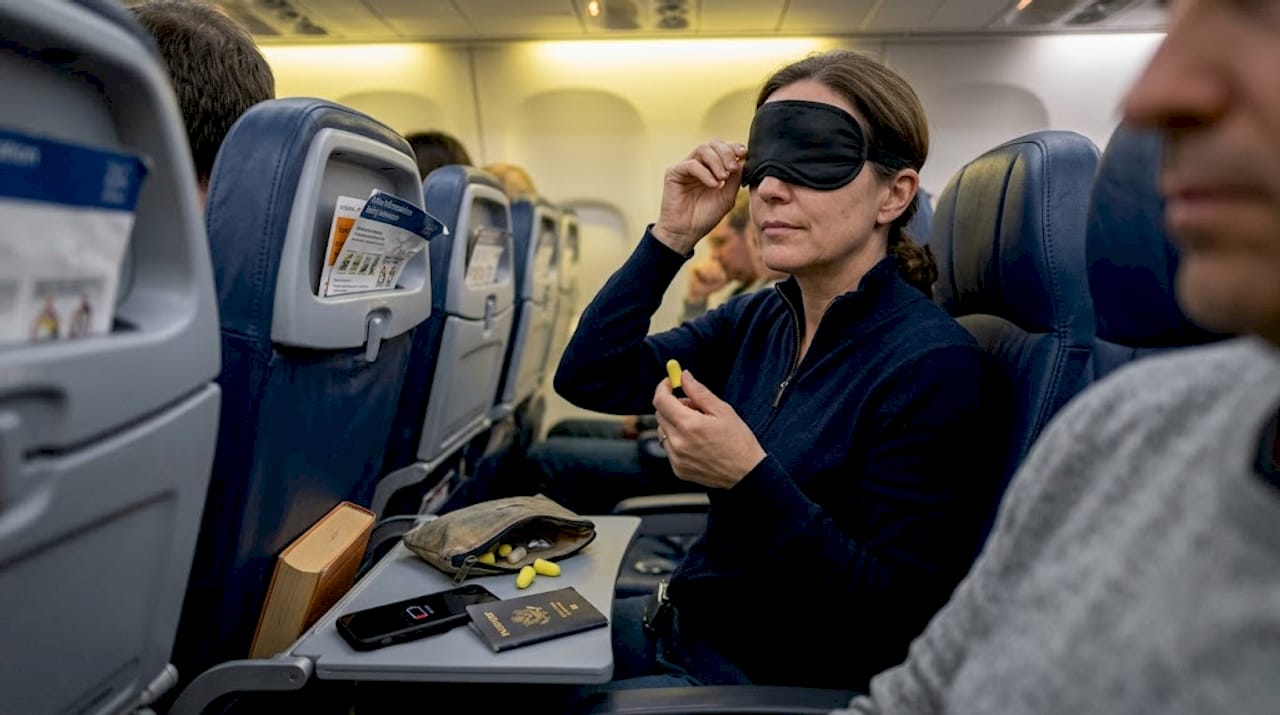
Layers matter more than most travelers realize. Cabin temperature drops significantly during overnight flights, and being cold is one of the fastest ways to interrupt light sleep. A light travel blanket or even a large scarf can double as lumbar support when rolled and placed behind your lower back. That small adjustment takes pressure off your spine and helps you settle into a more natural position.
Your economy sleep kit:
-
Neck pillow designed for upright sleep (not just neck wrapping)
-
Eye mask that fits flush without pressing on eyelids
-
Earplugs rated NRR 32+ or noise-canceling headphones for layered protection
-
Compression socks to support circulation during extended sitting
-
Layers or a packable blanket for warmth and lumbar support
-
Lip balm and nasal spray to combat cabin dryness
Browse recommended sleep accessories if you want to build out a kit that’s both effective and light. And if you’re still using whatever came in an airline amenity bag, it might be time to upgrade your travel gear before your next long haul.
| Item | Budget option | Better option |
|---|---|---|
| Neck pillow | Foam U-shape | Body-support upright pillow |
| Ear protection | Foam earplugs | NRR 32+ or noise-canceling |
| Eye mask | Basic fabric | Contoured, light-blocking |
| Warmth | Airline blanket | Packable travel blanket |
Pro Tip: Roll a thin hoodie into your neck pillow case or use a clothing-filled pillow. You save space, add firmness, and skip the extra bag.
Perfect your inflight routine: Reclining, positioning, and movement
Once your gear is ready, how you use your seat and position your body make all the difference. Having the right tools matters far less if your posture works against you for the entire flight.
Research shows that reclining to 100 to 140 degrees significantly improves sleep quality by reducing spinal pressure. Economy seats typically max out around 118 to 125 degrees, which is enough to help. Even a small recline shifts weight off your sit bones and onto your back, making your body much more willing to relax.
Positioning your neck correctly is just as critical. Sleeping with your neck flexed forward places serious strain on the cervical spine, and sleeping on the tray table amplifies that problem. Sitting upright without support increases alertness, while proper recline encourages drowsiness. The goal is a supported, neutral spine from your tailbone up through the base of your skull.
Step-by-step positioning routine:
-
Recline your seat as soon as the fasten seatbelt sign turns off
-
Place your neck pillow to support the back and sides of your head, not just the front
-
Roll your scarf or blanket into a lumbar support and wedge it into your lower back curve
-
Pull your knees slightly forward if you can, to reduce hip pressure
-
Use your window wall or headrest wings to let your head drift naturally sideways
-
Set a gentle timer every 60 to 90 minutes to shift position and do a brief ankle and leg stretch
For travelers curious about how to manage side sleeping, these side-sleeping tricks for basic economy are worth a read. And if you want to go deeper on upright sleep strategies, there’s strong evidence for why upright is actually more sustainable for long-haul rest than most travelers expect.
Moving every 60 to 90 minutes isn’t just about comfort. It’s about keeping circulation healthy and reducing your risk of deep vein thrombosis, especially on flights longer than six hours.
Pro Tip: Before you try to sleep, do a slow neck roll and five ankle circles on each side. It only takes 90 seconds, but it signals to your nervous system that it’s time to settle down, not stay alert.
Nutrition and sleep aids: When to eat, drink, and use melatonin
Fueling your body right and using science-backed sleep aids can make the difference on arrival. What you eat and drink in the hours before and during your flight has a bigger effect on your sleep quality than most people realize.
Cabin air at cruising altitude is extremely dry at 75 to 85 decibels of background noise and low humidity, which accelerates dehydration. Staying hydrated keeps your body comfortable enough to rest. Alcohol and caffeine are the two biggest sleep disruptors on planes. Both interfere with sleep architecture, and alcohol in particular causes more fragmented, lighter sleep even when it initially feels relaxing.
Light, easy meals timed at least two hours before your intended sleep window are your best bet. Heavy or spicy food raises core body temperature and triggers digestion, both of which are the opposite of what your body needs to drift off.
Key nutrition rules for inflight sleep:
-
Drink at least 250ml of water per hour of flight
-
Skip alcohol and caffeine for at least three hours before your sleep window
-
Choose light snacks over heavy meals if eating close to sleep time
-
Bring your own snacks so you’re not dependent on inflight service timing
-
Avoid salty snacks that amplify dehydration
On melatonin: the evidence is solid. A Cochrane review on melatonin found that 0.5 to 5mg taken at destination bedtime reduces jet lag with a number needed to treat of just 2 for travelers crossing five or more time zones, especially eastbound. At 5mg, sleep onset is faster and quality is better compared to 0.5mg. That’s meaningful. However, if you take epilepsy medications or warfarin, avoid melatonin without speaking to your doctor first, as interactions are real. For hydration and snack tips that pair with this approach, that guide covers practical meal timing in more detail.
📊 Stat callout: Travelers crossing five or more time zones have a 1-in-2 chance of benefiting from melatonin supplementation, based on clinical trial data. That’s not a placebo, that’s a tool.
Our take: The real trade-offs of sleeping in economy class
Now that you’ve seen the evidence-backed tactics, here’s the truth we’ve learned firsthand about sleeping in economy: even with perfect prep, economy sleep will not fully replicate a bed. And accepting that upfront is one of the most useful things you can do for your rest.
We’ve seen travelers exhaust themselves trying to chase uninterrupted eight-hour sleep in a 118-degree seat, and they arrive more frustrated than rested. The better mindset is to aim for three or four solid stretches of one to two hours each. That’s realistic. That’s achievable. And it makes a real difference when you land.
Personal experimentation matters too. What works brilliantly for one traveler, whether that’s melatonin at 5mg or a specific neck pillow position, might feel wrong for another body. Give yourself two or three flights to test and refine. Track what helped and what didn’t. Over time, you build a personal sleep ritual that becomes second nature.
Most guides won’t tell you this, but mental resistance to discomfort burns more energy than the discomfort itself. When you stop fighting the seat and start working with it, your whole body finally exhales. ❤️ Check out more real comfort strategies if you want to keep building that personal ritual.
Level up your inflight comfort with travel pillow solutions
Ready to put these strategies into action? The right travel pillow is your easiest upgrade. All the seat selection and positioning knowledge in the world lands better when you have gear that actually supports your body in an upright position.
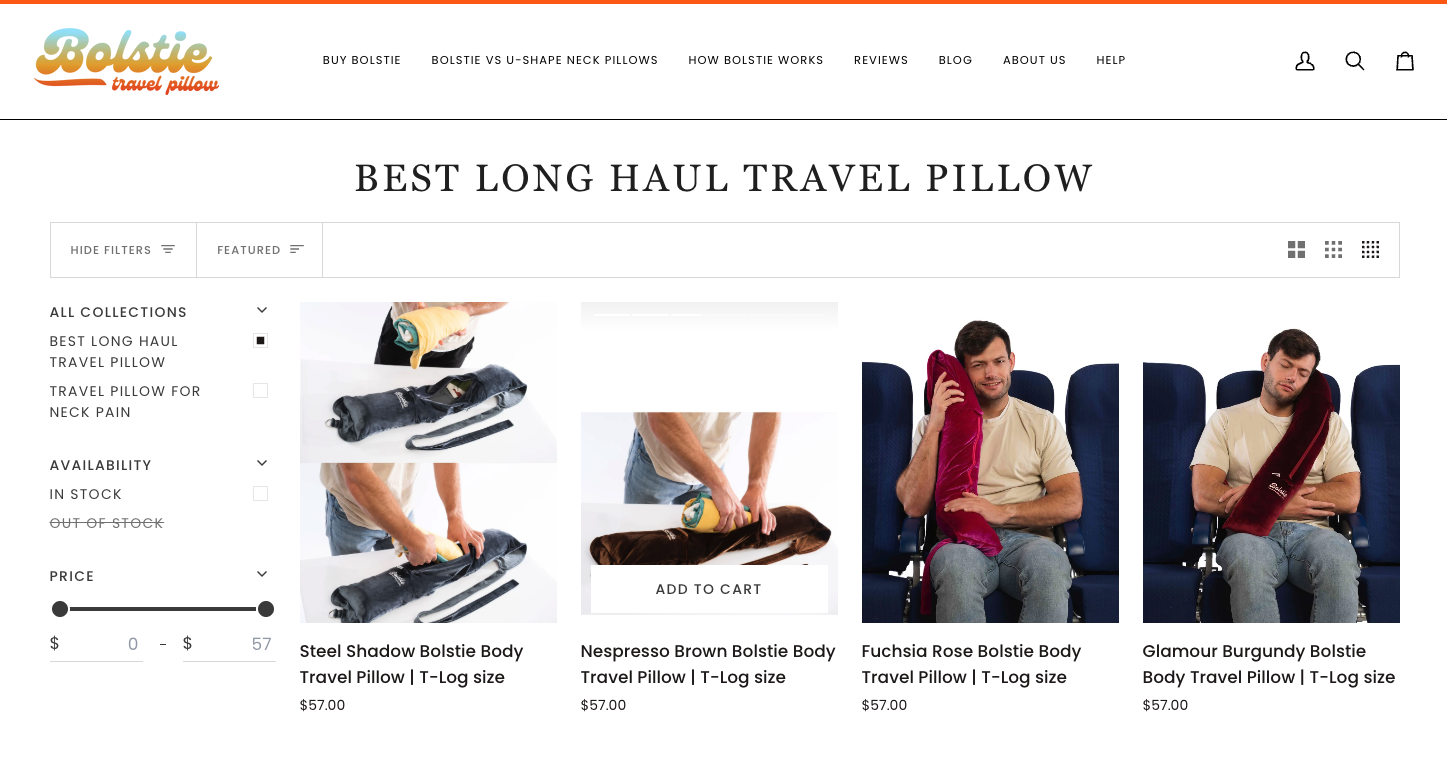
Bolstie Travel Pillow is built specifically for economy-class travelers who want real rest without adding bulk to their carry-on. It supports your head, jaw, chest, and upper torso together, working with your body’s natural diagonal resting position instead of just wrapping your neck. When it’s empty, it packs flat. When it’s filled with your clothes, it becomes a firm support pillow and a packing cylinder at once. Browse the best long-haul travel pillows to find your fit, or explore customizable travel pillows that adapt to your packing style. Your next long-haul flight doesn’t have to feel like an endurance test.
Frequently asked questions
Is it safe to sleep upright on long-haul flights?
Yes, sleeping upright is safe for most travelers as long as you support your neck properly and stretch regularly to keep circulation healthy and prevent stiffness from setting in.
What is the best seat for sleeping in economy class?
A window seat mid-cabin or over the wings is your best option because window seats over wings offer the least turbulence, a quieter environment, and a wall to support your head naturally.
How should I use melatonin for long-haul flights?
Take 0.5 to 5mg at your destination’s bedtime, especially for eastbound flights or crossings of five or more time zones. Melatonin at destination bedtime reduces jet lag effectively, but avoid it if you take epilepsy medications or warfarin.
What travel pillow works best for economy-class sleep?
A pillow that prevents forward head flexion and supports the neck in a neutral position is ideal. Look for options that allow lumbar and spine support so your whole torso stays aligned, not just your neck.
Why do I still feel tired after sleeping on a plane?
Economy sleep is rarely fully restorative because of interrupted cycles, fixed positioning, and environmental factors. Upright positioning increases alertness while cabin dryness and noise prevent the deep sleep stages your body really needs.
Recommended
-
How to Sleep Comfortably on Planes for Long Flights – BOLSTIE TRAVEL PILLOW
-
Space-smart tips for comfortable economy class sleep – BOLSTIE TRAVEL PILLOW
-
How to Sleep Comfortably While Traveling in Economy Class – BOLSTIE TRAVEL PILLOW
-
How I Sleep on My Side in a Plane Seat, Even in Basic Economy – BOLSTIE TRAVEL PILLOW

