

TL;DR:
Proper ergonomic support and posture adjustments can significantly improve sleep quality during long flights.
Essential items include lumbar support, neck support, eye mask, and noise-canceling earbuds for upright sleeping.
Flexibility and body awareness are key, as no single setup suits everyone, and habits impact comfort and recovery.
Most travelers step off a long-haul flight feeling like they aged five years in a single night. Stiff neck, aching lower back, that foggy exhaustion that no amount of coffee fixes. Sound familiar? ✈️ Sleeping upright in economy-class is genuinely hard, and most of the solutions out there are either too bulky to pack or too flimsy to actually help. This guide walks you through a compact, practical workflow, built on real ergonomic insight, that helps you rest better without hauling extra gear. From what to bring to how to position yourself, we cover every step so your next long flight feels a whole lot more human.
Table of Contents
Key Takeaways
| Point | Details |
|---|---|
| Compact support is key | A rolled-up sweater , hoodie, or stuffable travel pillow can make all the difference for upright sleep posture. |
| Change your position often | Alternate sitting positions every 30–45 minutes to prevent discomfort and stiffness. |
| Avoid common mistakes | Don’t lean on the tray table or stay rigid—listen to your body for a safer, more restful flight. |
| Evaluate your workflow | After landing, check for less soreness as a sign you’ve found the right setup for you. |
What you need for upright sleep success
After understanding the common struggle, it helps to know exactly what to bring, or use on hand, to make your upright sleep possible. The good news? You probably already have most of it.
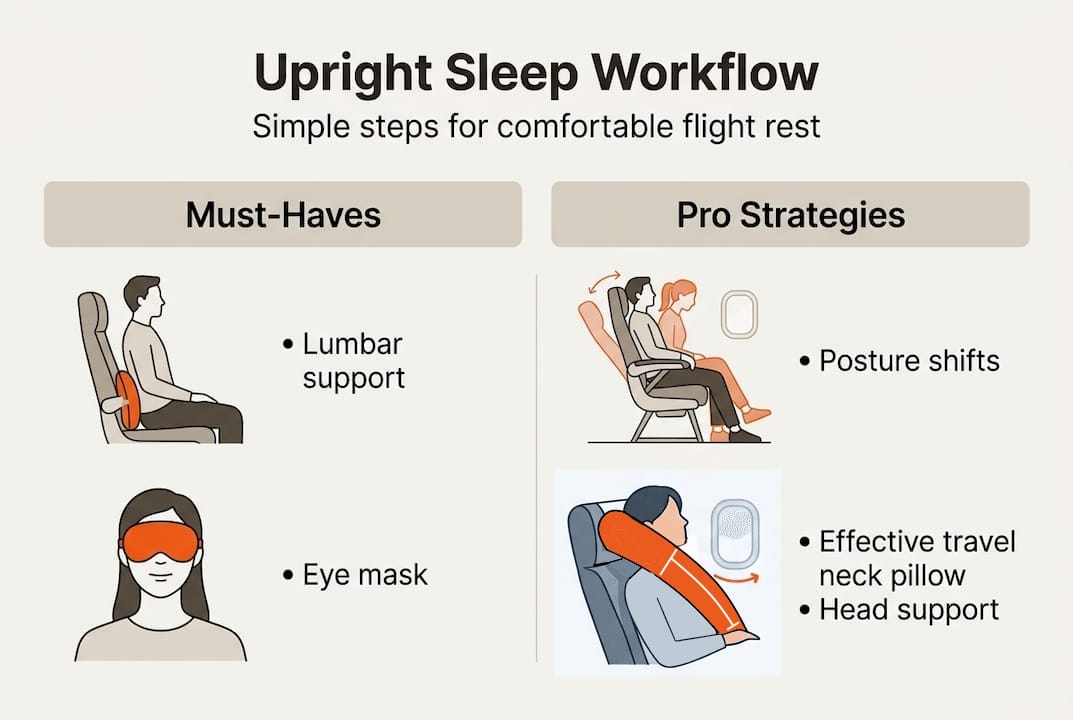
Here are the essentials and nice-to-haves for your upright sleep kit:
-
Compact lumbar support: A rolled-up hoodie, jacket, or small clothing bundle tucked behind your lower back works surprisingly well. Compact lumbar support using rolled clothing maintains spine curve and reduces pressure when sleeping upright. That’s not a small thing on a 12-hour flight.
-
Neck or head support: A roll ed up sweater, hoodie, or, a stuffable travel pillow can cradle your head without the bulk. Check out these upright sleeping essentials if you want a fuller breakdown.
-
Eye mask: Blocking cabin light is one of the fastest ways to signal your brain that it’s time to rest. Don’t skip this one.
-
Earplugs or noise-canceling earbuds: Ambient engine noise sits around 85 decibels. That’s loud enough to disrupt sleep cycles without you even realizing it.
-
Compression socks: Optional but genuinely helpful on flights over eight hours. They reduce swelling and keep circulation moving while you’re stationary. Another option is to use your backback to raise your legs for better circulation.
-
Hydration bottle: Cabin air is extremely dry, often below 20% humidity. Staying hydrated keeps muscles from cramping and helps your body recover during rest.
Here’s a quick comparison of what’s essential versus what’s a bonus:
| Item | Must-have | Nice-to-have |
|---|---|---|
| Rolled clothing (lumbar) | ✓ | |
| Eye mask | ✓ | |
| Earplugs or earbuds | ✓ | |
| Sweater or jacket (neck) | ✓ | |
| Compression socks or backpack | ✓ | |
| Hydration bottle | ✓ | |
| Stuffable travel pillow | ✓ |
One thing worth noting: improvised items often outperform dedicated travel gear because you can adjust their size and firmness on the fly. A jacket rolled tighter gives more support. Looser gives a softer feel. That flexibility matters. If you’re curious about smarter packing approaches, packing a cylinder pillow is a clever way to combine your support gear with your carry-on clothing.
Step-by-step upright sleep positions for long-haul flights
With the right items ready, it’s time to use them correctly. Follow these step-by-step positions for best results.
-
Set up your seat before takeoff. Recline slightly if the person behind you has space. Even a small angle shift helps. Place your lumbar roll between your lower back and the seat back before you sit down fully.
-
Position your lumbar support. It should sit at the curve of your lower back, not your mid-back or tailbone. You want your spine to feel gently supported, not pushed forward.
-
Prepare your neck support. If you have a window seat, fold your scarf or jacket and place it between your head and the window. This is the best passive support available in economy. If you’re in a center or aisle seat, a compact pillow that supports the side of your head works better.
-
Adjust your posture. Feet flat on the floor. Knees at roughly a 90-degree angle. Shoulders relaxed, not hunched. Chin slightly tucked, not dropped to your chest.
-
Put on your eye mask and earplugs. Do this before you feel tired. Waiting until you’re already restless makes it harder to settle.
-
Set a posture timer. This is the step most people skip. Alternate postures every 30 to 45 minutes to prevent strain. The optimal resting angle is 100 to 120 degrees from vertical, but most economy seats allow only 5 to 19 degrees of recline. Working with that reality, not against it, is what makes the difference.
Pro Tip: Set a gentle phone alarm or use a sleep app with a posture reminder. Even a small shift every 30 minutes dramatically reduces the stiffness you feel on landing.
Here’s how seat position affects your sleep quality:
| Seat type | Head support | Lumbar support | Overall sleep ease |
|---|---|---|---|
| Window | Best (wall lean) | Good | High |
| Aisle | None | Good | Medium |
| Center | None | Good | Low to medium |
For more detail on how to sleep comfortably on planes, including specific positions for different body types, we’ve put together a full guide. And if you want a deeper look at posture mechanics, the upright sleep support guide covers the body-geometry side in plain language.
Mistakes to avoid when sleeping upright
While following the method works well, it’s equally important to steer clear of classic mistakes that ruin good sleep and worsen soreness.
Here are the most common errors travelers make:
-
Leaning forward onto the tray table. This feels restful at first, but leaning forward increases spinal pressure and can pinch nerves. It’s one of the leading causes of mid-flight back pain.
-
Staying in one position for the entire flight. Static posture causes muscle fatigue faster than movement does. Your body needs micro-adjustments to stay comfortable.
-
Overpacking your seat area with bulky gear. If you can’t move freely, you can’t shift positions. Keep your footwell clear and your support items minimal.
-
Ignoring early warning signs. Tingling in your legs, numbness in your lower back, or a pins-and-needles feeling in your arms are all signals. Don’t push through them. Shift, stretch, and reset.
-
Skipping hydration. Dehydrated muscles cramp more easily and recover more slowly. Drink water consistently, not just when you feel thirsty.
Pro Tip: Every 45 minutes, do a quiet ankle rotation, 10 circles in each direction. It takes 20 seconds and noticeably improves circulation on longer flights.
“The biggest mistake isn’t the wrong pillow. It’s the wrong habit. Staying still for hours in a cramped seat is what breaks your body down, not economy class itself.”
For a broader look at staying comfortable from boarding to landing, these long flight comfort tips are worth a read. And if neck pain is your main concern, understanding how to avoid mid-flight neck pain starts with posture awareness, not just gear.
How to know your upright sleep workflow is working
Once you’ve put the workflow to the test, here’s how to make sure it’s actually helping you sleep and recover better on long-haul flights.
Here’s a simple self-check list to run after your next flight:
-
Less soreness on landing. If you feel noticeably less achy than past flights, your support setup is doing its job. Signs of reduced muscle strain emerge from maintaining proper lumbar support and making regular posture changes.
-
Easier to fall back asleep after wake-ups. If you can drift off again within a few minutes of waking mid-flight, your environment is working for you.
-
Stiffness resolves quickly after standing. Minor stiffness that disappears within 10 to 15 minutes of walking around post-flight is normal and manageable. Stiffness that lingers for hours means something needs adjusting.
-
You feel more mentally alert on arrival. Better physical rest translates directly to sharper thinking. If your brain feels clearer than usual, that’s a strong signal.
-
You’re not dreading the return flight. This one sounds small, but it matters. A workflow that actually helps changes your whole relationship with long-haul travel. ❤️
Stat to keep in mind: Sitting upright increases spine pressure by roughly 50% compared to standing. That’s why proper lumbar support isn’t optional. It’s the foundation of everything else.
For a deeper look at the upright sleep benefits beyond just comfort, including recovery and jet lag reduction, we’ve written a full breakdown. You can also follow a traveler comfort step-by-step guide to refine your approach flight by flight. And for managing the post-flight recovery side, these jet lag prevention tips offer some practical strategies worth bookmarking.

A fresh take: Why the perfect upright sleep workflow may not exist, and that’s fine
Here’s something most travel guides won’t tell you: there is no perfect formula. I’ve read the research, tested the positions, and talked to frequent flyers who log more air miles in a month than most people do in a year. The honest truth? Everyone’s body responds differently to the same setup.
Expert consensus says to vary your posture and adapt strategies to what works for your body, because no single position suits everyone. That’s not a cop-out. That’s actually the most useful advice available. The workflow in this guide is a starting framework, not a rigid prescription.
Recline if you can and if it’s considerate of the person behind you. The etiquette debate around reclining is real, but so is your need to rest. Find the balance that works for your situation. Even sleep routines for pilots on long-haul routes involve constant adaptation, not a fixed protocol.
The travelers who sleep best on planes aren’t the ones with the fanciest gear. They’re the ones who pay attention to their bodies, adjust early, and stay flexible. Trial and error matters more than any single accessory. Give yourself a few flights to find your rhythm.
Take your upright sleep workflow further
If you’ve worked through this guide and you’re ready to take things a step further, the right gear can make a real difference without adding bulk to your bag. ✈️
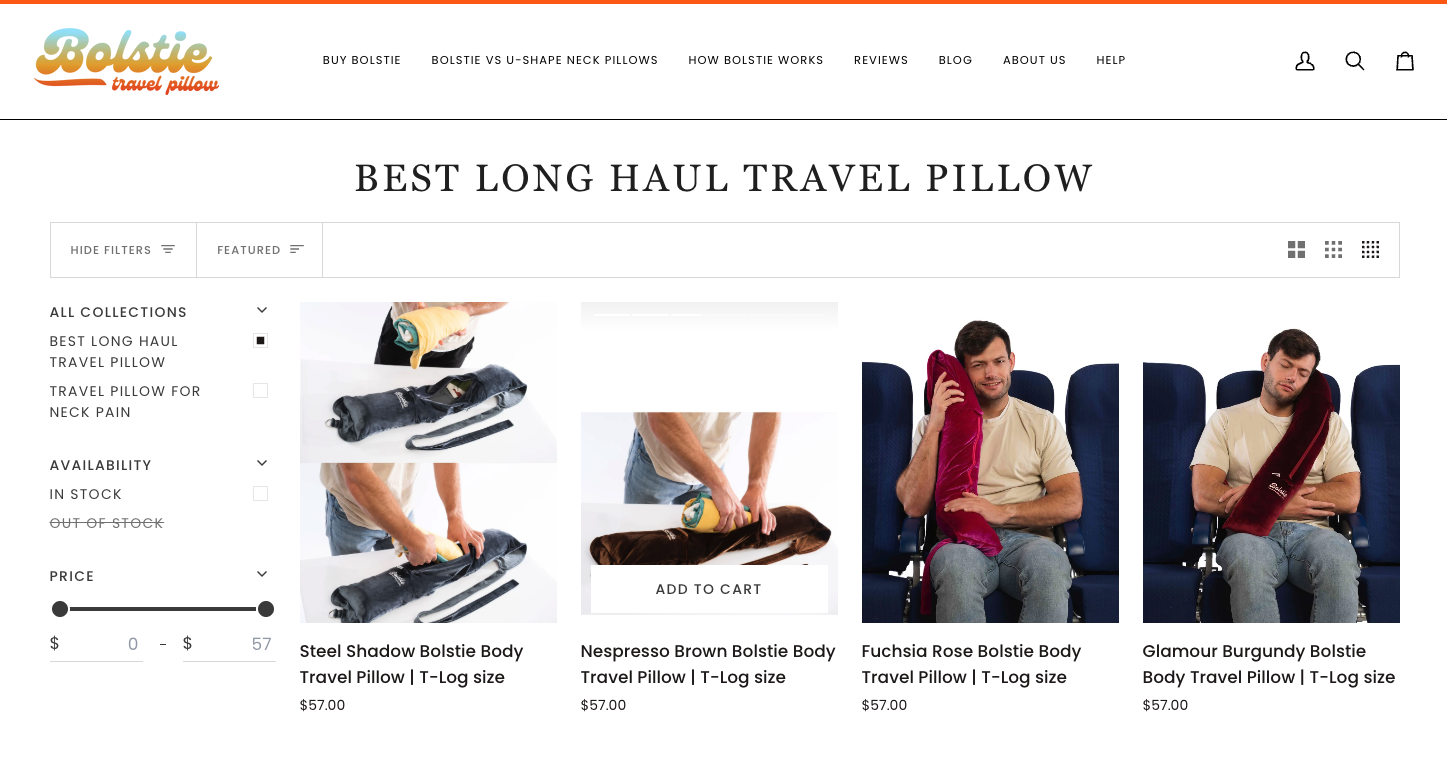
At Bolstie, we designed our travel pillow specifically for upright sleep in economy. It supports your head, jaw, chest, and upper torso together, working with your body’s natural diagonal resting position instead of fighting it. When it’s empty, it packs down small. When it’s filled with your clothing, it becomes a firm, structured support pillow that also doubles as a packing cylinder. Less gear, better rest. If you’re looking for the best long-haul travel pillow for economy-class sleep, or want to explore upright sleeping strategies in more depth, we’ve got you covered.
Frequently asked questions
How can I avoid neck and back pain when sleeping upright on a plane?
Use rolled clothing or a compact pillow for lumbar support and adjust your position every 30 to 45 minutes to reduce pressure and strain throughout the flight.
Is it safe to sleep leaning forward onto the tray table?
No. Leaning forward increases spine pressure and can pinch nerves, so it’s better to keep your back supported against the seat and avoid the tray table entirely.
Does a window seat really help with upright sleep?
Yes. A window seat lets you use the cabin wall for passive head support, which improves comfort significantly without needing any extra gear or a bulky pillow.
How do I know if my upright sleep routine is effective?
You should feel less sore on landing and find it easier to fall back asleep mid-flight. Improved comfort signs include less muscle stiffness and faster recovery after you land.
Recommended
-
Upright sleep support guide: rest easy in economy class – BOLSTIE TRAVEL PILLOW
-
Benefits of upright sleep on flights for economy travelers – BOLSTIE TRAVEL PILLOW
-
Step by step traveler comfort guide for long flights – BOLSTIE TRAVEL PILLOW
-
Benefits of upright sleeping on planes for economy class – BOLSTIE TRAVEL PILLOW
-
Les pilotes peuvent-ils dormir pendant les vols longs courriers ?

