

TL;DR:
- Traditional neck pillows often fail because their shapes do not match the body’s upright sitting position in economy seats. They can cause neck strain, discomfort, and heat buildup due to poor design and support targeting only the neck. Better alternatives focus on full upper-body support, support for seated posture, and packability to improve long-haul comfort.
Despite millions of neck pillows sold every year, most economy travelers still wake up stiff, sore, and wondering why they bothered. It’s not user error. It’s not bad luck. The problem runs deeper, right into the shape of the pillow itself and how poorly it matches the human body in an upright airplane seat. In this guide, we break down exactly why traditional neck pillows let you down, what the research actually says about pillow design, and what genuinely works for long-haul comfort. If you’ve ever landed after a red-eye feeling worse than when you boarded, this one’s for you. ✈️
Table of Contents
-
Design pitfalls: How traditional pillows miss the mark for travelers
-
Smarter alternatives: What actually works for long-haul comfort
-
What most travel ‘comfort’ guides get wrong about neck pillows
Key Takeaways
| Point | Details |
|---|---|
| Shape mismatch matters | Traditional U-shaped pillows often increase neck strain because they don’t fit upright seating on planes. |
| Function beats popularity | Choosing travel pillows based on research-proven support is more effective than buying trendy options. |
| Features for true comfort | Look for travel pillows offering flexibility, stability, and space-saving design to improve rest on long-haul flights. |
| Upgrade for better sleep | Alternatives like neck-free or body-support pillows are proven to significantly reduce discomfort and improve sleep quality. |
Common complaints: The real reasons neck pillows don’t work
Let’s be honest. Most of us have been there. You buy the neck pillow at the airport, strap it on, and settle in for a long flight. Two hours later, your head is drooping forward, your neck is aching, and the pillow has slipped sideways. Sound familiar?
You’re not alone. Most travelers experience persistent neck soreness even after using a neck pillow throughout their flight. That’s a staggering reality when you consider how many people invest in these products hoping for real relief.
“Despite widespread use of travel neck pillows, persistent neck soreness remains one of the most common complaints among economy-class passengers.”
The frustration is real, and it shows up in the same patterns over and over. Here’s what travelers most often report:
-
The pillow slips constantly. It shifts to one side, forcing the neck into an awkward angle instead of holding it steady.
-
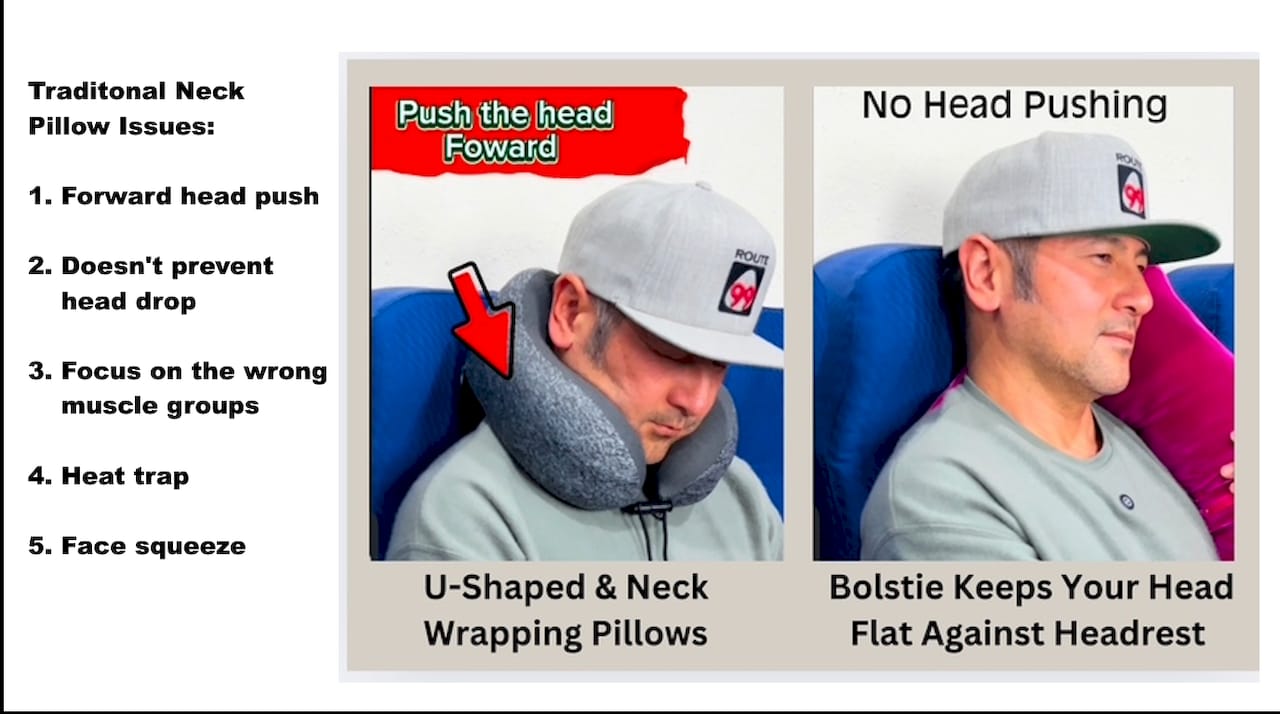
It pushes the head forward. U-shaped pillows tend to prop the head up and forward, creating tension rather than releasing it.
-
It’s too bulky to pack. Foam pillows take up half a carry-on and barely compress, which is a real problem when you’re watching your luggage space.
-
It traps heat. Wrapped around the neck, these pillows block airflow and make long flights feel stuffy and uncomfortable.
-
It only targets the neck. The neck doesn’t operate in isolation. When the rest of your upper body isn’t supported, the neck has to work overtime.
The deeper issue is that neck-only pillow discomfort is almost inevitable when the design ignores the rest of the body. The neck is connected to your shoulders, jaw, and chest. Isolating it with a ring-shaped cushion while the rest of you slumps is a recipe for tension, not rest.
Research into neck muscle activity during sleep confirms what travelers already feel: certain pillow shapes actively increase the muscular effort required to hold the head upright. That’s the opposite of what a pillow should do.
The complaints aren’t random. They’re a direct result of products designed without enough attention to how the human body actually sits, tilts, and rests in an economy seat.
The science: Why neck pillows fail in real life
Now that we know what travelers are feeling, let’s see what science and research actually reveal about these ineffective designs.
A key finding from published research is that pillow shape mismatch increases neck muscle activity, and cylindrical or U-shaped pillows are less optimal for upright positions compared to rectangular designs. In plain terms: the shape of your pillow changes how hard your neck muscles have to work. And for most travel pillows, that means more work, not less.
Here’s a simple comparison of how common pillow shapes perform in upright seating:
| Pillow shape | Neck muscle support | Comfort in upright seat | Portability |
|---|---|---|---|
| U-shaped (foam) | Low | Poor | Bulky |
| Cylindrical (inflatable) | Low to moderate | Poor to fair | Moderate |
| Rectangular (flat) | Moderate to high | Fair to good | Good |
| Body-support design | High | Good to excellent | Excellent |
The data tells a clear story. The shapes that dominate airport shelves are actually the least effective for the way we sit on planes. Economy seats don’t recline enough to make a U-shaped pillow work properly. They’re designed for a more supine, lying-down position. But in economy, you’re mostly upright, and that changes everything.
When your seat is only slightly reclined, a U-shaped pillow pushes your head forward and off-center. Your neck muscles then have to compensate, contracting to hold your head from falling. That’s fatigue, not rest.
Pro Tip: Before buying any travel pillow, sit upright in a chair at home and test it. If your chin drops forward or your head tilts to one side within a few minutes, that pillow won’t work on a plane either.
This is exactly why neck-based travel pillows often disappoint frequent flyers. The design logic made sense on paper but ignored the reality of upright seating. And if you’re still on the fence, reading up on why you should avoid traditional neck pillows can save you from another wasted purchase.
The biomechanics of pillow shapes matter more than marketing language. Softness, color, and brand name are irrelevant if the shape is working against your body.
Design pitfalls: How traditional pillows miss the mark for travelers
Building on the disappointing science, let’s break down exactly where these products fall short in real travel situations.
It’s not just about shape. Traditional neck pillows have a collection of design flaws that compound each other, especially in the context of economy travel. Here’s a quick comparison:
| Feature | Traditional neck pillow | Travel-optimized design |
|---|---|---|
| Support area | Neck only | Head, jaw, chest, upper torso |
| Packing size | Large and bulky | Compresses small |
| Heat management | Traps heat | Allows airflow |
| Seat compatibility | Reclined positions | Upright economy seats |
| Dual function | Pillow only | Pillow and packing organizer |
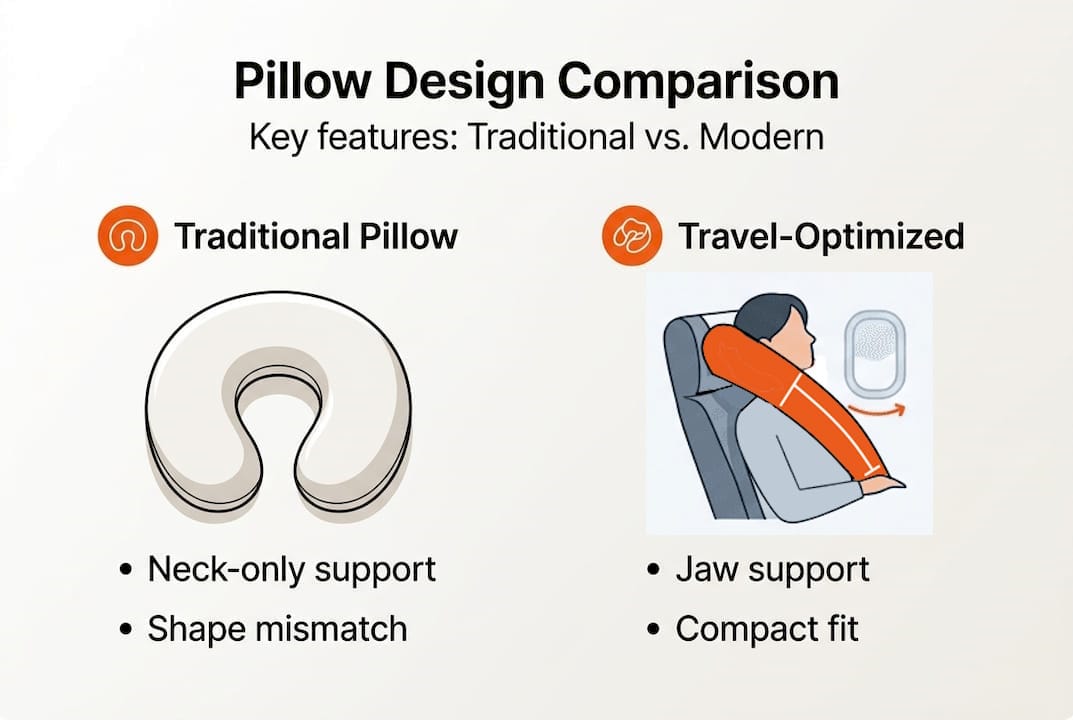
Research confirms that certain pillow designs actively increase muscle tension and discomfort when used in upright seating. That’s not a minor flaw. That’s a fundamental design failure for a product sold specifically to travelers.
Here are the top ergonomic mistakes to avoid when choosing a travel pillow:
-
Choosing a pillow designed for lying down. Most pillows are tested flat, not upright. Economy seats are upright. The mismatch is immediate.
-
Prioritizing softness over structure. A pillow that feels plush in the store will collapse under the weight of your head at 35,000 feet.
-
Ignoring the jaw and chest connection. The neck doesn’t hold itself up alone. Without support below and around it, neck muscles stay tense.
-
Buying bulky foam pillows for carry-on travel. If it takes up a third of your bag, you’ll resent it before you even board.
-
Overlooking airflow. A pillow that wraps around the neck traps heat, which disrupts sleep and adds physical discomfort over long flights.
The neck pillow vs body support debate really comes down to this: are you treating the symptom or the cause? And the evidence that travel pillows cause neck pain when poorly designed is hard to ignore once you’ve seen it.
Airplane seats make all of this worse. The narrow seat back, the limited recline, and the armrest competition mean your body is already fighting for position. A pillow that adds bulk or forces an unnatural angle just adds to the battle.
Smarter alternatives: What actually works for long-haul comfort
So, with all the common pitfalls in mind, what should you actually look for to arrive refreshed after a long-haul flight?
The answer isn’t a fancier version of the same old U-shape. It’s a fundamentally different approach to how your body rests upright. Here’s what to look for:
-
Full upper-body support. A good travel pillow stabilizes the head, jaw, and chest together, not just the neck in isolation.
-
Upright-seat geometry. It should be designed and tested specifically for the angle of economy seating, not for lying flat.
-
Packability. It should compress small enough to fit easily in your carry-on without sacrificing structure when in use.
-
Airflow-friendly design. It should not wrap tightly around the neck. Open designs reduce heat buildup and feel more natural over long periods.
-
Dual functionality. Bonus points for a pillow that doubles as a packing organizer, saving you space and baggage fees.
Research-backed features can significantly reduce neck fatigue and improve sleep quality for travelers. That’s not a marketing claim. It’s a measurable outcome when the design actually fits the body’s needs in an upright seat.
Exploring neck-free travel pillow benefits is a great starting point if you want to understand what a body-first design actually delivers. And if you want a thorough breakdown before your next trip, the pillow health guide covers the specifics in detail.
Pro Tip: When shopping online, look for pillows that explicitly describe support for the chest and jaw, not just the neck. If the product description only mentions neck support, it’s likely the same old design in a new package.
The goal is simple: you want to land feeling rested, not wrecked. That means auditing your travel gear with honest eyes and asking whether it’s actually built for the way you sit on a plane. ❤️
What most travel ‘comfort’ guides get wrong about neck pillows
Here’s something most travel content won’t tell you: the reason so many travelers keep buying disappointing neck pillows isn’t ignorance. It’s that the market rewards novelty over function. A pillow with memory foam, a cooling cover, and a carry clip looks great in a product photo. But if the shape is wrong for upright seating, none of those features matter.
Most guides also skip the biomechanics entirely. They compare softness, price, and packability without ever asking whether the pillow shape actually reduces neck muscle activity in an economy seat. That’s the one question that actually predicts whether you’ll sleep or suffer.
The mindset shift we’d encourage is this: stop evaluating travel pillows by how they feel in your hands and start evaluating them by how they perform when you’re upright, slightly reclined, and three hours into a flight. That’s the real test.
If you want to understand why fixing neck support on planes requires rethinking the whole approach, not just swapping one pillow for another, that’s where the real comfort gains live.
Ready for real travel comfort? Upgrading your journey
Armed with better insights, choosing the right pillow for your next flight is the final step towards genuine comfort.
At Bolstie Travel Pillow, we built our products specifically around the problems this guide covers. No neck wrapping. No forward head push. Just clean, body-first support that works with your natural resting position in an upright economy seat.
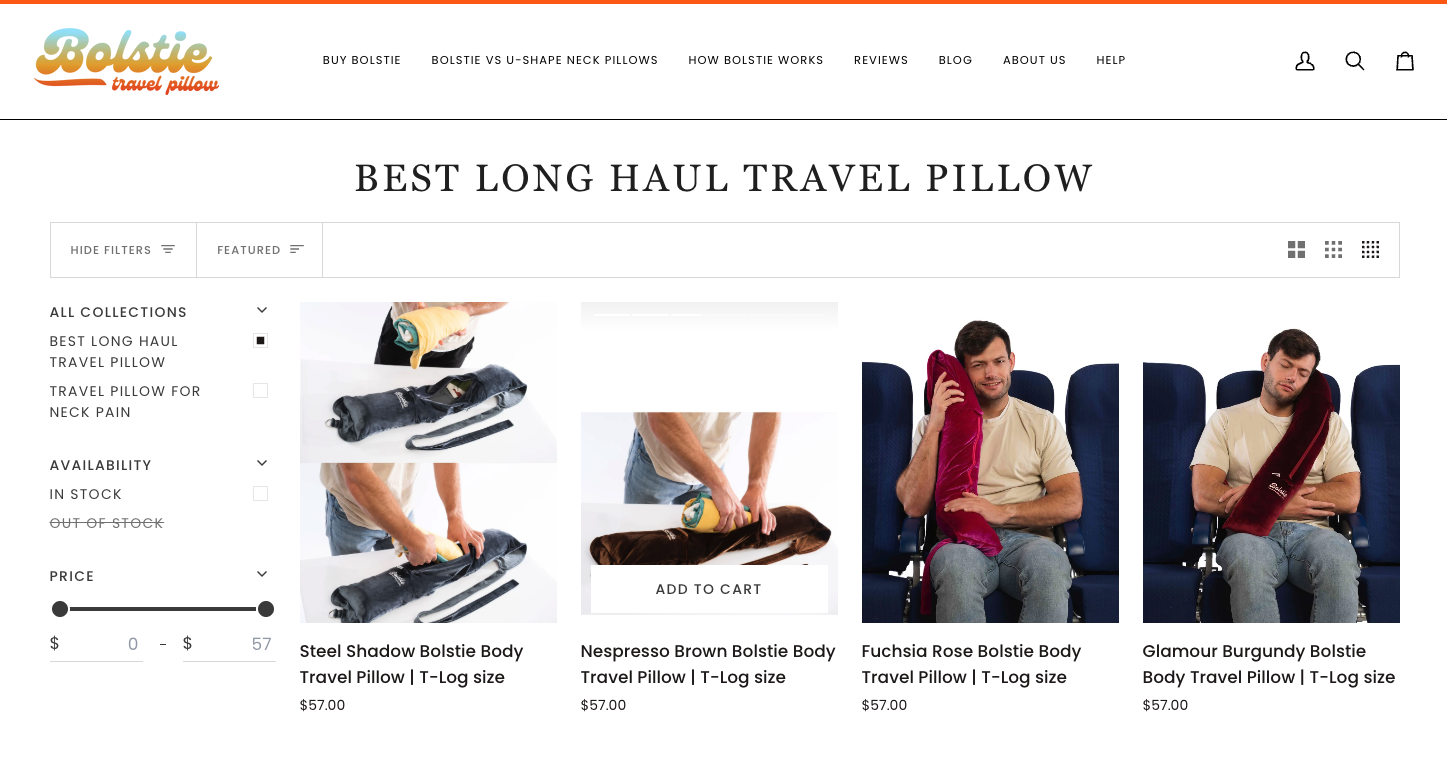
Our best long haul travel pillow collection is designed to compress small, support big, and double as a packing cylinder so you travel lighter without sacrificing rest. If you want to start with a fan favorite, the Nespresso Brown Bolstie is a great place to begin. Your next flight doesn’t have to end in stiffness. ✈️
Frequently asked questions
Why do most neck pillows fail to prevent neck pain on planes?
Most neck pillows fail because their shape does not match the sitting posture in airplane seats, increasing neck muscle strain instead of reducing it. The U-shape works better lying flat, not upright in economy.
Are there any travel pillows proven to reduce neck strain for long flights?
Yes, research shows that neck-free and body-support travel pillows can reduce neck strain by 60%, improving sleep quality on flights compared to traditional designs.
What features should I look for in a comfortable travel pillow?
Look for support that stabilizes the neck without pushing it forward, a design built for upright seating, and a compact size that fits easily in your carry-on without bulk.
Can traditional neck pillows actually worsen neck discomfort?
Yes, poorly shaped pillows can increase neck muscle activity and worsen discomfort during long-haul flights, especially in the upright positions typical of economy seating.
Recommended
-
Why neck support fails on planes and how to fix it in 2026 – BOLSTIE TRAVEL PILLOW
-
Why Avoid Neck-Only Pillows for Travel Comfort – BOLSTIE TRAVEL PILLOW
-
Travel pillow design trends 2026: Up to 50% better comfort – BOLSTIE TRAVEL PILLOW
-
Why Neck Pillows Fail – Impact on Travel Comfort – BOLSTIE TRAVEL PILLOW

