

You bought the neck pillow. You were excited. You boarded your eight-hour flight, wrapped it around your neck, closed your eyes, and waited for sleep to arrive. Then, somewhere over the Atlantic, you woke up with a stiff neck, a sore back, and the distinct feeling that your whole body had been slowly folding in on itself for hours. Sound familiar? Here’s the thing: neck pillows and body support pillows solve completely different problems. Most travelers don’t realize that until they’re already mid-flight and miserable. This guide breaks down exactly what each pillow type does, where each one shines, and how to pick the right one for your actual flying style. ✈️
Table of Contents
-
Understanding neck pillows: Design, strengths, and limitations
-
Side-by-side: Key differences between neck pillow and body support
Key Takeaways
| Point | Details |
|---|---|
| Neck vs body support | Neck pillows excel in portability but can’t prevent head drop and full-body slump, especially on long flights. |
| Body pillow advantages | Body support pillows stabilize your head, shoulders, and torso , making them better for restful posture on extended journeys. |
| Suitcase strategy | Choose your travel pillow based on your sleep style, trip length, and comfort priorities rather than just price or trends. |
| Expert pick | Side and window seat sleepers fare best with body support, while upright short-trip travelers can use lightweight neck options. |
Understanding neck pillows: Design, strengths, and limitations
Now that we’ve set the stage for why not every pillow solves your travel woes, let’s look closer at the quintessential neck pillow.
Neck pillows are the most recognized travel accessory on the market. Walk through any airport and you’ll spot them looped around carry-on handles or already wrapped around someone’s neck at the gate. They’re popular for a reason. But popularity doesn’t always mean the right fit for you.
At their core, neck pillows are U-shaped or wrap designs focused on cradling the head and preventing lateral drop (when your head tilts sideways) or forward drop (when your chin falls to your chest) in upright positions. That’s the job. Nothing more, nothing less.
What neck pillows do well:
-
Lightweight and easy to pack or clip to a bag
-
Widely available and affordable across many price points
-
Works as a regular head pillow if the seat reclines
Expert tests show neck pillows like the Cabeau S3 and Trtl provide reliable neck alignment in economy class. They do share the same problems and challenges as u-shape pillows because the all do the same wrong action…they all wrap around your neck.
But here’s where it gets honest. Neck pillows don’t support your head, torso, shoulders, or chest. So if your body starts to slump forward or sideways from fatigue, the neck pillow can’t stop that. It’s holding your head up while the rest of you slowly collapses. That’s a real limitation on flights over four hours.
They also tend to trap heat around the neck, which gets uncomfortable fast. And if you’re a side sleeper or prefer to lean against the window, a standard U-shape often works against your natural position rather than with it.
“The best pillow is the one that matches how your body actually wants to rest, not the one with the best marketing.”
Pro Tip: If you’re exploring neck pillow options, look for designs that don’t squeeze the throat or force your chin down. Airflow and jaw clearance matter more than most people think on long flights.
For tips on sleeping comfortably in economy, pairing any pillow with a good seat position strategy makes a real difference. And if you want a broader look at what’s currently available, top-rated travel pillows cover a wide range of styles worth comparing.
What body support pillows do differently
While neck pillows offer obvious convenience, let’s look at how body support pillows attempt to solve a different and often overlooked problem for economy flyers.
Body support pillows provide torso, shoulder, and upper body stabilization, supporting natural diagonal rest and preventing overall slump in economy seats. That’s a fundamentally different design goal. Instead of just catching your head, they anchor your whole upper body so you don’t fold forward or sideways as fatigue sets in.

Think about what actually happens on a long flight. Your neck gets tired. Then your shoulders drop. Then your chest follows. By hour five, you’re practically horizontal in a seat that won’t recline. A neck pillow can’t fix that cascade. A body support pillow addresses it from the start.
What body support pillows do well:
-
Stabilize the chest, shoulders, and upper torso together
-
Help maintain a natural diagonal resting angle without forcing an unnatural posture
-
Reduce muscle tension across the full upper body, not just the neck
-
Work especially well for window seat travelers who lean against the cabin wall
-
Support longer, more restful sleep on flights over five hours
Pro Tip: If you tend to wake up mid-flight with a sore upper back rather than just a stiff neck, that’s your body telling you it needs torso support, not just neck alignment. Understanding the difference between neck vs body support in flight can genuinely change how you feel when you land.
Body support pillows can be bulkier than a standard neck pillow. That’s a real trade-off. But smart designs, like those that double as packing cylinders when filled with clothing, solve the space problem while adding functional value to your carry-on. For more practical upright sleep support tips, pairing the right pillow with a window seat strategy makes a noticeable difference. You can also review travel pillow selection advice to see how body support fits into a broader comfort plan.
Side-by-side: Key differences between neck pillow and body support
So, with both types explained, how exactly do they stack up head-to-head? This side-by-side makes your decision clearer.
Neck pillows excel in portability and quick upright neck alignment but limit torso support, leading to fatigue on long flights. Meanwhile, body support offers longer comfort for long-haul but may be bulkier, and is better for preventing forward collapse via shoulder and chest anchoring.
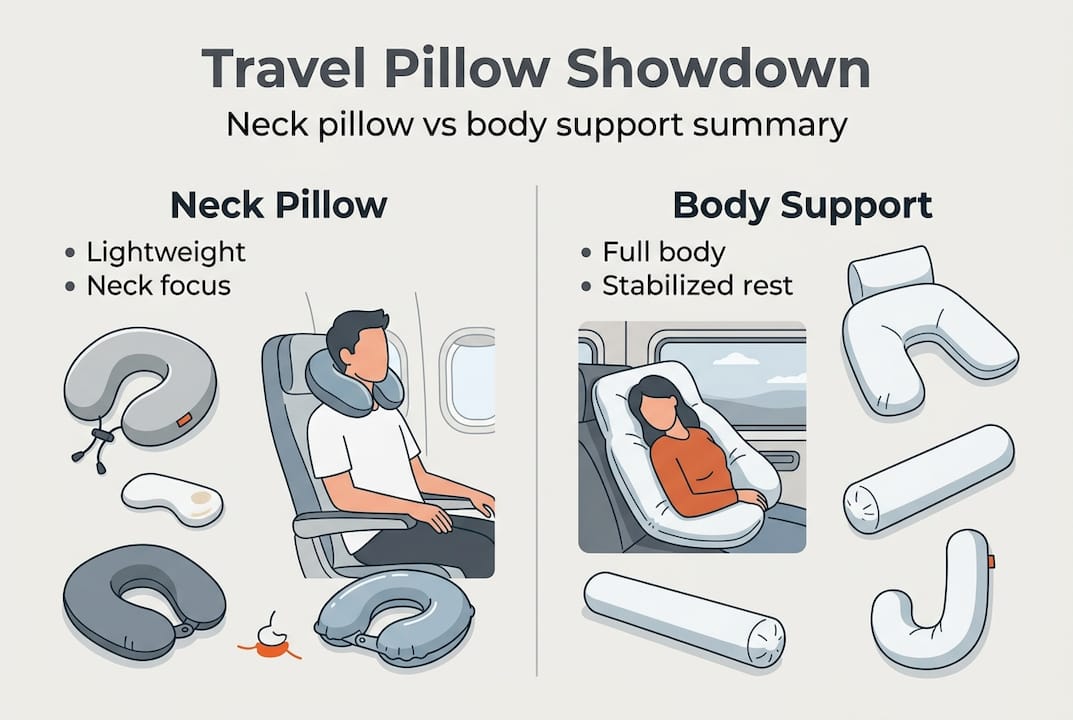
| Feature | Neck pillow | Body support pillow |
|---|---|---|
| Primary support area | Neck focus | Head, neck, chest, shoulders, torso |
| Portability | High, lightweight and compact | Moderate, can be bulkier |
| Best flight length | Under 3 hours | 4 or more hours |
| Best sleep position | Upright, centered | Diagonal, side, window lean |
| Heat buildup | Common around neck | Less, more airflow options |
| Prevents body slump | No | Yes |
| Packing versatility | Limited | High with dual-use designs |
| Price range | Budget to mid-range | Mid-range to premium |
Here’s a numbered breakdown of who benefits most from each:
-
Short-haul travelers (under 3 hours): Neck pillows are usually enough. You’re not in the seat long enough for full-body fatigue to set in.
-
Long-haul travelers (4 or more hours): Body support wins here. The torso stabilization prevents the slump that makes you feel wrecked on arrival.
-
Side and window seat sleepers: Body support designs work better because they accommodate the diagonal lean that feels most natural.
-
Upright center seat sleepers: A well-fitted neck pillow can work, especially for travelers who don’t tend to slump.
-
Space-conscious packers: Dual-use body support pillows that compress or fill with clothing offer the best value per inch of carry-on space.
For more economy class comfort tips and help choosing travel pillows based on your specific needs, those resources go deeper into the decision. The Forbes travel pillow roundup is also worth a read for a broad market overview.
Picking the right pillow for your travel style
With the facts in hand, here’s a practical decision-making framework to help you buy the pillow that genuinely fits your flying style, not just what sounds good on the shelf.
For economy long flights, neck pillows suit upright sleepers prioritizing lightness; body support is better for slump-prone travelers needing full posture stability. And there are real edge cases worth noting: short necks often favor wrap-style designs like the Trtl, side and window sleepers need non-U shapes, and no pillow fully replicates flat rest.
Four-step selection framework:
-
Identify your sleep position. Do you sleep upright with your head centered? A neck pillow may be enough. Do you lean sideways, rest against the window, or tend to slump forward? You need body support.
-
Consider your flight length. Under four hours, portability matters most. Over five hours, comfort and posture stability become the priority. Don’t let a short-flight mindset guide a long-haul purchase.
-
Think about your packing constraints. If carry-on space is tight, look for dual-use designs that serve as both a pillow and a packing tool. A pillow that fills with your own clothes saves space and adds firmness.
-
Be honest about your underlying needs. If you consistently arrive stiff and exhausted, a neck pillow alone isn’t solving your problem. That’s a signal your whole upper body needs support, not just your neck.
Common pitfall: choosing a pillow based on price or looks alone. A cheap neck pillow that doesn’t match your sleep style will feel worse than no pillow at all. And an expensive one won’t fix a body-support problem.
Pro Tip: Use the step-by-step pillow guide to map your exact needs before buying. And for red-eye or overnight flights, the long-haul comfort tips resource is genuinely worth reading before your next trip.
Why most travelers still get travel pillow comfort wrong
Having mapped out how to choose, it’s worth examining why so many still land at their destination stiff and weary, despite all the gear.
Here’s the honest truth: most travelers buy a pillow once, based on what they see at the airport or what’s trending online. They don’t think about how their body actually rests. They assume any pillow is better than none. And then they’re surprised when they still feel terrible after a ten-hour flight.
Reputable reviews from major outlets emphasize neck-focused designs almost exclusively, while body support from niche sources claims superior long-haul efficacy. The market conversation is dominated by neck pillows, which means body support is consistently underrepresented, even for travelers who clearly need it.
The smartest flyers we’ve seen treat their pillow as one tool in a broader comfort system. They pair it with a good seat selection, a light blanket, and an honest understanding of how they personally sleep. They also understand that why pillow choice matters goes beyond brand names or price tags. It comes down to geometry: does this pillow work with your body or against it?
If you’re still waking up mid-flight with your chin on your chest, the answer is clear. It’s time to think beyond the neck. ❤️
Find your perfect travel pillow
Ready to upgrade your comfort on your next flight? Whether you need targeted neck alignment or full upper-body support, there’s a design built specifically for how you travel.

At Bolstie, we built our best travel pillow collection around one idea: your body deserves real support in economy, not just a cushion for your neck. The best neck travel pillow fills with your own clothes for a firm, custom fit that saves carry-on space. And the Bolstie body travel pillow stabilizes your head, jaw, chest, and upper torso together, so your whole body finally exhales. Find the right fit for your next flight and feel the difference from the first hour in the air. ✈️
Frequently asked questions
Which travel pillow is best for economy class long-haul flights?
Body support pillows offer wider stabilization for long flights, but neck pillows are lighter and suit short trips or travelers who primarily need upright neck alignment. Match the pillow to your flight length and sleep position for the best result.
Are neck pillows effective for side or window seat sleepers?
Traditional neck pillows fall short for side or window seat positions because they don’t accommodate the diagonal lean most travelers naturally adopt. Body support designs reduce muscle strain across the full upper body and work much better in these scenarios.
What’s the main drawback of neck pillows on long flights?
Neck pillows limit torso support, which means they can’t prevent overall body slump. You may keep your head from dropping, but your shoulders and chest still collapse forward, leading to fatigue and stiffness by the end of a long flight.
Are body support pillows too bulky for travel?
Body support may be bulkier than a standard neck pillow, but smart dual-use designs that fill with your own clothing solve the space problem while adding firmness and structure. For most long-haul travelers, the comfort payoff is well worth it.
Recommended
-
Travel Pillows Cut Neck Pain by 65%: Health Guide 2026 – BOLSTIE TRAVEL PILLOW
-
Travel pillow that’s both space-saving & comfort for economy-class – BOLSTIE TRAVEL PILLOW
-
Why Avoid Neck-Based Travel Pillows When Flying – BOLSTIE TRAVEL PILLOW
-
Why Avoid Neck-Only Pillows for Travel Comfort – BOLSTIE TRAVEL PILLOW

