

Most travelers assume a travel pillow is just a travel pillow. Grab any U-shaped foam ring, toss it around your neck, and call it a day. But the industry tells a very different story. The global travel pillow market is growing at CAGRs between 4% and 7% through 2030, driven by rising travel frequency, health awareness, and a real hunger for ergonomic comfort in economy class. That growth is not happening by accident. It is happening because travelers are finally demanding better, and designers are finally delivering it. This guide breaks down exactly what is changing, why it matters for economy flyers, and how to choose the right pillow for your next long-haul flight. ✈️
Table of Contents
Key Takeaways
| Point | Details |
|---|---|
| Rapid market growth | The travel pillow market is expanding quickly, driven by economy-class traveler needs. |
| Innovative designs | Adjustable memory foam, compressible features, and cooling vents are transforming comfort for flyers. |
| Benchmark-driven choices | Choosing a travel pillow based on tilt reduction, packability, and neck support ensures the best experience. |
| Sustainability matters | Eco-friendly materials and responsible manufacturing are increasingly influencing pillow purchases. |
| Asia-Pacific leads growth | Asia-Pacific is the fastest-growing region in the travel pillow market due to rising tourism and offline sales. |
How travel pillows became essential for economy comfort
Economy class has always been a comfort challenge. Seats recline less than they used to, legroom keeps shrinking, and overnight flights are longer than ever. Your body wants to rest, but the seat was not designed with rest in mind. That tension is exactly why the travel pillow market has exploded.
The numbers are striking. The memory foam travel pillow market is projected to grow from USD 555 million in 2024 to USD 815 million by 2030, at a 6.6% CAGR. And the broader neck pillow market is expected to reach USD 6.65 billion by 2031 at a 4.97% CAGR. These are not niche numbers. This is a mainstream comfort category.
Why are economy flyers driving so much of this demand? Because they face a unique set of challenges that business and first-class travelers simply do not deal with:
-
No flat-bed option. You are sleeping upright, period.
-
Limited recline. Many modern economy seats recline only a few inches.
-
Shared armrests. Leaning sideways is not always possible.
-
Long durations. Transatlantic and transpacific routes regularly exceed 10 hours.
-
Carry-on constraints. Bulky pillows eat into precious luggage space.
Understanding the benefits of upright sleep is the first step toward solving the problem. When your head drops forward or tilts sideways without support, your neck muscles work overtime just to hold it up. That leads to stiffness, soreness, and the kind of exhaustion that follows you off the plane.
“The best travel pillow is not the one that looks the most comfortable in the store. It is the one that keeps your head from dropping at 35,000 feet.”
Looking at support pillows for economy travel through this lens changes everything. It is not about softness. It is about geometry, positioning, and keeping your body in a natural resting alignment for hours at a time. Now that the industry’s growth is clear, let’s examine the game-changing innovations shaping traveler comfort.
Key innovations reshaping travel pillow design
The travel pillow of 2026 looks almost nothing like the foam donut of a decade ago. Designers are rethinking everything, from materials to shape to how the pillow interacts with your seat. Here is what is actually new and worth paying attention to.

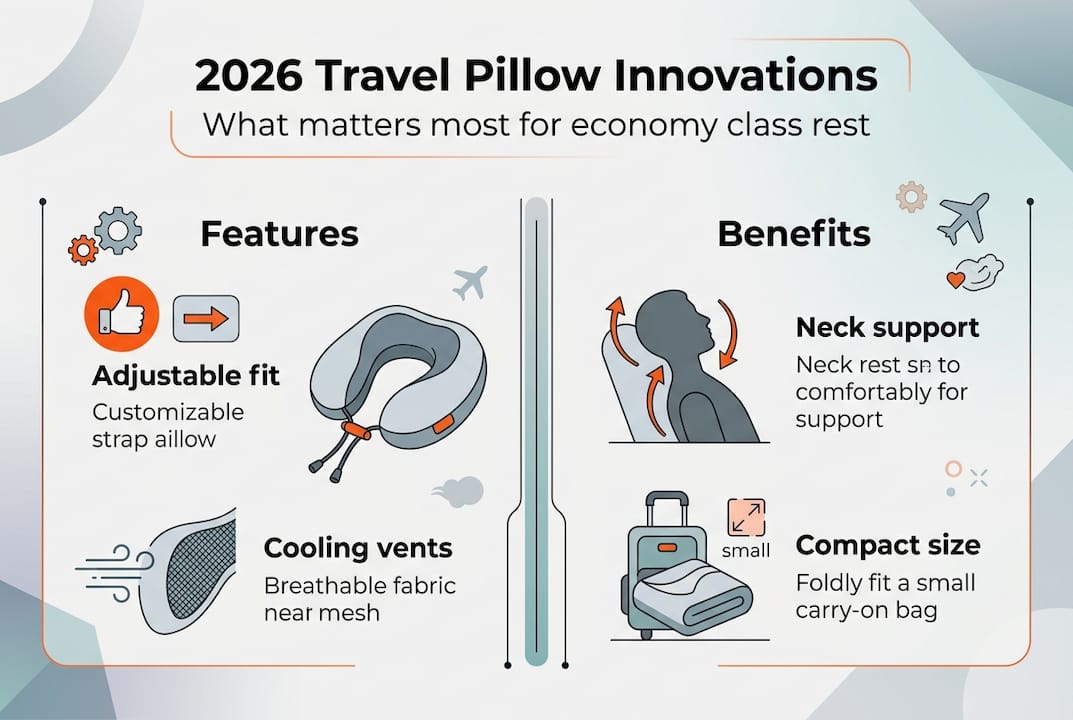
1. Adjustable memory foam with customizable fit Products like the Cabeau Evolution X now offer adjustable height and circumference, letting you dial in the exact level of support your neck needs. No more one-size-fits-all guessing.
2. 360-degree chin cradles Chin support is a game changer for upright sleepers. Without it, your jaw drops and your head follows. With it, your whole face stays supported, and your neck finally gets a break.
3. Cooling vents and breathable materials Overheating is one of the most common complaints about memory foam pillows. Newer designs address this directly. HeadCatch technology cradles the jawline while built-in cooling vents actively reduce heat buildup during long flights.
4. Thin back profiles for upright seats A thick back on a travel pillow pushes your head forward, which is the opposite of helpful. Slim-back designs sit flush against economy headrests without forcing your neck into an unnatural angle.
5. Compressibility Some of today’s best pillows compress to 60% of their original size, making them genuinely carry-on friendly without sacrificing structure when you need it.
Here is a quick comparison of the main pillow types available in 2026:
| Pillow type | Support level | Packability | Heat retention | Best for |
|---|---|---|---|---|
| Memory foam | High | Medium | Higher | Long-haul, neck support |
| Inflatable | Low to medium | Excellent | Low | Short trips, minimalists |
| Microbead | Medium | Low | Medium | Side sleepers |
| Clothing-filled | High | Excellent | Low | Space-conscious packers |
Pro Tip: If you tend to overheat on flights, prioritize pillows with vented foam or open-cell construction. A pillow that makes you sweat will wake you up faster than turbulence.
The design trends shaping 2026 point clearly toward body-first thinking. It is no longer enough to cushion the neck. The best pillows now consider how the head, jaw, and upper torso work together during upright rest. And for travelers who want to go even lighter, space-saving pillow solutions are making it possible to pack smart without giving up comfort. You can also check out CNN Underscored’s best travel pillow reviews for real-world testing data across dozens of models.
Choosing the best pillow for your economy seat
With so many options, how do you actually choose? The answer starts with knowing your own sleep style and the specific challenges of your route.
Travel + Leisure tested 48 pillows over 220+ hours of real travel to build their benchmark criteria. Their top findings: prioritize pillows that keep your head tilt under 10 degrees, offer genuine breathability, and fit the specific shape of your neck. Edge cases matter too. Short necks do better with wrap-style designs like the Trtl. Hot sleepers need vented foam. Side sleepers need more lateral support than upright sleepers.
Here is a practical checklist to guide your decision:
-
Sleeping position: Do you sleep upright, tilted, or leaning against the window?
-
Neck length: Shorter necks need more wrap; longer necks need more height.
-
Flight duration: Longer flights demand more support, not just more softness.
-
Carry-on space: If you are packing light, compressibility is non-negotiable.
-
Heat sensitivity: If you run warm, avoid dense closed-cell foam.
The Cabeau S3 and Evolution X consistently top the rankings for support and portability. The Trtl is the go-to for short necks. But no single pillow wins for everyone, which is why matching features to your personal needs matters more than chasing the highest-rated product. The most effective pillow should never wrap the neck as the focus should be on supporting the head and body together and at the same time
Pro Tip: Test your pillow at home before your flight. Sit upright in a chair, close your eyes, and let your head relax naturally. If the pillow keeps your head stable without you actively holding it, it will work on a plane. If you have to adjust constantly, keep looking.
For a deeper look at what makes a pillow truly work in economy, the guides on ergonomic pillows for economy flyers and improving upright rest are worth your time. And if you want to understand the science behind why positioning matters so much, the breakdown of travel pillow ergonomics explains it clearly. The inflatable U-shaped pillow market is also growing fast, so inflatables are worth a second look if packability is your top priority.
Sustainability and regional market trends
The travel pillow industry is not just getting smarter. It is getting greener, and it is growing fastest in places you might not expect.
Asia-Pacific is the fastest-growing region in the travel pillow market right now, fueled by a surge in outbound tourism, the rise of affordable carriers, and the explosive growth of e-commerce across the region. Interestingly, offline retail still dominates distribution there, because travelers want to physically try a pillow before committing to it. That tactile trust factor is real.
On the sustainability side, the shift is clear and accelerating:
-
Organic cotton covers are replacing synthetic fabrics in premium models.
-
Recycled fill materials are becoming a standard option, not a premium add-on.
-
Minimal packaging is increasingly common as brands respond to eco-conscious buyers.
-
Tech integration like pressure sensors and temperature regulation is emerging, though still niche.
“Sustainability in travel gear is no longer a marketing angle. It is becoming a baseline expectation, especially among younger frequent flyers.”
The sustainability trend in travel pillows reflects a broader shift in how travelers think about their gear. They want products that last, that do not waste space, and that align with their values. That is exactly why multi-use travel pillows are gaining traction. A pillow that doubles as a packing cylinder, for example, is not just clever. It is genuinely more sustainable because it replaces two items with one. And when design matters this much, every detail counts.
Explore innovative travel pillows for your next flight
All of these trends point to one thing: economy travelers deserve better rest, and the tools to get it are finally here. ❤️
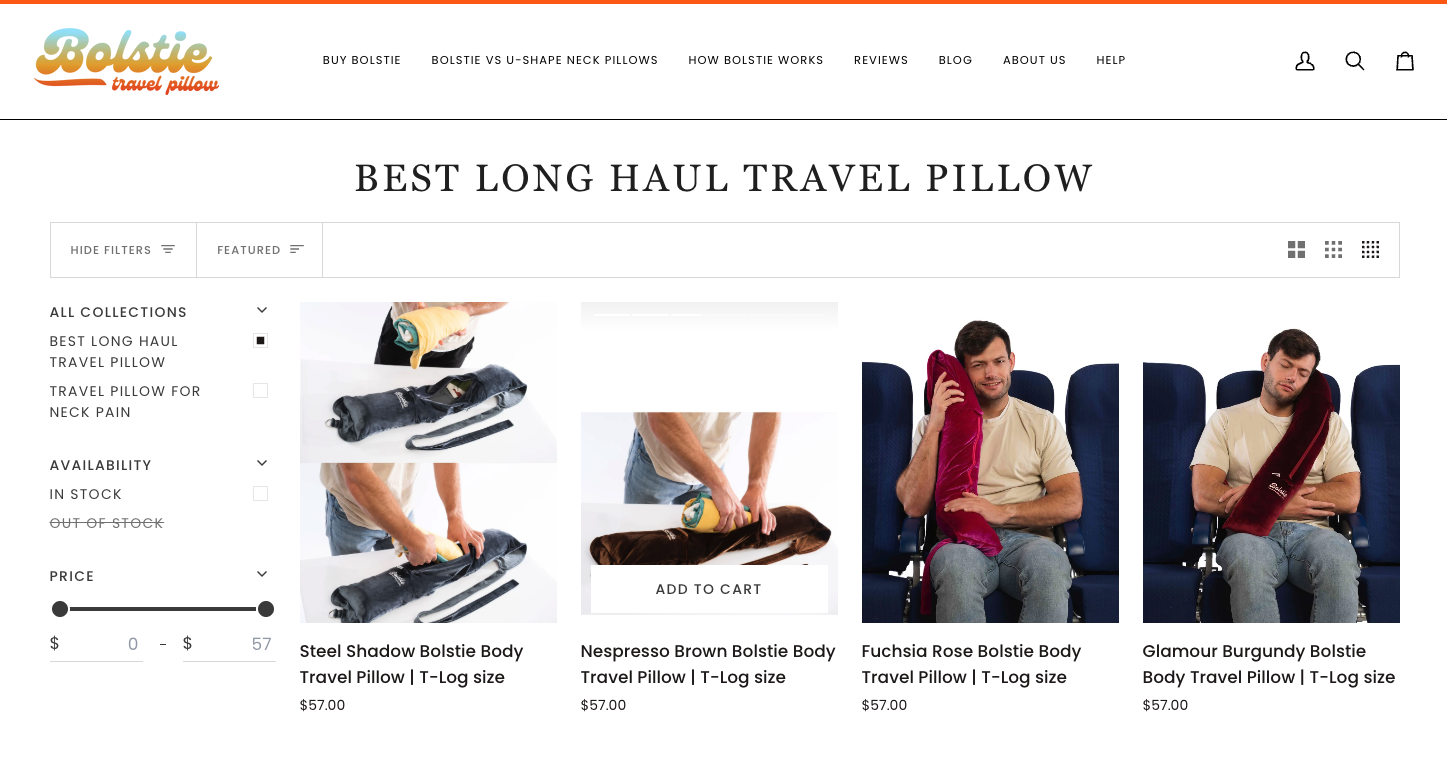
At Bolstie, we built our travel pillow around the exact challenges this article covers. No neck squeezing. No forward head drop. No wasted luggage space. Our best long-haul travel pillow supports your head, jaw, and upper torso together, keeping you in a natural resting position for hours. Our travel pillow stuffed with clothes fills with your own clothing to create a firm, structured support pillow that also saves carry-on space. And if you want full upper-body support, our body travel pillow takes comfort to a whole new level. Real rest, without the bulk.
Frequently asked questions
What travel pillow designs work best for economy seats?
U-shaped and adjustable memory foam designs offer the best combination of neck support and packability for upright economy seating, especially on long-haul routes where consistent support matters most.
How is sustainability influencing travel pillow choices?
Organic cotton and recycled materials are increasingly standard in premium travel pillow models, reflecting growing demand from eco-conscious travelers who want gear that aligns with their values.
Are inflatables or memory foam pillows better for economy flyers?
Memory foam wins on support but tends to retain heat, scoring around 6.5 out of 10 for long-haul comfort in extended reviews. Inflatables pack smaller but sacrifice durability and structural support over time.
Which region is driving the fastest growth in travel pillow sales?
Asia-Pacific leads market growth thanks to rising outbound tourism, affordable carrier expansion, and strong e-commerce adoption, making it the most dynamic region in the global travel pillow industry right now.
Recommended
-
Travel pillow design trends 2026: Up to 50% better comfort – BOLSTIE TRAVEL PILLOW
-
Travel pillow ergonomics: improve economy-class comfort – BOLSTIE TRAVEL PILLOW
-
Travel pillow that’s both space-saving & comfort for economy-class – BOLSTIE TRAVEL PILLOW
-
Economy class travel comfort guide for better sleep 2026 – BOLSTIE TRAVEL PILLOW

