

Economy flying is genuinely hard on your body, and not just in the way most people assume. Cabin pressure equivalent to 6,000-8,000 feet reduces blood oxygen by 6 to 25%, triggering fatigue, headaches, and mental fog before you even land. Add a cramped seat, recycled air, and hours of upright stillness, and what feels like a minor inconvenience becomes a measurable health event. This article breaks down exactly what happens to your body on a long-haul flight, why upright sleep is so difficult, and which practical, space-efficient tools actually help you arrive feeling human.
Table of Contents
Key Takeaways
| Point | Details |
|---|---|
| Discomfort affects health | Poor comfort in economy class triggers real physiological stress, dehydration, and DVT risk. |
| Sleep quality impacts jet lag | Sleeping poorly upright can extend jet lag recovery for over a week after your trip. |
| Smart packing beats bulk | Compact pillows, compression socks, and foot hammocks maximize comfort without clogging your carry-on. |
| Economy hacks work | Strategic routines and products can rival some premium comfort for much less money. |
The hidden effects of economy travel discomfort
Most travelers chalk up post-flight exhaustion to time zones or a bad night’s sleep. The reality is more specific. Cabin pressure reduces blood oxygen by up to 25% on long-haul flights, producing mild hypoxia that causes real cognitive fog and physical fatigue. This isn’t just feeling tired. It’s your brain and muscles running on less fuel than they need.
The air inside the cabin makes things worse. Cabin humidity drops to 10-20%, which is drier than most deserts, and ambient noise runs between 75 and 85 decibels, loud enough to prevent deep sleep. Both factors quietly drain your hydration, slow digestion, and keep your nervous system in a low-grade stress state for the entire flight.
Discomfort doesn’t stay flat over time. It compounds. What starts as a stiff neck at hour two becomes genuine pain by hour eight. Minor dehydration becomes a headache. Mild fatigue becomes the kind of exhaustion that wrecks your first day at your destination. Checking out some economy flight comfort tips before you fly can make a real difference in how you land.
| In-flight stressor | Effect on the body | Onset time |
|---|---|---|
| Low cabin pressure | Reduced blood oxygen, fatigue, headaches | 1-2 hours |
| Humidity below 20% | Dry mucous membranes, dehydration, poor digestion | 1-3 hours |
| Noise at 75-85 dB | Disrupted sleep, elevated stress hormones | Ongoing |
| Immobility | Muscle stiffness, circulation issues, DVT risk | 2-4 hours |
| Forward head posture | Neck and upper back strain | 1-2 hours |
“The physiological effects of long-haul economy travel are not trivial. Reduced oxygen, extreme dryness, and noise combine to create a stress load that affects cognition, hydration, and recovery for days after landing.”
For a deeper look at what your body goes through at altitude, the guide on surviving economy long-haul flights covers the full picture with practical takeaways.
Why upright sleep is so hard and so crucial
Economy seats are designed to maximize the number of passengers per aircraft, not to support human sleep. Seat pitch in economy typically runs 31 to 32 inches, and limited recline over 8+ hours overloads neck muscles by forcing the head forward against gravity. Your neck muscles were not built to hold your head up for eight hours straight. They fatigue, and then they hurt.
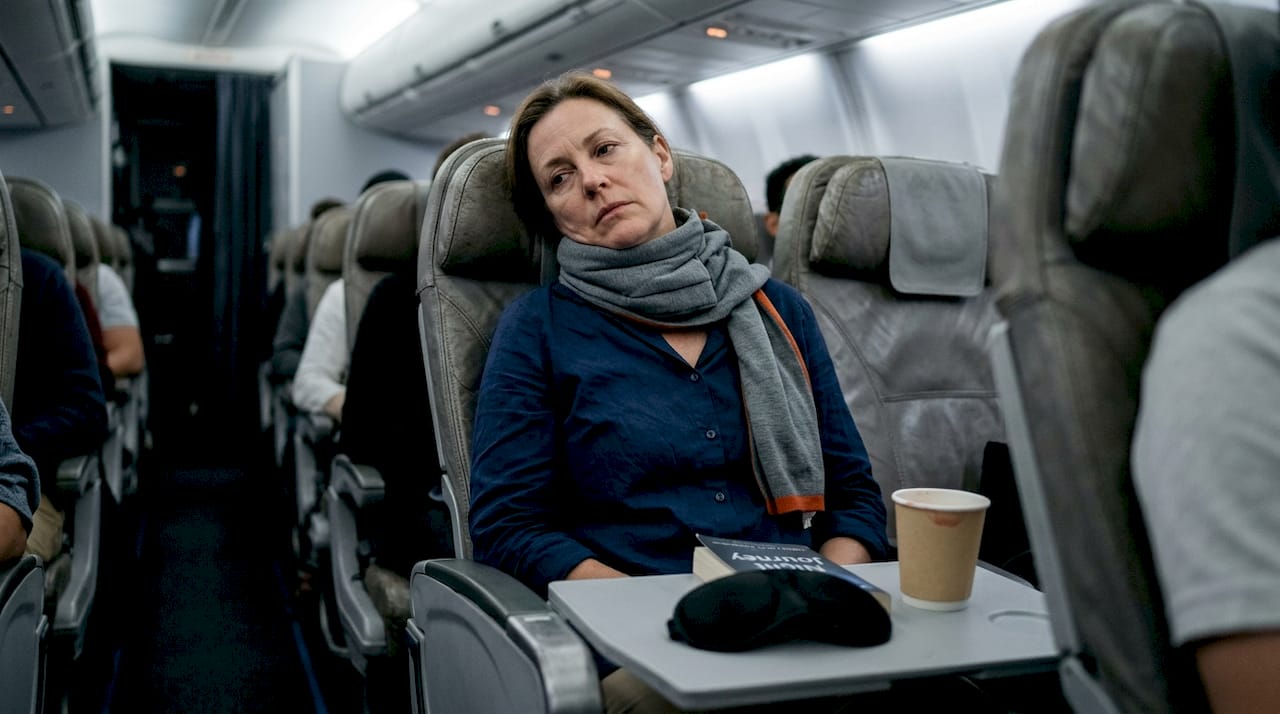
The problem goes beyond discomfort. Poor sleep on a flight doesn’t just mean you’re tired. Sleep timing and structure recovery takes over a week after long-haul travel, especially eastward. That means your immune response, memory consolidation, and mood regulation are all running below capacity for days. Getting even a few hours of quality upright sleep can cut that recovery window significantly.
Traditional neck pillows fail here because they only address one point of contact. Your head is heavy, roughly 10 to 12 pounds, and when it drops forward or sideways, a ring-shaped pillow around your neck can’t stop it. Diagonal torso support, which stabilizes the head, jaw, chest, and upper torso together, works with the body’s natural resting angle instead of fighting it. Learning how to sleep comfortably on planes starts with understanding that geometry.
Top 3 effects of poor upright sleep in economy:
-
Neck and back pain that persists for days after landing, caused by sustained forward head posture and muscle fatigue
-
Extended jet lag due to disrupted sleep architecture, which delays circadian rhythm reset and slows cognitive recovery
-
Reduced post-flight performance, including impaired memory, slower reaction time, and weakened immune response
If you fly regularly, economy sleep tips and strategies for better sleep on long flights are worth building into your pre-flight routine, not just something you figure out at 35,000 feet.
DVT, dehydration, and other health risks you can’t ignore
Sitting still in a cramped seat for hours isn’t just uncomfortable. It’s medically risky. Immobility on flights over 4 hours raises deep vein thrombosis (DVT) risk by 2 to 4 times, with symptomatic DVT occurring in roughly 1 in every 4,600 person-flights. DVT is a blood clot that forms in a deep vein, usually in the leg, and it can become life-threatening if it travels to the lungs.
Dehydration is the other silent threat. Cabin humidity below 20% dries out your mucous membranes, slows digestion, and dulls alertness in ways that feel like jet lag but are actually just thirst. Most travelers don’t drink nearly enough water on flights because they don’t feel thirsty until they’re already dehydrated.
| Risk factor | Do nothing | Use economy hacks |
|---|---|---|
| DVT risk | 2-4x elevated on 4+ hour flights | Reduced up to 90% with compression socks |
| Dehydration | Ongoing throughout flight | Managed with regular water intake |
| Muscle stiffness | Builds steadily from hour 2 onward | Reduced with movement every 2 hours |
| Post-flight recovery | 1-3 days for mild cases | Noticeably faster with proactive strategies |
Essentials to fight DVT and dehydration on long flights:
-
Compression socks (knee-high): reduce asymptomatic DVT by 90% and take up almost no packing space
-
Water intake routine: aim for at least 8 ounces per hour of flight time, skipping alcohol and excess caffeine
-
Movement schedule: stand and walk the aisle every 2 hours, even just for 2 to 3 minutes
-
Ankle circles and calf raises: do these in your seat between walks to keep blood moving
Pro Tip: A foot hammock is one of the most underrated carry-on items for long flights. It attaches to the tray table, elevates your feet slightly, and reduces both lower back pressure and leg swelling. It weighs almost nothing and folds flat. Pair it with compression socks and a movement routine for a real difference in how your legs feel on arrival. For a full breakdown of minimizing discomfort for economy flyers, including gear and routines, the step-by-step comfort guide for long flights is worth bookmarking.
Space-efficient comfort: What actually works in economy
The best economy comfort gear shares one trait: it solves a real problem without taking up real space. Bulky neck pillows that clip to your bag, oversized blankets, and rigid lumbar supports all add weight and volume without delivering proportional comfort. The gear that actually works is compact, multi-purpose, and designed for upright use.
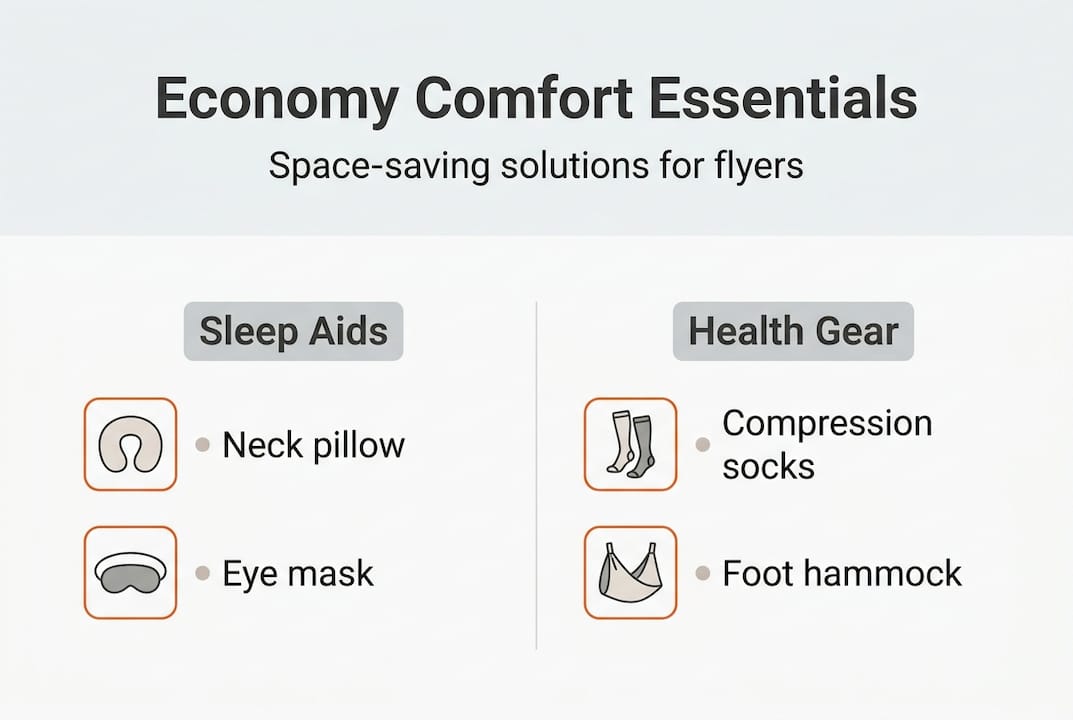
Compact travel aids like scarf-style neck pillows, compression socks, foot hammocks, and contoured eye masks each address a specific discomfort without adding meaningful bulk to your carry-on. The most effective approach combines two or three of these rather than relying on any single item. A pillow that also functions as a packing cylinder, for example, earns its space twice.
Multi-use pillows filled with your own clothing outperform traditional neck-only supports for upright sleep. They create a firmer, more customizable surface, support a broader area of the torso, and eliminate the need to pack a separate pillow entirely. This is especially useful for red-eye flight comfort, where sleep quality directly affects your ability to function the next morning.
Top space-saving comfort gear for economy flyers:
-
Clothing-filled travel pillow: doubles as a packing cylinder, supports diagonal torso rest, and compresses flat when empty
-
Compression socks: essential for DVT prevention, lightweight, and easy to pack in any bag
-
Foot hammock: attaches to the tray table, elevates feet, reduces back and leg fatigue
-
Contoured eye mask: blocks cabin light without pressing on eyes, folds flat
-
Foam earplugs or noise-canceling earbuds: reduce the 75-85 dB cabin noise that prevents deep sleep
Pro Tip: Pack your socks and slip-on shoes in an easy-access spot in your bag. Switching into comfortable socks as soon as you board and keeping slip-ons for quick aisle walks removes a friction point that stops most people from moving as often as they should. More movement means better circulation and a noticeably easier landing. For more on packing travel pillows efficiently, there are some smart strategies that save space without sacrificing support.
Is premium economy worth it? Economy hacks vs. upgrades
Premium economy seats typically offer 38 to 42 inches of pitch, wider cushions, and more recline. Extra legroom seats at 34-38 inches do improve circulation and sleep quality on flights over 8 hours, and that’s a real benefit. But the price difference between economy and premium economy can run from $200 to over $1,000 depending on the route.
The honest answer is that economy hacks suffice for tolerable flights, and no seat design fully eliminates strain because aircraft interiors prioritize passenger density over ergonomics. Premium economy reduces the problem. Smart economy strategies manage it. For most travelers on most routes, the gap between the two is smaller than the price suggests.
| Option | Typical cost premium | Comfort improvement | Best for |
|---|---|---|---|
| Standard economy | Baseline | Baseline | Short to medium flights |
| Extra legroom seat | $50-$150 | Meaningful for 8+ hour flights | Tall travelers, frequent flyers |
| Premium economy | $200-$1,000+ | Significant but not complete | Very long haul, business travel |
| Economy + comfort kit | $30-$80 total | 60-80% of premium benefits | Budget-conscious long-haul travelers |
A well-chosen comfort kit, including a multi-use pillow, compression socks, a foot hammock, and an eye mask, delivers most of what an upgrade offers at a fraction of the cost. For a direct comparison of strategies, the guide on economy vs. premium comfort lays out the trade-offs clearly.
Upgrade your rest: Smart comfort for real travelers
Everything covered in this article points to the same conclusion: comfort on long flights is a design problem, and the right gear solves it without bulk, without upgrades, and without compromise. Most travelers are one or two well-chosen products away from a genuinely better flight experience.
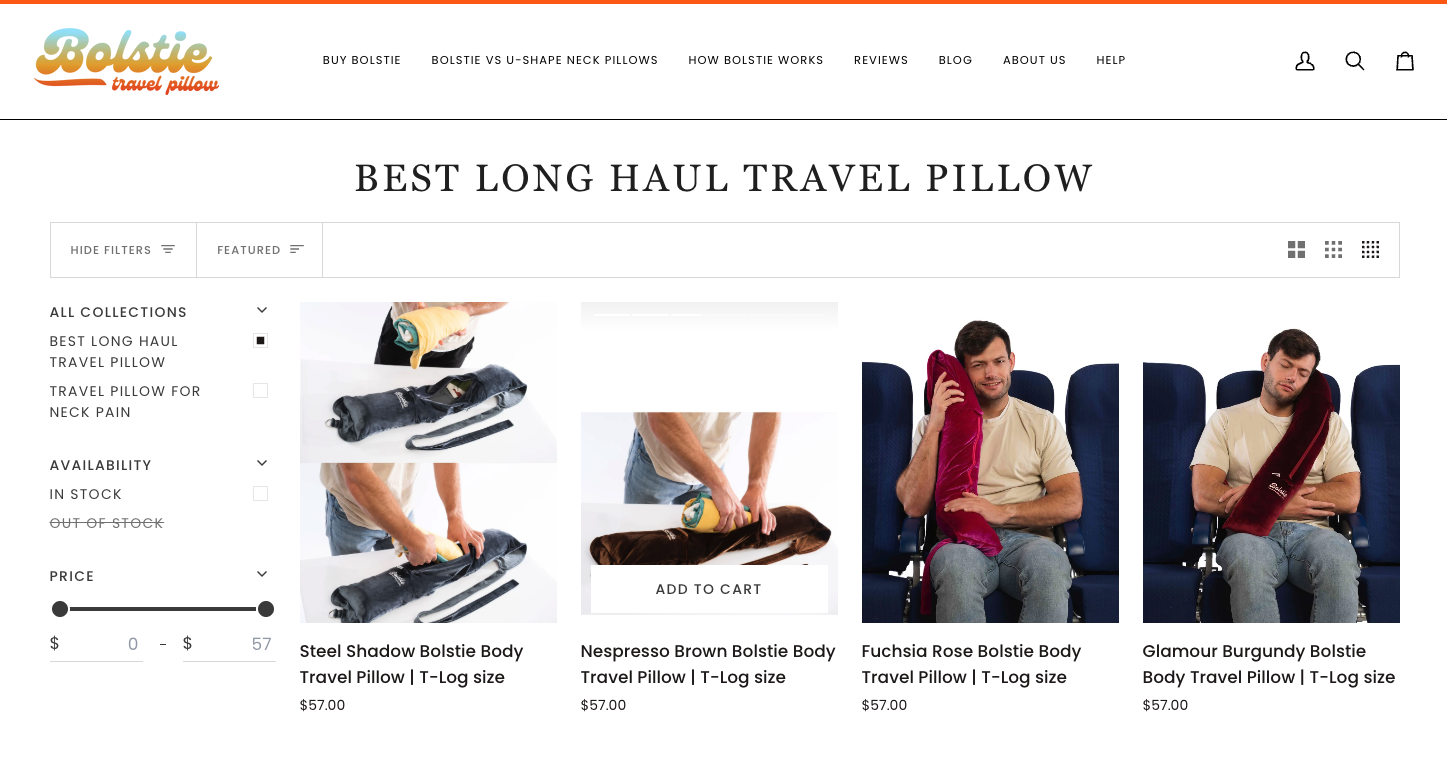
Bolstie travel pillows are built specifically for this problem. Each pillow supports the diagonal resting position that actually keeps your head, jaw, and upper torso stable during upright sleep, without wrapping around your neck or trapping heat. When empty, it compresses flat. When filled with your own clothing, it becomes a firm, structured support pillow that doubles as a packing cylinder, saving carry-on space on every trip. If you’re ready to stop guessing and start resting, browse the full range of best neck travel pillows designed for real economy travelers.
Frequently asked questions
Why does comfort matter more on long flights than short ones?
Discomfort compounds over time, and physiological stress from long-haul flights builds steadily across hours, turning mild fatigue and stiffness into real health risks and days-long recovery. Short flights don’t give these effects enough time to accumulate.
What’s the one must-have item for upright sleep in economy?
A compact, multi-use support pillow that stabilizes more than just the neck is the single biggest upgrade for upright sleep. Space-efficient travel aids like diagonal support pillows outperform traditional ring-style options because they work with the body’s natural resting angle.
Do compression socks really prevent DVT on long flights?
Yes. Wearing compression socks can reduce asymptomatic DVT risk by 90% on flights over four hours, making them one of the highest-impact, lowest-bulk items any long-haul traveler can pack.
Are premium economy seats always worth the money?
Not always. Economy seat design prioritizes density over ergonomics, and no upgrade fully eliminates strain. A smart economy comfort kit delivers 60 to 80% of the premium experience at a fraction of the cost for most travelers.
Recommended
-
Minimize travel discomfort for economy flyers: 2026 guide – BOLSTIE TRAVEL PILLOW
-
Travel pillow ergonomics: improve economy-class comfort – BOLSTIE TRAVEL PILLOW
-
Benefits of compressible travel pillows for economy comfort – BOLSTIE TRAVEL PILLOW
-
Why choose multi-use travel pillows for economy comfort – BOLSTIE TRAVEL PILLOW

